

261
solution were collected for the subsequent analytical determinations. The behaviour
of this pharmaceutical in the dark was tested too.
Levofloxacin concentrations were monitored using High Performance Liquid
Chromatography (HPLC) (1200 series, Agilent Technologies, USA) equipped with
a C-18 column (SUPELCOSIL Discovery 5 micron-C18, 250 × 4.6 mm) and a
diode array detector (DAD); λ, 295 nm.
The isocratic mobile phase was 75% formic acid (0.05%) and 25% methanol.
The flow rate was 1.0 mL min
−1
.
The identification of photoproducts was performed using micrOTOF-Q-II-Mass
Spectrometer (LC-MS, Bruker Daltonik GmbH, Bremen). Mass spectrometric conditions were optimized by direct infusion of standard solutions. The instrument was
tuned to facilitate the ionization process and to achieve the highest sensitivity.
27.3 Results and Discussion
The chemical characteristics of the groundwater used in the experiments are reported
in Table 27.1.
Kinetic data calculated considering three replicates for each experiment are summarized in Table 27.2 (Table 27.3).
The levofloxacin fates in ultrapure and in groundwater seem to follow the same
kinetic behaviour and the same photo-intermediates were detected and identified
until the complete mineralization of the parent compound. During the photoreactions samples were collected to test the remaining toxicity of the solution by using
official environmental assays (Daphnia magna and Vibrio fischeri) and phytotoxicity assays as seed germination (SG) and radical elongation (RE) of Solanum lycopersicum L. (tomato) and Lepidium sativum L. (garden cress).The toxicological data
shows that the products of intermediate degradation are more toxic than the parent
compound. Therefore, it is necessary to complete the reaction up to the
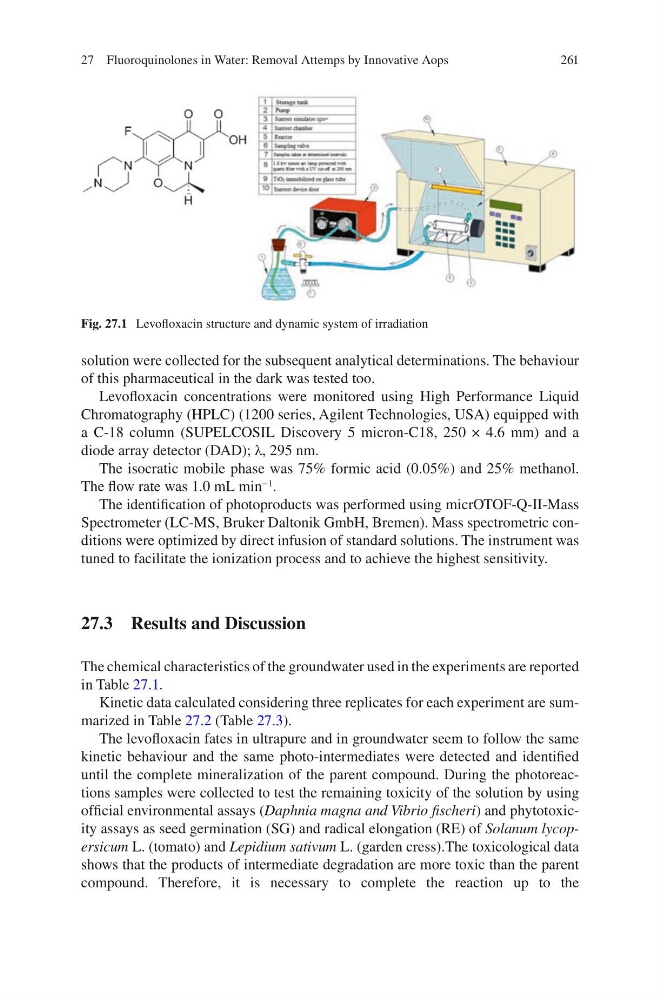
Fig. 27.1 Levofloxacin structure and dynamic system of irradiation
27 Fluoroquinolones in Water: Removal Attemps by Innovative Aops
solution were collected for the subsequent analytical determinations. The behaviour
of this pharmaceutical in the dark was tested too.
Levofloxacin concentrations were monitored using High Performance Liquid
Chromatography (HPLC) (1200 series, Agilent Technologies, USA) equipped with
a C-18 column (SUPELCOSIL Discovery 5 micron-C18, 250 × 4.6 mm) and a
diode array detector (DAD); λ, 295 nm.
The isocratic mobile phase was 75% formic acid (0.05%) and 25% methanol.
The flow rate was 1.0 mL min
−1
.
The identification of photoproducts was performed using micrOTOF-Q-II-Mass
Spectrometer (LC-MS, Bruker Daltonik GmbH, Bremen). Mass spectrometric conditions were optimized by direct infusion of standard solutions. The instrument was
tuned to facilitate the ionization process and to achieve the highest sensitivity.
27.3 Results and Discussion
The chemical characteristics of the groundwater used in the experiments are reported
in Table 27.1.
Kinetic data calculated considering three replicates for each experiment are summarized in Table 27.2 (Table 27.3).
The levofloxacin fates in ultrapure and in groundwater seem to follow the same
kinetic behaviour and the same photo-intermediates were detected and identified
until the complete mineralization of the parent compound. During the photoreactions samples were collected to test the remaining toxicity of the solution by using
official environmental assays (Daphnia magna and Vibrio fischeri) and phytotoxicity assays as seed germination (SG) and radical elongation (RE) of Solanum lycopersicum L. (tomato) and Lepidium sativum L. (garden cress).The toxicological data
shows that the products of intermediate degradation are more toxic than the parent
compound. Therefore, it is necessary to complete the reaction up to the
Fig. 27.1 Levofloxacin structure and dynamic system of irradiation
27 Fluoroquinolones in Water: Removal Attemps by Innovative Aops