

256
of DRV to inhibit in vitro gelatinases A (MMP-2) and B (MMP-9) in astrocytes has
been demonstrated [1]. However, owing to its low bioavailability when administered orally, poor water solubility and intermediate CNS penetration effectiveness
score, innovative DRV formulation could improve its effectiveness to cross the
blood brain barrier (BBB) and ability to reach the targets. The use of optically traceable nanoparticles (NPs) able to encapsulate and deliver specific therapeutic agents
may not only enhance drug transport through the BBB and target relevant regions in
the brain, but also provide an effective optical monitoring of the process. For this
purpose, biodegradable poly (D,L-lactide-co-glycolide) (PLGA)-based NPs were
used as nanovectors for the delivery of biocompatible luminescent Carbon Dots
(C-Dots) and DRV. The resulting nanoformulations were extensively investigated in
terms of their optical and morphological properties. PLGA-based NPs offers drug
improved stability, high loading capacity, sustained drug release, non-immunogenic
property, reduced drug toxicity and enhanced bioavailability, while C-Dots are
promising candidate for imaging-guided therapy [2]. The prepared NPs with an
average hydrodynamic diameter of ~130 nm, resulted characterized by high colloidal stability in aqueous medium, high drug encapsulation efficiency and emission
properties in the visible region. The in vitro study on astrocytes demonstrated the
high biocompatibility of the NPs and, remarkably, proved their ability to cross an in
vitro model of BBB [3] and to modulate the expression of MMP-9. The overall
results highlight the great promise hold by the luminescent nanoformulations as
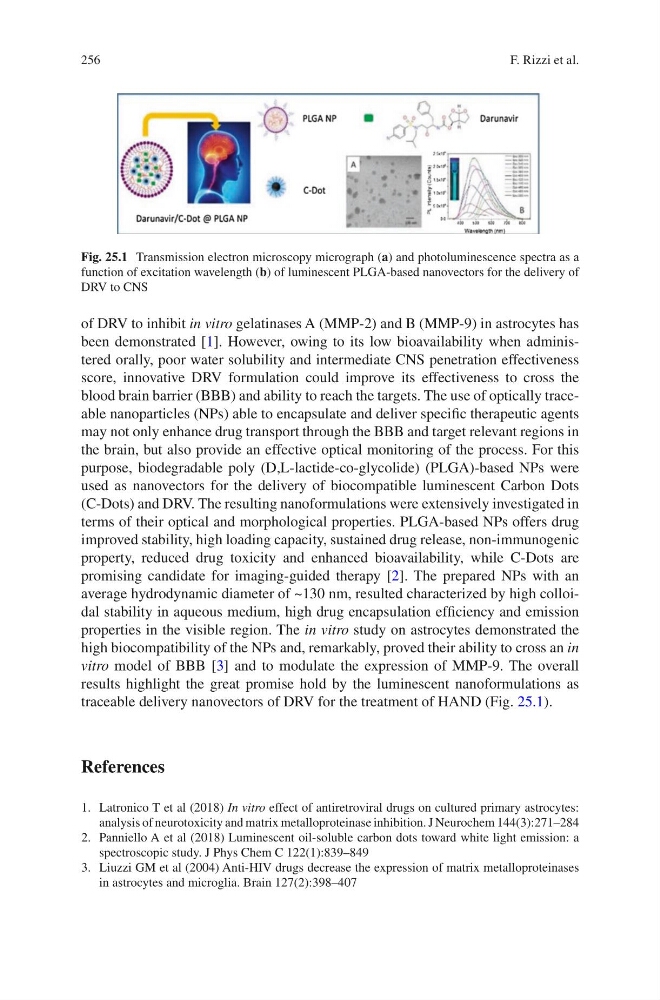
traceable delivery nanovectors of DRV for the treatment of HAND (Fig. 25.1).
References
1. Latronico T et al (2018) In vitro effect of antiretroviral drugs on cultured primary astrocytes:
analysis of neurotoxicity and matrix metalloproteinase inhibition. J Neurochem 144(3):271–284
2. Panniello A et al (2018) Luminescent oil-soluble carbon dots toward white light emission: a
spectroscopic study. J Phys Chem C 122(1):839–849
3. Liuzzi GM et al (2004) Anti-HIV drugs decrease the expression of matrix metalloproteinases
in astrocytes and microglia. Brain 127(2):398–407
Fig. 25.1 Transmission electron microscopy micrograph (a) and photoluminescence spectra as a
function of excitation wavelength (b) of luminescent PLGA-based nanovectors for the delivery of
DRV to CNS
F. Rizzi et al.
of DRV to inhibit in vitro gelatinases A (MMP-2) and B (MMP-9) in astrocytes has
been demonstrated [1]. However, owing to its low bioavailability when administered orally, poor water solubility and intermediate CNS penetration effectiveness
score, innovative DRV formulation could improve its effectiveness to cross the
blood brain barrier (BBB) and ability to reach the targets. The use of optically traceable nanoparticles (NPs) able to encapsulate and deliver specific therapeutic agents
may not only enhance drug transport through the BBB and target relevant regions in
the brain, but also provide an effective optical monitoring of the process. For this
purpose, biodegradable poly (D,L-lactide-co-glycolide) (PLGA)-based NPs were
used as nanovectors for the delivery of biocompatible luminescent Carbon Dots
(C-Dots) and DRV. The resulting nanoformulations were extensively investigated in
terms of their optical and morphological properties. PLGA-based NPs offers drug
improved stability, high loading capacity, sustained drug release, non-immunogenic
property, reduced drug toxicity and enhanced bioavailability, while C-Dots are
promising candidate for imaging-guided therapy [2]. The prepared NPs with an
average hydrodynamic diameter of ~130 nm, resulted characterized by high colloidal stability in aqueous medium, high drug encapsulation efficiency and emission
properties in the visible region. The in vitro study on astrocytes demonstrated the
high biocompatibility of the NPs and, remarkably, proved their ability to cross an in
vitro model of BBB [3] and to modulate the expression of MMP-9. The overall
results highlight the great promise hold by the luminescent nanoformulations as
traceable delivery nanovectors of DRV for the treatment of HAND (Fig. 25.1).
References
1. Latronico T et al (2018) In vitro effect of antiretroviral drugs on cultured primary astrocytes:
analysis of neurotoxicity and matrix metalloproteinase inhibition. J Neurochem 144(3):271–284
2. Panniello A et al (2018) Luminescent oil-soluble carbon dots toward white light emission: a
spectroscopic study. J Phys Chem C 122(1):839–849
3. Liuzzi GM et al (2004) Anti-HIV drugs decrease the expression of matrix metalloproteinases
in astrocytes and microglia. Brain 127(2):398–407
Fig. 25.1 Transmission electron microscopy micrograph (a) and photoluminescence spectra as a
function of excitation wavelength (b) of luminescent PLGA-based nanovectors for the delivery of
DRV to CNS
F. Rizzi et al.