

244
of a novel origami paper-based chemiluminescent (CL) biosensor for acetylcholinesterase activity detection and its implementation into portable analytical devices as
proof-of-principle of low-cost point-of-care applications. This biosensor is based on
the inhibition process of acetylcholinesterase (AChE) by molecules such as organophosphate pesticides, nerve gases, and some drugs. The AchE activity is measured
through a series of coupled enzymatic reactions leading to light emission. When
acetylcholinesterase is inhibited, there is a decreased production of hydrogen peroxide, and consequently, a reduction in light emission. In particular, three different
enzymes, AChE, choline oxidase (ChOx), and Horse Radish Peroxidase (HRP), are
adsorbed on a paper pad obtained by wax printing. The origami technique allows to
add reagents in separate steps and trigger the reactions to occur sequentially.
In the perspective of using our smartphone-based assay for rapid and on-field
analysis of environmental samples, Reldan 22 (chlorpyrifos-methyl 21.4% v/v), a
broad-spectrum insecticide for control of insects and pests that infest grain and
grain stores, has been used as model analyte. As proof of concept, different spiked
concentrations of Reldan 22 have been tested in the work concentration range of
0.5% v/v for direct application and 0.03–0.12% v/v for large area application. Signal
acquisition was carried out by OnePlus 6 photocamera placing the 3D paper PAD
cartridge inside a 3D-printed dark box and integrating CL signals for 30 sec
with ISO800.
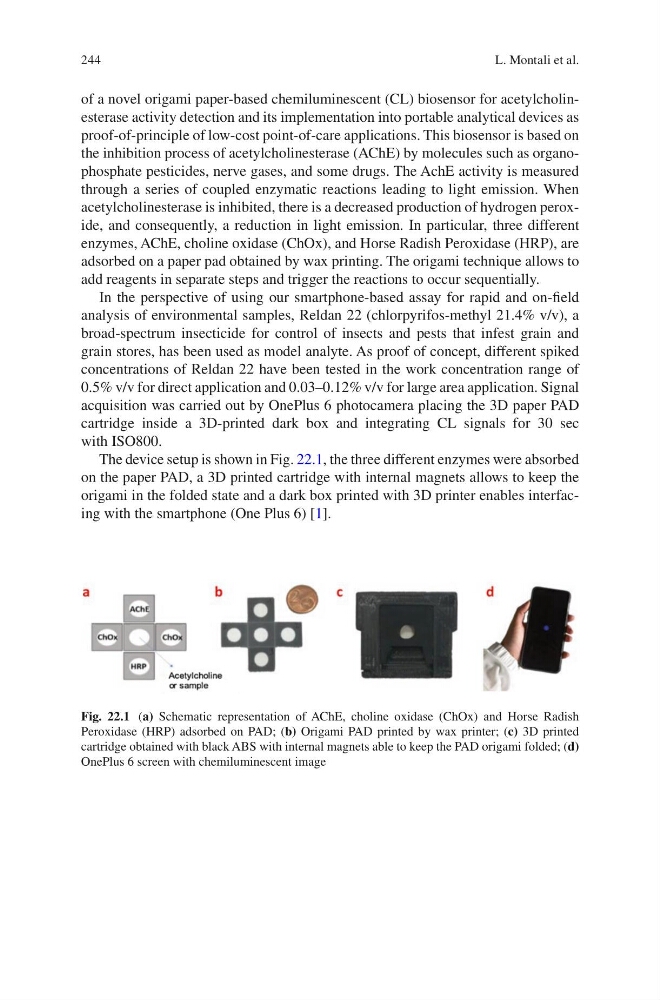
The device setup is shown in Fig. 22.1, the three different enzymes were absorbed
on the paper PAD, a 3D printed cartridge with internal magnets allows to keep the
origami in the folded state and a dark box printed with 3D printer enables interfacing with the smartphone (One Plus 6) [1].
Fig. 22.1 (a) Schematic representation of AChE, choline oxidase (ChOx) and Horse Radish
Peroxidase (HRP) adsorbed on PAD; (b) Origami PAD printed by wax printer; (c) 3D printed
cartridge obtained with black ABS with internal magnets able to keep the PAD origami folded; (d)
OnePlus 6 screen with chemiluminescent image
L. Montali et al.
of a novel origami paper-based chemiluminescent (CL) biosensor for acetylcholinesterase activity detection and its implementation into portable analytical devices as
proof-of-principle of low-cost point-of-care applications. This biosensor is based on
the inhibition process of acetylcholinesterase (AChE) by molecules such as organophosphate pesticides, nerve gases, and some drugs. The AchE activity is measured
through a series of coupled enzymatic reactions leading to light emission. When
acetylcholinesterase is inhibited, there is a decreased production of hydrogen peroxide, and consequently, a reduction in light emission. In particular, three different
enzymes, AChE, choline oxidase (ChOx), and Horse Radish Peroxidase (HRP), are
adsorbed on a paper pad obtained by wax printing. The origami technique allows to
add reagents in separate steps and trigger the reactions to occur sequentially.
In the perspective of using our smartphone-based assay for rapid and on-field
analysis of environmental samples, Reldan 22 (chlorpyrifos-methyl 21.4% v/v), a
broad-spectrum insecticide for control of insects and pests that infest grain and
grain stores, has been used as model analyte. As proof of concept, different spiked
concentrations of Reldan 22 have been tested in the work concentration range of
0.5% v/v for direct application and 0.03–0.12% v/v for large area application. Signal
acquisition was carried out by OnePlus 6 photocamera placing the 3D paper PAD
cartridge inside a 3D-printed dark box and integrating CL signals for 30 sec
with ISO800.
The device setup is shown in Fig. 22.1, the three different enzymes were absorbed
on the paper PAD, a 3D printed cartridge with internal magnets allows to keep the
origami in the folded state and a dark box printed with 3D printer enables interfacing with the smartphone (One Plus 6) [1].
Fig. 22.1 (a) Schematic representation of AChE, choline oxidase (ChOx) and Horse Radish
Peroxidase (HRP) adsorbed on PAD; (b) Origami PAD printed by wax printer; (c) 3D printed
cartridge obtained with black ABS with internal magnets able to keep the PAD origami folded; (d)
OnePlus 6 screen with chemiluminescent image
L. Montali et al.