

215
mental impacts, especially since respiratory diseases have reached their maximum in this region.
– Air quality in the Annaba area varies from excellent to fairly good with a rate of
81%. The poor quality is due in most cases to dust levels and to a lesser extent to
photochemical pollution during the summer season.
– The degradation of environment in Algeria costing $ 1.7 billion per year, or
3.6% of GDP.
– The state report on environment shown that 30% of consultations are for respiratory diseases, 40% of infant mortality (children under 1 year) is caused by respiratory diseases and 600000 asthmatics suffer permanently.
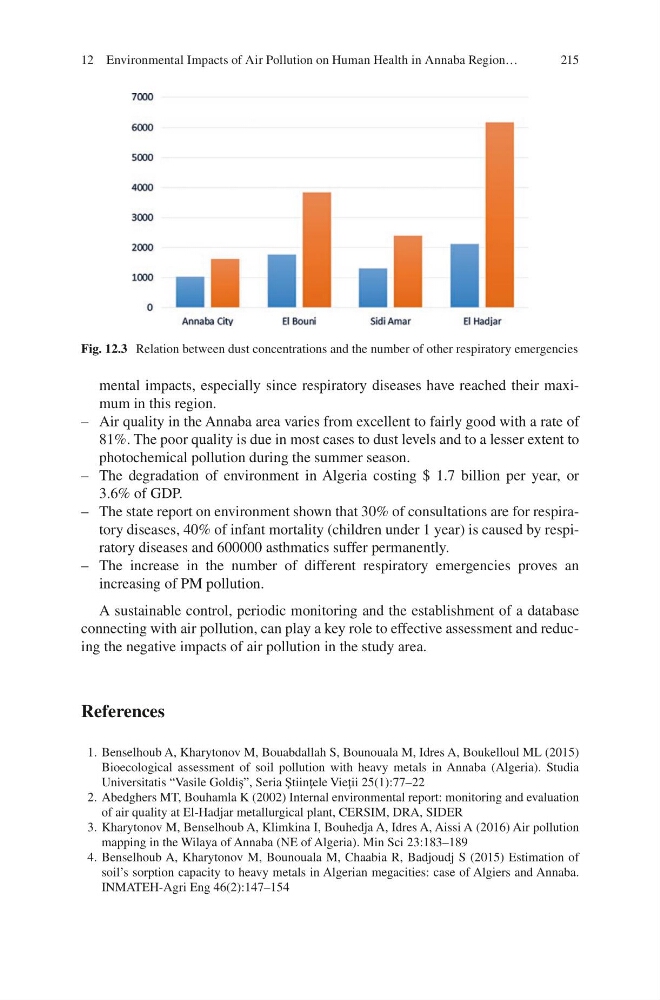
– The increase in the number of different respiratory emergencies proves an
increasing of PM pollution.
A sustainable control, periodic monitoring and the establishment of a database
connecting with air pollution, can play a key role to effective assessment and reducing the negative impacts of air pollution in the study area.
References
1. Benselhoub A, Kharytonov M, Bouabdallah S, Bounouala M, Idres A, Boukelloul ML (2015)
Bioecological assessment of soil pollution with heavy metals in Annaba (Algeria). Studia
Universitatis “Vasile Goldiş”, Seria Ştiinţele Vieţii 25(1):77–22
2. Abedghers MT, Bouhamla K (2002) Internal environmental report: monitoring and evaluation
of air quality at El-Hadjar metallurgical plant, CERSIM, DRA, SIDER
3. Kharytonov M, Benselhoub A, Klimkina I, Bouhedja A, Idres A, Aissi A (2016) Air pollution
mapping in the Wilaya of Annaba (NE of Algeria). Min Sci 23:183–189
4. Benselhoub A, Kharytonov M, Bounouala M, Chaabia R, Badjoudj S (2015) Estimation of
soil’s sorption capacity to heavy metals in Algerian megacities: case of Algiers and Annaba.
INMATEH-Agri Eng 46(2):147–154
Fig. 12.3 Relation between dust concentrations and the number of other respiratory emergencies
12 Environmental Impacts of Air Pollution on Human Health in Annaba Region…
mental impacts, especially since respiratory diseases have reached their maximum in this region.
– Air quality in the Annaba area varies from excellent to fairly good with a rate of
81%. The poor quality is due in most cases to dust levels and to a lesser extent to
photochemical pollution during the summer season.
– The degradation of environment in Algeria costing $ 1.7 billion per year, or
3.6% of GDP.
– The state report on environment shown that 30% of consultations are for respiratory diseases, 40% of infant mortality (children under 1 year) is caused by respiratory diseases and 600000 asthmatics suffer permanently.
– The increase in the number of different respiratory emergencies proves an
increasing of PM pollution.
A sustainable control, periodic monitoring and the establishment of a database
connecting with air pollution, can play a key role to effective assessment and reducing the negative impacts of air pollution in the study area.
References
1. Benselhoub A, Kharytonov M, Bouabdallah S, Bounouala M, Idres A, Boukelloul ML (2015)
Bioecological assessment of soil pollution with heavy metals in Annaba (Algeria). Studia
Universitatis “Vasile Goldiş”, Seria Ştiinţele Vieţii 25(1):77–22
2. Abedghers MT, Bouhamla K (2002) Internal environmental report: monitoring and evaluation
of air quality at El-Hadjar metallurgical plant, CERSIM, DRA, SIDER
3. Kharytonov M, Benselhoub A, Klimkina I, Bouhedja A, Idres A, Aissi A (2016) Air pollution
mapping in the Wilaya of Annaba (NE of Algeria). Min Sci 23:183–189
4. Benselhoub A, Kharytonov M, Bounouala M, Chaabia R, Badjoudj S (2015) Estimation of
soil’s sorption capacity to heavy metals in Algerian megacities: case of Algiers and Annaba.
INMATEH-Agri Eng 46(2):147–154
Fig. 12.3 Relation between dust concentrations and the number of other respiratory emergencies
12 Environmental Impacts of Air Pollution on Human Health in Annaba Region…