

196
11.8 A Typical Example of the Mass Spectrometry
Characterization of an Anthrax Biothreat
Bacillus anthracis is a Gram-positive bacterium that causes anthrax to both humans
and animals [76]. The formation of endospores [77] at the maturity stage of the
bacterium allows protection against severe conditions, such as extreme temperatures, radiations, physical damages, and chemicals [78]. Bacillus anthracis is the
etiologic agent of anthrax that can be used as a biological weapon [79, 80].
Indeed, Bacillus anthracis a pathogen that is lethal in most cases for both humans
and animals. There are different Bacillus anthracis strains, among those, 89 of them
were identified, such as the Sterne strain [81], the Vollum strain [82], the Ames
strain [80, 83], and the H9401 strain [84]. The last one has also been studied for the
development of anthrax vaccine [84]. In addition, Bacillus anthracis has been
extensively studied to understand its pathogenesis, identifying new biomarkers and
vaccines design [85]. The capsular polypeptide (polyglutamic acid) of the Bacillus
anthracis has been targeted for the development of synthetic vaccines [86].
Daubenspeck et al. reported the structure of the tetrasaccharide side chain of the
collagen-like region of the major glycoprotein of the B. anthracis exosporium [87].
Their findings were that the upstream terminal of the tetrasaccharide corresponds to
the sugar anthrose [4,6-dideoxy-4-(3-hydroxy-3-methylbutyramido)-2-O-methylD-glucopyranose].
The group of Kováč prepared a vaccine composed of a synthesized tetrasaccharide side chain of the collagen-like region of the major glycoprotein of the B. anthracis exosporium (MW = 950.43 Da) attached to the BSA using the squaric acid
chemistry [54]. The conjugation led to the formation of vaccines with different carbohydrate: BSA ratios.
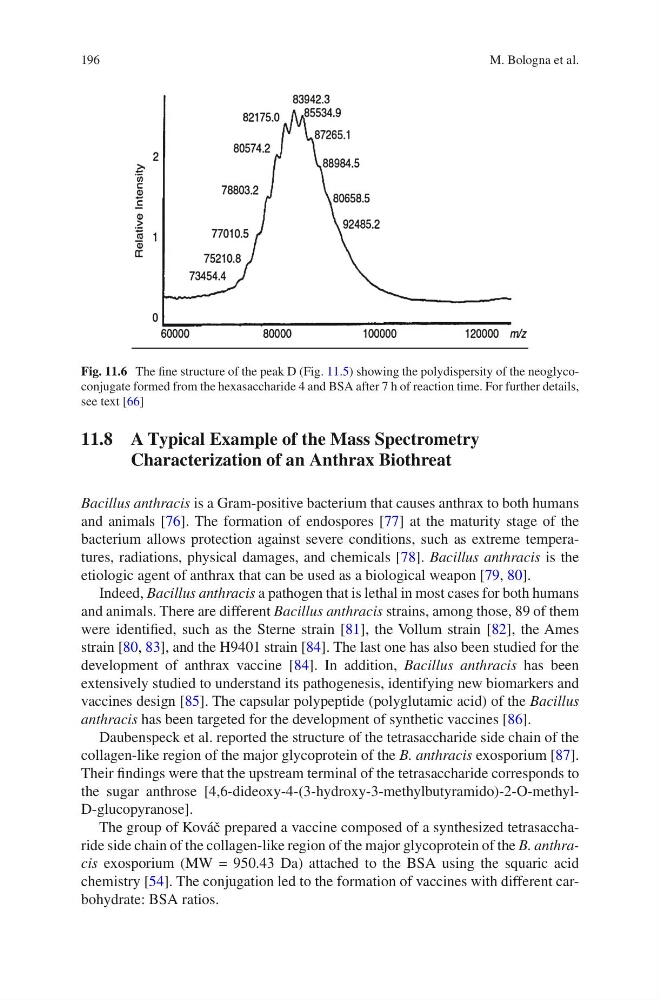
Fig. 11.6 The fine structure of the peak D (Fig. 11.5) showing the polydispersity of the neoglycoconjugate formed from the hexasaccharide 4 and BSA after 7 h of reaction time. For further details,
see text [66]
M. Bologna et al.
11.8 A Typical Example of the Mass Spectrometry
Characterization of an Anthrax Biothreat
Bacillus anthracis is a Gram-positive bacterium that causes anthrax to both humans
and animals [76]. The formation of endospores [77] at the maturity stage of the
bacterium allows protection against severe conditions, such as extreme temperatures, radiations, physical damages, and chemicals [78]. Bacillus anthracis is the
etiologic agent of anthrax that can be used as a biological weapon [79, 80].
Indeed, Bacillus anthracis a pathogen that is lethal in most cases for both humans
and animals. There are different Bacillus anthracis strains, among those, 89 of them
were identified, such as the Sterne strain [81], the Vollum strain [82], the Ames
strain [80, 83], and the H9401 strain [84]. The last one has also been studied for the
development of anthrax vaccine [84]. In addition, Bacillus anthracis has been
extensively studied to understand its pathogenesis, identifying new biomarkers and
vaccines design [85]. The capsular polypeptide (polyglutamic acid) of the Bacillus
anthracis has been targeted for the development of synthetic vaccines [86].
Daubenspeck et al. reported the structure of the tetrasaccharide side chain of the
collagen-like region of the major glycoprotein of the B. anthracis exosporium [87].
Their findings were that the upstream terminal of the tetrasaccharide corresponds to
the sugar anthrose [4,6-dideoxy-4-(3-hydroxy-3-methylbutyramido)-2-O-methylD-glucopyranose].
The group of Kováč prepared a vaccine composed of a synthesized tetrasaccharide side chain of the collagen-like region of the major glycoprotein of the B. anthracis exosporium (MW = 950.43 Da) attached to the BSA using the squaric acid
chemistry [54]. The conjugation led to the formation of vaccines with different carbohydrate: BSA ratios.
Fig. 11.6 The fine structure of the peak D (Fig. 11.5) showing the polydispersity of the neoglycoconjugate formed from the hexasaccharide 4 and BSA after 7 h of reaction time. For further details,
see text [66]
M. Bologna et al.