

146
major causes of gastroenteritis in developed nations. EHEC/STEC infections may
lead to a complication known as hemolytic uremic syndrome (HUS) that leads to
high levels of morbidity and mortality in the young and the elderly. EHEC also
forms AE lesions on enterocytes through a T3SS. However, it encodes a potent toxin
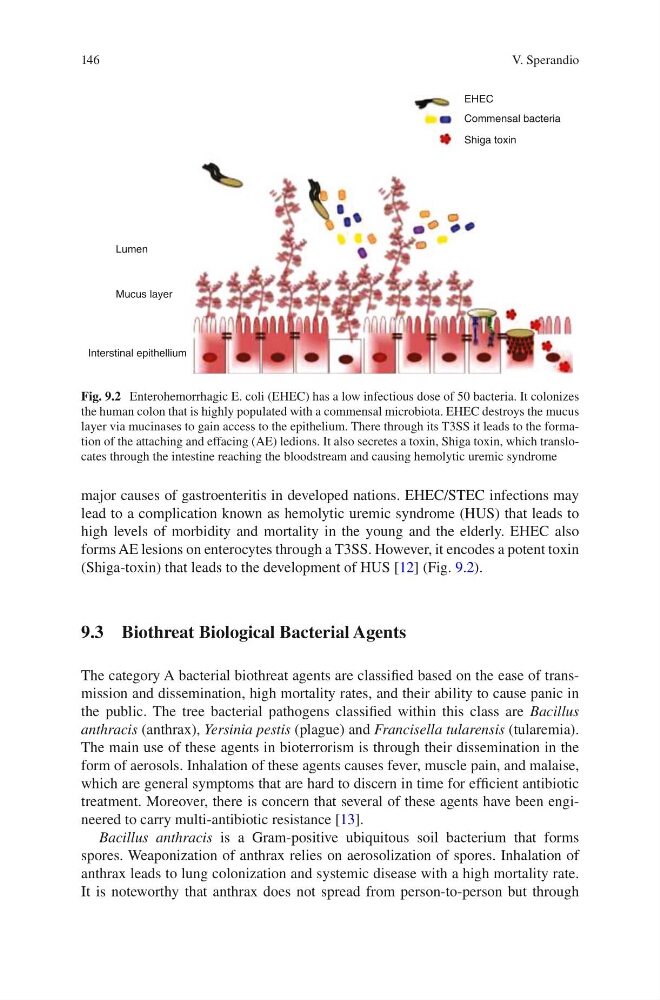
(Shiga-toxin) that leads to the development of HUS [12] (Fig. 9.2).
9.3 Biothreat Biological Bacterial Agents
The category A bacterial biothreat agents are classified based on the ease of transmission and dissemination, high mortality rates, and their ability to cause panic in
the public. The tree bacterial pathogens classified within this class are Bacillus
anthracis (anthrax), Yersinia pestis (plague) and Francisella tularensis (tularemia).
The main use of these agents in bioterrorism is through their dissemination in the
form of aerosols. Inhalation of these agents causes fever, muscle pain, and malaise,
which are general symptoms that are hard to discern in time for efficient antibiotic
treatment. Moreover, there is concern that several of these agents have been engineered to carry multi-antibiotic resistance [13].
Bacillus anthracis is a Gram-positive ubiquitous soil bacterium that forms
spores. Weaponization of anthrax relies on aerosolization of spores. Inhalation of
anthrax leads to lung colonization and systemic disease with a high mortality rate.
It is noteworthy that anthrax does not spread from person-to-person but through
EHEC
Commensal bacteria
Shiga toxin
Lumen
Mucus layer
Interstinal epithellium
Fig. 9.2 Enterohemorrhagic E. coli (EHEC) has a low infectious dose of 50 bacteria. It colonizes
the human colon that is highly populated with a commensal microbiota. EHEC destroys the mucus
layer via mucinases to gain access to the epithelium. There through its T3SS it leads to the formation of the attaching and effacing (AE) ledions. It also secretes a toxin, Shiga toxin, which translocates through the intestine reaching the bloodstream and causing hemolytic uremic syndrome
V. Sperandio
major causes of gastroenteritis in developed nations. EHEC/STEC infections may
lead to a complication known as hemolytic uremic syndrome (HUS) that leads to
high levels of morbidity and mortality in the young and the elderly. EHEC also
forms AE lesions on enterocytes through a T3SS. However, it encodes a potent toxin
(Shiga-toxin) that leads to the development of HUS [12] (Fig. 9.2).
9.3 Biothreat Biological Bacterial Agents
The category A bacterial biothreat agents are classified based on the ease of transmission and dissemination, high mortality rates, and their ability to cause panic in
the public. The tree bacterial pathogens classified within this class are Bacillus
anthracis (anthrax), Yersinia pestis (plague) and Francisella tularensis (tularemia).
The main use of these agents in bioterrorism is through their dissemination in the
form of aerosols. Inhalation of these agents causes fever, muscle pain, and malaise,
which are general symptoms that are hard to discern in time for efficient antibiotic
treatment. Moreover, there is concern that several of these agents have been engineered to carry multi-antibiotic resistance [13].
Bacillus anthracis is a Gram-positive ubiquitous soil bacterium that forms
spores. Weaponization of anthrax relies on aerosolization of spores. Inhalation of
anthrax leads to lung colonization and systemic disease with a high mortality rate.
It is noteworthy that anthrax does not spread from person-to-person but through
EHEC
Commensal bacteria
Shiga toxin
Lumen
Mucus layer
Interstinal epithellium
Fig. 9.2 Enterohemorrhagic E. coli (EHEC) has a low infectious dose of 50 bacteria. It colonizes
the human colon that is highly populated with a commensal microbiota. EHEC destroys the mucus
layer via mucinases to gain access to the epithelium. There through its T3SS it leads to the formation of the attaching and effacing (AE) ledions. It also secretes a toxin, Shiga toxin, which translocates through the intestine reaching the bloodstream and causing hemolytic uremic syndrome
V. Sperandio