

145
main virulence factor, which is its flagellum, a whip-like structure used for locomotion and cellular adhesion, is also required for colonization of chicks [11].
Diarrheagenic E. coli are subdivided in six pathovars according to their virulence
repertoire and the disease they cause. Enterotoxigenic E. coli (ETEC) causes watery
diarrhea mainly in developing nations, and is commonly known as the cause of
travelers’ diarrhea. ETEC uses afimbrial and fimbrial adhesins to attach to host
cells, and delivers exotoxins that cause changes in signal transduction leading to
diarrhea. Enteroaggregative E. coli (EAEC) is quickly becoming more prevalent as
a diarrheal agent in developing countries than ETEC. EAEC adheres in a distinct
honey-comb pattern to gut epithelial cells forming a biofilm. The delivery of enterotoxins combined with the biofilm adherence, leads to a longer term colonization and
diarrheal disease of the host. Diffuse adherence E. coli (DAEC) is a cause of diarrheal disease in developing nations. Other than its diffuse adherence pattern to epithelial cells, not much is known about the mechanisms that this pathovar engenders
to cause disease. Enteroinvasive E. coli (EIEC) is really similar to Shigella. It causes
bloody diarrhea accompanied with inflammation, and high. EIEC and Shigella
employ a T3SS to invade intestinal epithelial cells. They break free from the vacuole, replicating within the cytoplasm, and spreading in a horizontal manner through
the intestinal epithelium. Enteropathogenic E. coli (EPEC) is an important cause of
diarrhea in infants in developing countries. EPEC causes watery diarrhea by
employing a T3SS that allows it to form attaching and effacing lesions on enterocytes. AE lesions are characterized by effacement of the microvilli and rearrangement of the host cell cytoskeleton to cup each bacterium forming a pedestal- like
structure. Enterohemorrhagic E. coli (EHEC) or Shiga-toxin producing E. coli
(STEC) cause outbreaks of bloody diarrhea throughout the world, being one of the
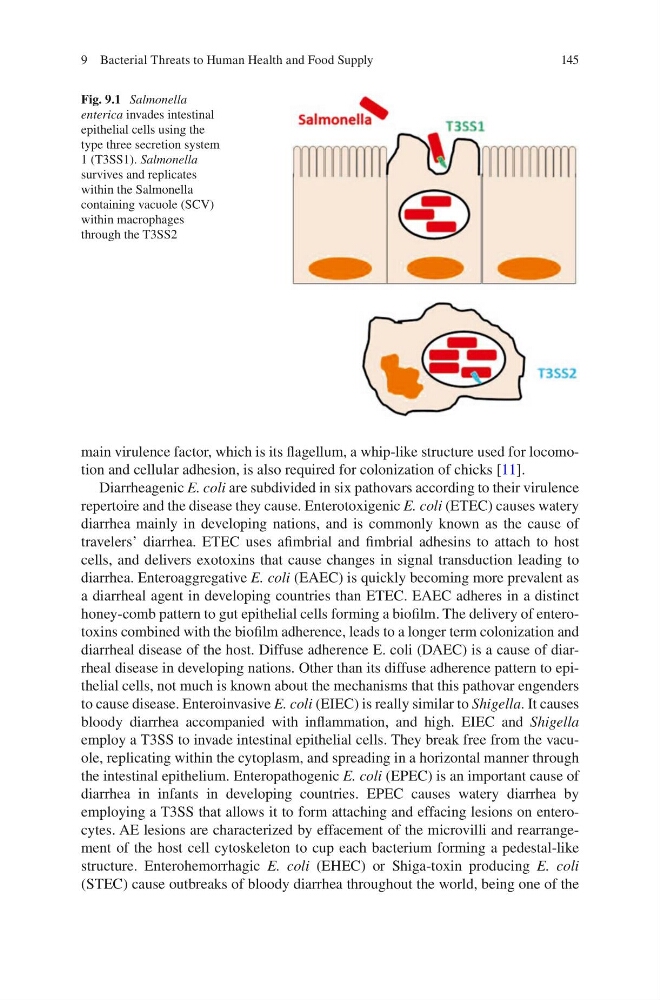
Fig. 9.1 Salmonella
enterica invades intestinal
epithelial cells using the
type three secretion system
1 (T3SS1). Salmonella
survives and replicates
within the Salmonella
containing vacuole (SCV)
within macrophages
through the T3SS2
9 Bacterial Threats to Human Health and Food Supply
main virulence factor, which is its flagellum, a whip-like structure used for locomotion and cellular adhesion, is also required for colonization of chicks [11].
Diarrheagenic E. coli are subdivided in six pathovars according to their virulence
repertoire and the disease they cause. Enterotoxigenic E. coli (ETEC) causes watery
diarrhea mainly in developing nations, and is commonly known as the cause of
travelers’ diarrhea. ETEC uses afimbrial and fimbrial adhesins to attach to host
cells, and delivers exotoxins that cause changes in signal transduction leading to
diarrhea. Enteroaggregative E. coli (EAEC) is quickly becoming more prevalent as
a diarrheal agent in developing countries than ETEC. EAEC adheres in a distinct
honey-comb pattern to gut epithelial cells forming a biofilm. The delivery of enterotoxins combined with the biofilm adherence, leads to a longer term colonization and
diarrheal disease of the host. Diffuse adherence E. coli (DAEC) is a cause of diarrheal disease in developing nations. Other than its diffuse adherence pattern to epithelial cells, not much is known about the mechanisms that this pathovar engenders
to cause disease. Enteroinvasive E. coli (EIEC) is really similar to Shigella. It causes
bloody diarrhea accompanied with inflammation, and high. EIEC and Shigella
employ a T3SS to invade intestinal epithelial cells. They break free from the vacuole, replicating within the cytoplasm, and spreading in a horizontal manner through
the intestinal epithelium. Enteropathogenic E. coli (EPEC) is an important cause of
diarrhea in infants in developing countries. EPEC causes watery diarrhea by
employing a T3SS that allows it to form attaching and effacing lesions on enterocytes. AE lesions are characterized by effacement of the microvilli and rearrangement of the host cell cytoskeleton to cup each bacterium forming a pedestal- like
structure. Enterohemorrhagic E. coli (EHEC) or Shiga-toxin producing E. coli
(STEC) cause outbreaks of bloody diarrhea throughout the world, being one of the
Fig. 9.1 Salmonella
enterica invades intestinal
epithelial cells using the
type three secretion system
1 (T3SS1). Salmonella
survives and replicates
within the Salmonella
containing vacuole (SCV)
within macrophages
through the T3SS2
9 Bacterial Threats to Human Health and Food Supply