

124
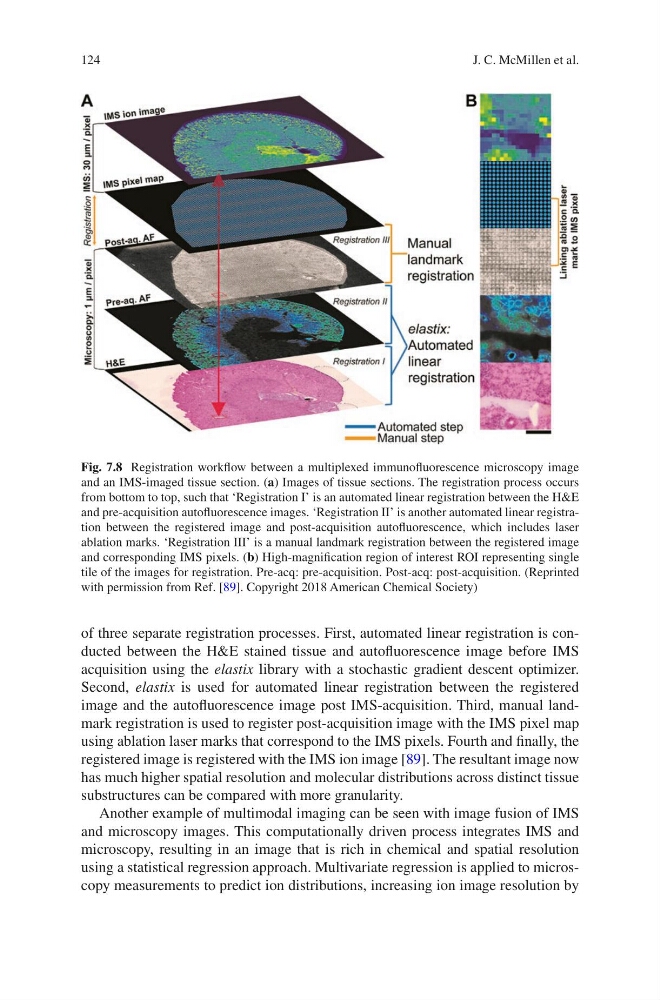
of three separate registration processes. First, automated linear registration is conducted between the H&E stained tissue and autofluorescence image before IMS
acquisition using the elastix library with a stochastic gradient descent optimizer.
Second, elastix is used for automated linear registration between the registered
image and the autofluorescence image post IMS-acquisition. Third, manual landmark registration is used to register post-acquisition image with the IMS pixel map
using ablation laser marks that correspond to the IMS pixels. Fourth and finally, the
registered image is registered with the IMS ion image [89]. The resultant image now
has much higher spatial resolution and molecular distributions across distinct tissue
substructures can be compared with more granularity.
Another example of multimodal imaging can be seen with image fusion of IMS
and microscopy images. This computationally driven process integrates IMS and
microscopy, resulting in an image that is rich in chemical and spatial resolution
using a statistical regression approach. Multivariate regression is applied to microscopy measurements to predict ion distributions, increasing ion image resolution by
Fig. 7.8 Registration workflow between a multiplexed immunofluorescence microscopy image
and an IMS-imaged tissue section. (a) Images of tissue sections. The registration process occurs
from bottom to top, such that ‘Registration I’ is an automated linear registration between the H&E
and pre-acquisition autofluorescence images. ‘Registration II’ is another automated linear registration between the registered image and post-acquisition autofluorescence, which includes laser
ablation marks. ‘Registration III’ is a manual landmark registration between the registered image
and corresponding IMS pixels. (b) High-magnification region of interest ROI representing single
tile of the images for registration. Pre-acq: pre-acquisition. Post-acq: post-acquisition. (Reprinted
with permission from Ref. [89]. Copyright 2018 American Chemical Society)
J. C. McMillen et al.
of three separate registration processes. First, automated linear registration is conducted between the H&E stained tissue and autofluorescence image before IMS
acquisition using the elastix library with a stochastic gradient descent optimizer.
Second, elastix is used for automated linear registration between the registered
image and the autofluorescence image post IMS-acquisition. Third, manual landmark registration is used to register post-acquisition image with the IMS pixel map
using ablation laser marks that correspond to the IMS pixels. Fourth and finally, the
registered image is registered with the IMS ion image [89]. The resultant image now
has much higher spatial resolution and molecular distributions across distinct tissue
substructures can be compared with more granularity.
Another example of multimodal imaging can be seen with image fusion of IMS
and microscopy images. This computationally driven process integrates IMS and
microscopy, resulting in an image that is rich in chemical and spatial resolution
using a statistical regression approach. Multivariate regression is applied to microscopy measurements to predict ion distributions, increasing ion image resolution by
Fig. 7.8 Registration workflow between a multiplexed immunofluorescence microscopy image
and an IMS-imaged tissue section. (a) Images of tissue sections. The registration process occurs
from bottom to top, such that ‘Registration I’ is an automated linear registration between the H&E
and pre-acquisition autofluorescence images. ‘Registration II’ is another automated linear registration between the registered image and post-acquisition autofluorescence, which includes laser
ablation marks. ‘Registration III’ is a manual landmark registration between the registered image
and corresponding IMS pixels. (b) High-magnification region of interest ROI representing single
tile of the images for registration. Pre-acq: pre-acquisition. Post-acq: post-acquisition. (Reprinted
with permission from Ref. [89]. Copyright 2018 American Chemical Society)
J. C. McMillen et al.