

117
The protocol for application of a MALDI matrix to a tissue sample can dictate
crystal size, analyte extraction, and analyte delocalization (Fig. 7.4c). MALDI
matrices are most commonly applied by either aerosol spray or sublimation. Aerosol
application can be accomplished using an airbrush sprayer or more homogenously
and reproducibly using a robotic sprayer. Temperature, gas flow, and solvent composition can all influence analyte extraction and unwanted delocalization. Ideally,
matrix application is wet enough to ensure analyte extraction yet not so wet to promote analyte delocalization. Optimal matrix concentration and deposition density
are determined by resultant mass spectra, and delocalization is evaluated by MS
acquisition off tissue [71]. When necessary, final assessment of a matrix application
can be assessed using scanning electron microscopy to determine the matrix crystal
size, an important factor when performing high spatial resolution IMS due to the
need for crystals to be much smaller than the incident laser spot size [3]. Matrix
application by sublimation has been shown to produce small crystal sizes [72].
However, sublimation does not provide the level of analyte extraction achieved by
aerosol spray. A recrystallization procedure was developed to achieve efficient
extraction after matrix application by sublimation (Fig. 7.4d) [35]. One issue with
sublimation is the achievement of reproducible deposition amounts. Variation in the
sublimation time or temperature will impact the amount of matrix deposited.
Sublimation is generally not commonly used for large sample cohorts [3, 35, 49,
73]. Sample preparation and matrix selection are important considerations when
developing a method for IMS analysis.
7.7 Application to Kidney Disease
The progression of chronic kidney disease often leads to a host of medical issues
including vascular disease, blindness, and diabetic nephropathy. Kidney disease is
characterized by damage to the many small sub-structures within the kidney such as
the tubules and glomeruli and changes in the molecular profile of lipids, proteins,
and peptides. Glomeruli, the central filtration units of the kidney, have a relatively
small diameter (100–200 μm) and are distributed throughout the kidney. The untargeted nature of IMS is an ideal discovery tool for the detection of a range of intact
biomolecules for the characterization of diseased tissue.
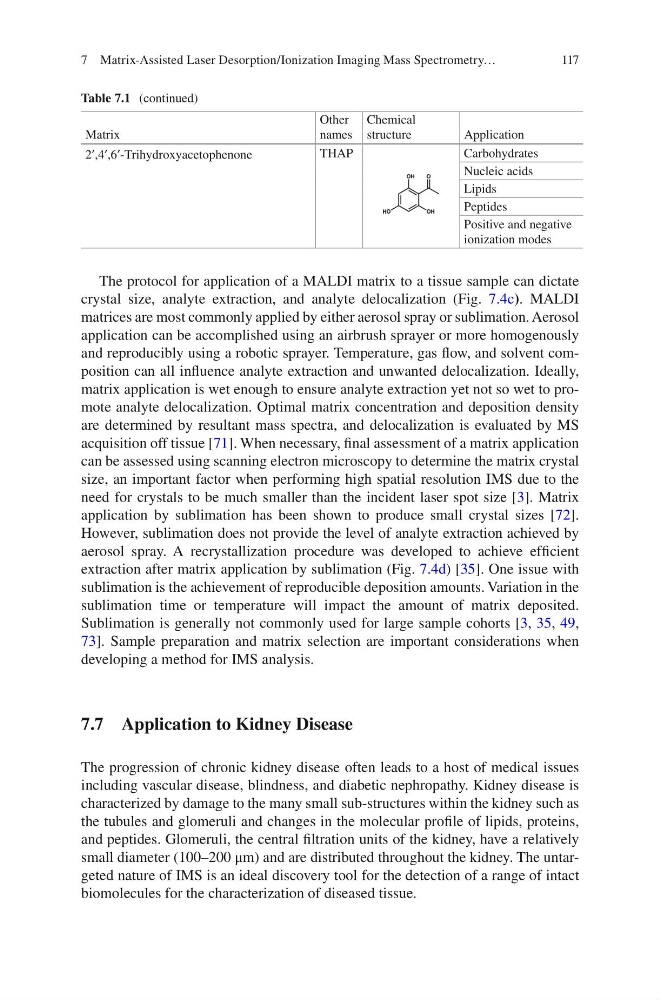
Table 7.1 (continued)
Matrix
Other
names
Chemical
structure
Application
2′,4′,6′-Trihydroxyacetophenone
THAP
Carbohydrates
Nucleic acids
Lipids
Peptides
Positive and negative
ionization modes
7 Matrix-Assisted Laser Desorption/Ionization Imaging Mass Spectrometry…
The protocol for application of a MALDI matrix to a tissue sample can dictate
crystal size, analyte extraction, and analyte delocalization (Fig. 7.4c). MALDI
matrices are most commonly applied by either aerosol spray or sublimation. Aerosol
application can be accomplished using an airbrush sprayer or more homogenously
and reproducibly using a robotic sprayer. Temperature, gas flow, and solvent composition can all influence analyte extraction and unwanted delocalization. Ideally,
matrix application is wet enough to ensure analyte extraction yet not so wet to promote analyte delocalization. Optimal matrix concentration and deposition density
are determined by resultant mass spectra, and delocalization is evaluated by MS
acquisition off tissue [71]. When necessary, final assessment of a matrix application
can be assessed using scanning electron microscopy to determine the matrix crystal
size, an important factor when performing high spatial resolution IMS due to the
need for crystals to be much smaller than the incident laser spot size [3]. Matrix
application by sublimation has been shown to produce small crystal sizes [72].
However, sublimation does not provide the level of analyte extraction achieved by
aerosol spray. A recrystallization procedure was developed to achieve efficient
extraction after matrix application by sublimation (Fig. 7.4d) [35]. One issue with
sublimation is the achievement of reproducible deposition amounts. Variation in the
sublimation time or temperature will impact the amount of matrix deposited.
Sublimation is generally not commonly used for large sample cohorts [3, 35, 49,
73]. Sample preparation and matrix selection are important considerations when
developing a method for IMS analysis.
7.7 Application to Kidney Disease
The progression of chronic kidney disease often leads to a host of medical issues
including vascular disease, blindness, and diabetic nephropathy. Kidney disease is
characterized by damage to the many small sub-structures within the kidney such as
the tubules and glomeruli and changes in the molecular profile of lipids, proteins,
and peptides. Glomeruli, the central filtration units of the kidney, have a relatively
small diameter (100–200 μm) and are distributed throughout the kidney. The untargeted nature of IMS is an ideal discovery tool for the detection of a range of intact
biomolecules for the characterization of diseased tissue.
Table 7.1 (continued)
Matrix
Other
names
Chemical
structure
Application
2′,4′,6′-Trihydroxyacetophenone
THAP
Carbohydrates
Nucleic acids
Lipids
Peptides
Positive and negative
ionization modes
7 Matrix-Assisted Laser Desorption/Ionization Imaging Mass Spectrometry…