

100
above. However, the investigation becomes much more challenging as soon as targeted analysis returns a blank and the identity of the effect-causing chemical
remains unknown [22]. This then calls for a differential non-targeted analysis,
which will be demonstrated using the following case study.
Around the year 2000, fishermen on Lake Thun in the Bernese Oberland,
Switzerland, found that cleaning out their fish was more difficult than in previous
years. This was partially caused by adhesions/fusions of the gonads to the peritoneal
wall and the musculature. When the white fish (Coregonus lavaretus) were analyzed
by veterinarians, they found additional deviations of gonadal morphology, such as
asymmetry of the gonad strands, atrophy and aplasia, compartmentations, hermaphroditism and intersex [23].
Potential causes considered for this effect were biological, such as genetic factors or infectious diseases (contracted in the lake or local hatcheries), or related to
environmental conditions (temperature, habitat quality, food availability or water
quality). However, the intersex features observed could also have developed as a
result of interactions of chemicals with the endocrine system. Therefore, sediments,
lake water, muscle tissue and bile were extracted and analyzed chemically and with
in vitro assays according to the EDA approach. The analysis of muscle (long-time
storage) and bile (short-time storage) from white fish (Corregonus lavaratus) in
Lake Thun showed that the estrogenicity determined in the YES could fully be
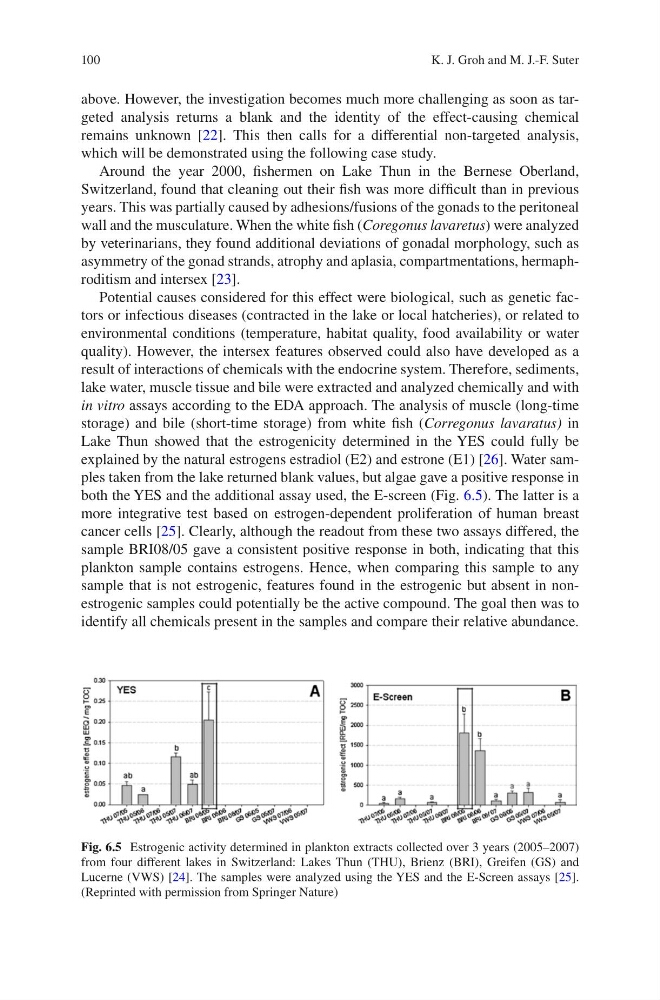
explained by the natural estrogens estradiol (E2) and estrone (E1) [26]. Water samples taken from the lake returned blank values, but algae gave a positive response in
both the YES and the additional assay used, the E-screen (Fig. 6.5). The latter is a
more integrative test based on estrogen-dependent proliferation of human breast
cancer cells [25]. Clearly, although the readout from these two assays differed, the
sample BRI08/05 gave a consistent positive response in both, indicating that this
plankton sample contains estrogens. Hence, when comparing this sample to any
sample that is not estrogenic, features found in the estrogenic but absent in nonestrogenic samples could potentially be the active compound. The goal then was to
identify all chemicals present in the samples and compare their relative abundance.
Fig. 6.5 Estrogenic activity determined in plankton extracts collected over 3 years (2005–2007)
from four different lakes in Switzerland: Lakes Thun (THU), Brienz (BRI), Greifen (GS) and
Lucerne (VWS) [24]. The samples were analyzed using the YES and the E-Screen assays [25].
(Reprinted with permission from Springer Nature)
K. J. Groh and M. J.-F. Suter
above. However, the investigation becomes much more challenging as soon as targeted analysis returns a blank and the identity of the effect-causing chemical
remains unknown [22]. This then calls for a differential non-targeted analysis,
which will be demonstrated using the following case study.
Around the year 2000, fishermen on Lake Thun in the Bernese Oberland,
Switzerland, found that cleaning out their fish was more difficult than in previous
years. This was partially caused by adhesions/fusions of the gonads to the peritoneal
wall and the musculature. When the white fish (Coregonus lavaretus) were analyzed
by veterinarians, they found additional deviations of gonadal morphology, such as
asymmetry of the gonad strands, atrophy and aplasia, compartmentations, hermaphroditism and intersex [23].
Potential causes considered for this effect were biological, such as genetic factors or infectious diseases (contracted in the lake or local hatcheries), or related to
environmental conditions (temperature, habitat quality, food availability or water
quality). However, the intersex features observed could also have developed as a
result of interactions of chemicals with the endocrine system. Therefore, sediments,
lake water, muscle tissue and bile were extracted and analyzed chemically and with
in vitro assays according to the EDA approach. The analysis of muscle (long-time
storage) and bile (short-time storage) from white fish (Corregonus lavaratus) in
Lake Thun showed that the estrogenicity determined in the YES could fully be
explained by the natural estrogens estradiol (E2) and estrone (E1) [26]. Water samples taken from the lake returned blank values, but algae gave a positive response in
both the YES and the additional assay used, the E-screen (Fig. 6.5). The latter is a
more integrative test based on estrogen-dependent proliferation of human breast
cancer cells [25]. Clearly, although the readout from these two assays differed, the
sample BRI08/05 gave a consistent positive response in both, indicating that this
plankton sample contains estrogens. Hence, when comparing this sample to any
sample that is not estrogenic, features found in the estrogenic but absent in nonestrogenic samples could potentially be the active compound. The goal then was to
identify all chemicals present in the samples and compare their relative abundance.
Fig. 6.5 Estrogenic activity determined in plankton extracts collected over 3 years (2005–2007)
from four different lakes in Switzerland: Lakes Thun (THU), Brienz (BRI), Greifen (GS) and
Lucerne (VWS) [24]. The samples were analyzed using the YES and the E-Screen assays [25].
(Reprinted with permission from Springer Nature)
K. J. Groh and M. J.-F. Suter