

99
One popular reporter gene assay in the field of endocrine disruption is the yeast
estrogen screen (YES), which is used to determine estrogenicity of a sample [19].
This assay detects estrogenic compounds binding to the estrogen receptor; this
binding activates a reporter gene, resulting in a synthesis of an enzyme which in turn
then transforms its substrate into a quantifiable colored product. In a Swiss survey
of rivers, estrogenicity determined in the YES was shown to correlate with estradiol
equivalents calculated based on determined concentrations and relative potencies of
17ß-estrogen, estrone and 17α-ethinlyestradiol, both in grab samples and extracts
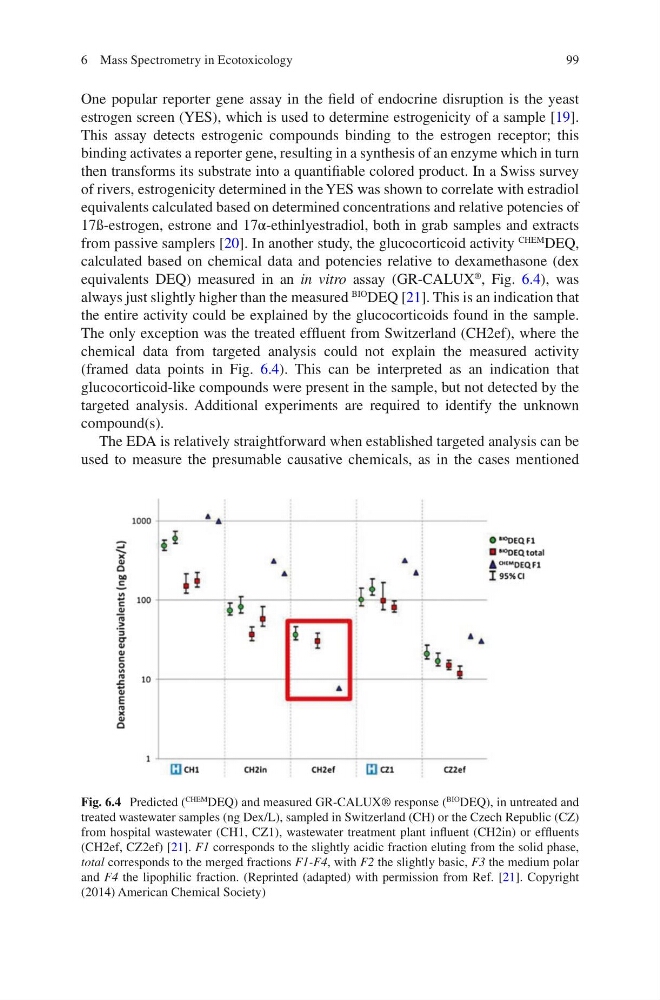
from passive samplers [20]. In another study, the glucocorticoid activity
CHEM
DEQ,
calculated based on chemical data and potencies relative to dexamethasone (dex
equivalents DEQ) measured in an in vitro assay (GR-CALUX
®
, Fig. 6.4), was
always just slightly higher than the measured
BIO
DEQ [21]. This is an indication that
the entire activity could be explained by the glucocorticoids found in the sample.
The only exception was the treated effluent from Switzerland (CH2ef), where the
chemical data from targeted analysis could not explain the measured activity
(framed data points in Fig. 6.4). This can be interpreted as an indication that
glucocorticoid- like compounds were present in the sample, but not detected by the
targeted analysis. Additional experiments are required to identify the unknown
compound(s).
The EDA is relatively straightforward when established targeted analysis can be
used to measure the presumable causative chemicals, as in the cases mentioned
Fig. 6.4 Predicted (
CHEM
DEQ) and measured GR-CALUX® response (
BIO
DEQ), in untreated and
treated wastewater samples (ng Dex/L), sampled in Switzerland (CH) or the Czech Republic (CZ)
from hospital wastewater (CH1, CZ1), wastewater treatment plant influent (CH2in) or effluents
(CH2ef, CZ2ef) [21]. F1 corresponds to the slightly acidic fraction eluting from the solid phase,
total corresponds to the merged fractions F1-F4, with F2 the slightly basic, F3 the medium polar
and F4 the lipophilic fraction. (Reprinted (adapted) with permission from Ref. [21]. Copyright
(2014) American Chemical Society)
6 Mass Spectrometry in Ecotoxicology
One popular reporter gene assay in the field of endocrine disruption is the yeast
estrogen screen (YES), which is used to determine estrogenicity of a sample [19].
This assay detects estrogenic compounds binding to the estrogen receptor; this
binding activates a reporter gene, resulting in a synthesis of an enzyme which in turn
then transforms its substrate into a quantifiable colored product. In a Swiss survey
of rivers, estrogenicity determined in the YES was shown to correlate with estradiol
equivalents calculated based on determined concentrations and relative potencies of
17ß-estrogen, estrone and 17α-ethinlyestradiol, both in grab samples and extracts
from passive samplers [20]. In another study, the glucocorticoid activity
CHEM
DEQ,
calculated based on chemical data and potencies relative to dexamethasone (dex
equivalents DEQ) measured in an in vitro assay (GR-CALUX
®
, Fig. 6.4), was
always just slightly higher than the measured
BIO
DEQ [21]. This is an indication that
the entire activity could be explained by the glucocorticoids found in the sample.
The only exception was the treated effluent from Switzerland (CH2ef), where the
chemical data from targeted analysis could not explain the measured activity
(framed data points in Fig. 6.4). This can be interpreted as an indication that
glucocorticoid- like compounds were present in the sample, but not detected by the
targeted analysis. Additional experiments are required to identify the unknown
compound(s).
The EDA is relatively straightforward when established targeted analysis can be
used to measure the presumable causative chemicals, as in the cases mentioned
Fig. 6.4 Predicted (
CHEM
DEQ) and measured GR-CALUX® response (
BIO
DEQ), in untreated and
treated wastewater samples (ng Dex/L), sampled in Switzerland (CH) or the Czech Republic (CZ)
from hospital wastewater (CH1, CZ1), wastewater treatment plant influent (CH2in) or effluents
(CH2ef, CZ2ef) [21]. F1 corresponds to the slightly acidic fraction eluting from the solid phase,
total corresponds to the merged fractions F1-F4, with F2 the slightly basic, F3 the medium polar
and F4 the lipophilic fraction. (Reprinted (adapted) with permission from Ref. [21]. Copyright
(2014) American Chemical Society)
6 Mass Spectrometry in Ecotoxicology