

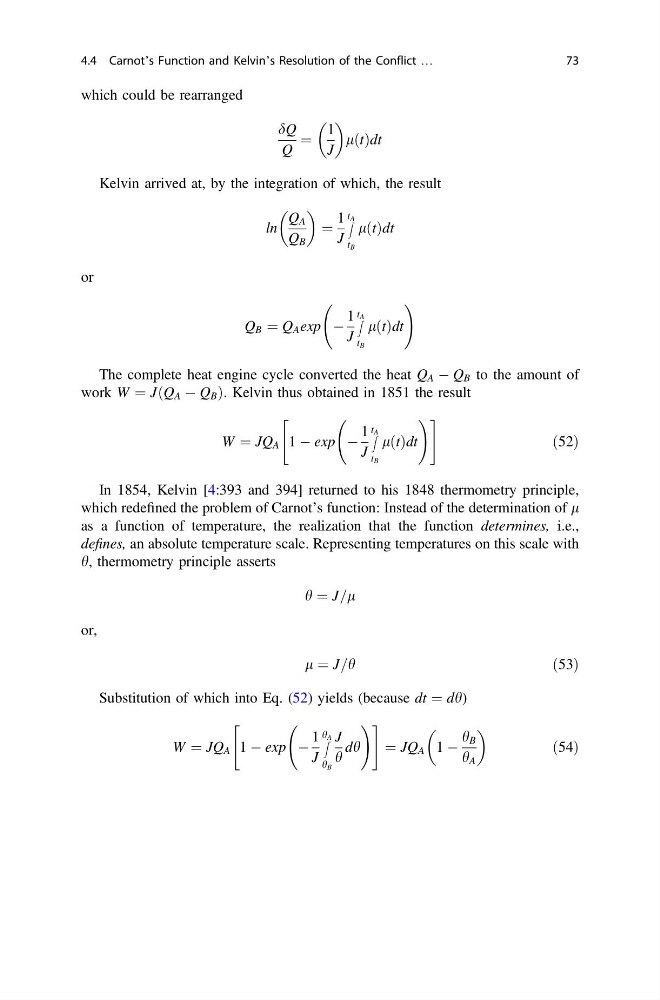
which could be rearranged
dQ
Q
¼
1
J
l t
ð Þdt
Kelvin arrived at, by the integration of which, the result
ln
Q A
Q B
¼
1
J
Z
t A
t B
l t
ð Þdt
or
Q B ¼ Q A exp À
1
J
Z
t A
t B
l t
ð Þdt
!
The complete heat engine cycle converted the heat Q A À Q B to the amount of
work W ¼ J Q A À Q B
ð
Þ . Kelvin thus obtained in 1851 the result
W ¼ JQ A 1 À exp À
1
J
Z
t A
t B
l t
ð Þdt
!
"
#
ð52Þ
In 1854, Kelvin [4:393 and 394] returned to his 1848 thermometry principle,
which redefined the problem of Carnot’s function: Instead of the determination of l
as a function of temperature, the realization that the function determines, i.e.,
defines, an absolute temperature scale. Representing temperatures on this scale with
h, thermometry principle asserts
h ¼ J=l
or,
l ¼ J=h
ð53Þ
Substitution of which into Eq. (52) yields (because dt ¼ dh)
W ¼ JQ A 1 À exp À
1
J
Z
h A
h B
J
h
dh
!
"
#
¼ JQ A 1 À
h B
h A
ð54Þ
4.4 Carnot’s Function and Kelvin’s Resolution of the Conflict …
73
dQ
Q
¼
1
J
l t
ð Þdt
Kelvin arrived at, by the integration of which, the result
ln
Q A
Q B
¼
1
J
Z
t A
t B
l t
ð Þdt
or
Q B ¼ Q A exp À
1
J
Z
t A
t B
l t
ð Þdt
!
The complete heat engine cycle converted the heat Q A À Q B to the amount of
work W ¼ J Q A À Q B
ð
Þ . Kelvin thus obtained in 1851 the result
W ¼ JQ A 1 À exp À
1
J
Z
t A
t B
l t
ð Þdt
!
"
#
ð52Þ
In 1854, Kelvin [4:393 and 394] returned to his 1848 thermometry principle,
which redefined the problem of Carnot’s function: Instead of the determination of l
as a function of temperature, the realization that the function determines, i.e.,
defines, an absolute temperature scale. Representing temperatures on this scale with
h, thermometry principle asserts
h ¼ J=l
or,
l ¼ J=h
ð53Þ
Substitution of which into Eq. (52) yields (because dt ¼ dh)
W ¼ JQ A 1 À exp À
1
J
Z
h A
h B
J
h
dh
!
"
#
¼ JQ A 1 À
h B
h A
ð54Þ
4.4 Carnot’s Function and Kelvin’s Resolution of the Conflict …
73