

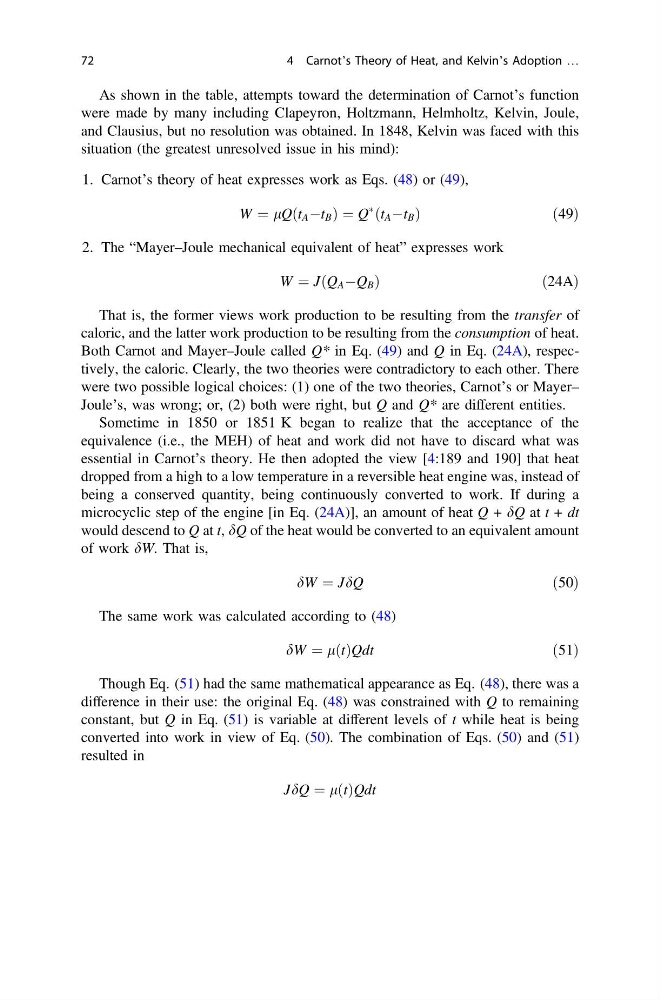
As shown in the table, attempts toward the determination of Carnot’s function
were made by many including Clapeyron, Holtzmann, Helmholtz, Kelvin, Joule,
and Clausius, but no resolution was obtained. In 1848, Kelvin was faced with this
situation (the greatest unresolved issue in his mind):
1. Carnot’s theory of heat expresses work as Eqs. (48) or (49),
W ¼ lQ t A Àt B
ð
Þ¼Q
à t A Àt B
ð
Þ
ð49Þ
2. The “Mayer–Joule mechanical equivalent of heat” expresses work
W ¼ J Q A ÀQ B
ð
Þ
ð 24AÞ
That is, the former views work production to be resulting from the transfer of
caloric, and the latter work production to be resulting from the consumption of heat.
Both Carnot and Mayer–Joule called Q* in Eq. (49) and Q in Eq. (24A), respectively, the caloric. Clearly, the two theories were contradictory to each other. There
were two possible logical choices: (1) one of the two theories, Carnot’s or Mayer–
Joule’s, was wrong; or, (2) both were right, but Q and Q* are different entities.
Sometime in 1850 or 1851 K began to realize that the acceptance of the
equivalence (i.e., the MEH) of heat and work did not have to discard what was
essential in Carnot’s theory. He then adopted the view [4:189 and 190] that heat
dropped from a high to a low temperature in a reversible heat engine was, instead of
being a conserved quantity, being continuously converted to work. If during a
microcyclic step of the engine [in Eq. (24A)], an amount of heat Q + dQ at t + dt
would descend to Q at t, dQ of the heat would be converted to an equivalent amount
of work dW. That is,
dW ¼ JdQ
ð50Þ
The same work was calculated according to (48)
dW ¼ l t
ð ÞQdt
ð51Þ
Though Eq. (51) had the same mathematical appearance as Eq. (48), there was a
difference in their use: the original Eq. (48) was constrained with Q to remaining
constant, but Q in Eq. (51) is variable at different levels of t while heat is being
converted into work in view of Eq. (50). The combination of Eqs. (50) and (51)
resulted in
JdQ ¼ l t
ð ÞQdt
72
4 Carnot’s Theory of Heat, and Kelvin’s Adoption …
were made by many including Clapeyron, Holtzmann, Helmholtz, Kelvin, Joule,
and Clausius, but no resolution was obtained. In 1848, Kelvin was faced with this
situation (the greatest unresolved issue in his mind):
1. Carnot’s theory of heat expresses work as Eqs. (48) or (49),
W ¼ lQ t A Àt B
ð
Þ¼Q
à t A Àt B
ð
Þ
ð49Þ
2. The “Mayer–Joule mechanical equivalent of heat” expresses work
W ¼ J Q A ÀQ B
ð
Þ
ð 24AÞ
That is, the former views work production to be resulting from the transfer of
caloric, and the latter work production to be resulting from the consumption of heat.
Both Carnot and Mayer–Joule called Q* in Eq. (49) and Q in Eq. (24A), respectively, the caloric. Clearly, the two theories were contradictory to each other. There
were two possible logical choices: (1) one of the two theories, Carnot’s or Mayer–
Joule’s, was wrong; or, (2) both were right, but Q and Q* are different entities.
Sometime in 1850 or 1851 K began to realize that the acceptance of the
equivalence (i.e., the MEH) of heat and work did not have to discard what was
essential in Carnot’s theory. He then adopted the view [4:189 and 190] that heat
dropped from a high to a low temperature in a reversible heat engine was, instead of
being a conserved quantity, being continuously converted to work. If during a
microcyclic step of the engine [in Eq. (24A)], an amount of heat Q + dQ at t + dt
would descend to Q at t, dQ of the heat would be converted to an equivalent amount
of work dW. That is,
dW ¼ JdQ
ð50Þ
The same work was calculated according to (48)
dW ¼ l t
ð ÞQdt
ð51Þ
Though Eq. (51) had the same mathematical appearance as Eq. (48), there was a
difference in their use: the original Eq. (48) was constrained with Q to remaining
constant, but Q in Eq. (51) is variable at different levels of t while heat is being
converted into work in view of Eq. (50). The combination of Eqs. (50) and (51)
resulted in
JdQ ¼ l t
ð ÞQdt
72
4 Carnot’s Theory of Heat, and Kelvin’s Adoption …