

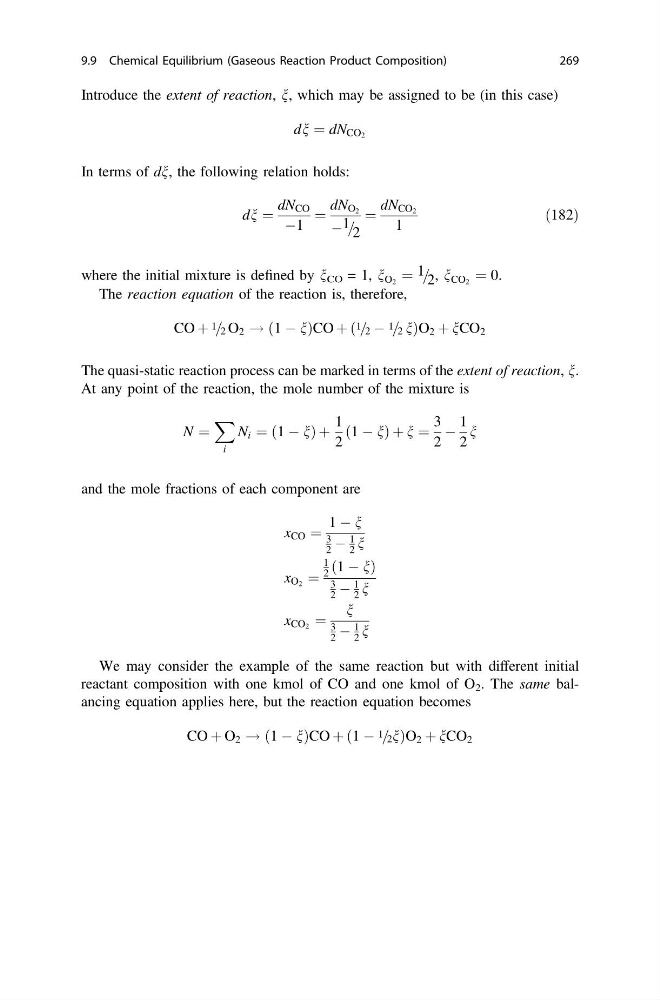
Introduce the extent of reaction, n, which may be assigned to be (in this case)
dn ¼ dN CO 2
In terms of dn, the following relation holds:
dn ¼
dN CO
À1
¼
dN O 2
À 1 = 2
¼
dN CO 2
1
ð182Þ
where the initial mixture is defined by n CO = 1, n O 2 ¼ 1 = 2 , n CO 2 ¼ 0.
The reaction equation of the reaction is, therefore,
CO þ 1 = 2 O 2 ! 1 À n
ð
ÞCO þ ð 1 = 2 À 1 = 2 nÞO 2 þ nCO 2
The quasi-static reaction process can be marked in terms of the extent of reaction, n.
At any point of the reaction, the mole number of the mixture is
N ¼
X
i
N i ¼ ð1 À nÞ þ
1
2
1 À n
ð
Þþn ¼
3
2
À
1
2
n
and the mole fractions of each component are
x CO ¼
1 À n
3
2 À
1
2 n
x O 2 ¼
1
2 1 À n
ð
Þ
3
2 À
1
2 n
x CO 2 ¼
n
3
2 À
1
2 n
We may consider the example of the same reaction but with different initial
reactant composition with one kmol of CO and one kmol of O 2 . The same balancing equation applies here, but the reaction equation becomes
CO þ O 2 ! 1 À n
ð
ÞCO þ ð1 À 1 = 2 nÞO 2 þ nCO 2
9.9 Chemical Equilibrium (Gaseous Reaction Product Composition)
269
dn ¼ dN CO 2
In terms of dn, the following relation holds:
dn ¼
dN CO
À1
¼
dN O 2
À 1 = 2
¼
dN CO 2
1
ð182Þ
where the initial mixture is defined by n CO = 1, n O 2 ¼ 1 = 2 , n CO 2 ¼ 0.
The reaction equation of the reaction is, therefore,
CO þ 1 = 2 O 2 ! 1 À n
ð
ÞCO þ ð 1 = 2 À 1 = 2 nÞO 2 þ nCO 2
The quasi-static reaction process can be marked in terms of the extent of reaction, n.
At any point of the reaction, the mole number of the mixture is
N ¼
X
i
N i ¼ ð1 À nÞ þ
1
2
1 À n
ð
Þþn ¼
3
2
À
1
2
n
and the mole fractions of each component are
x CO ¼
1 À n
3
2 À
1
2 n
x O 2 ¼
1
2 1 À n
ð
Þ
3
2 À
1
2 n
x CO 2 ¼
n
3
2 À
1
2 n
We may consider the example of the same reaction but with different initial
reactant composition with one kmol of CO and one kmol of O 2 . The same balancing equation applies here, but the reaction equation becomes
CO þ O 2 ! 1 À n
ð
ÞCO þ ð1 À 1 = 2 nÞO 2 þ nCO 2
9.9 Chemical Equilibrium (Gaseous Reaction Product Composition)
269