

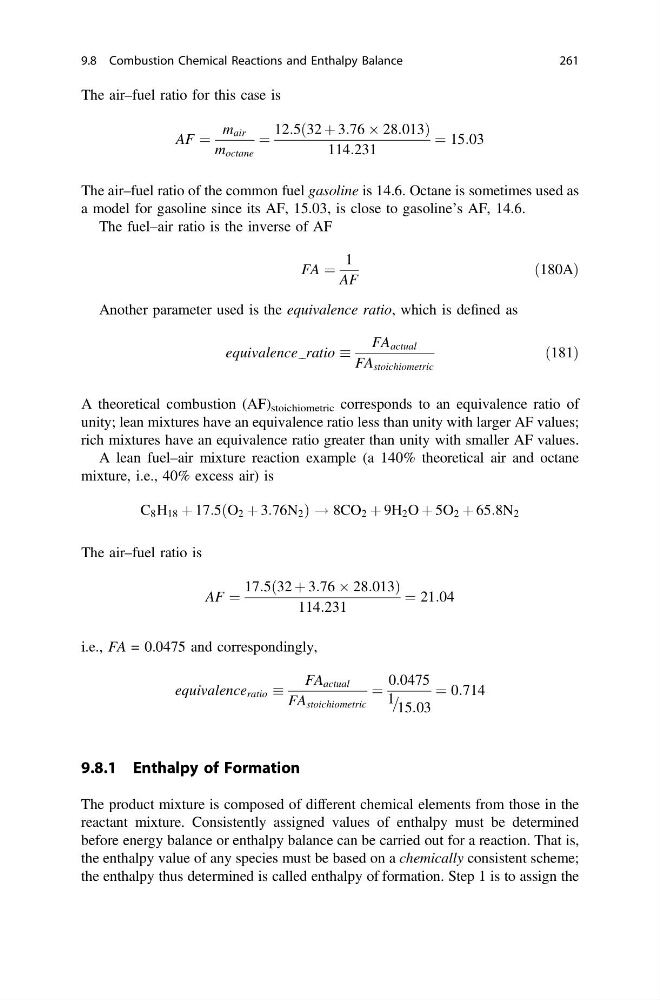
The air–fuel ratio for this case is
AF ¼
m air
m octane
¼
12:5 32 þ 3:76 Â 28:013
ð
Þ
114:231
¼ 15:03
The air–fuel ratio of the common fuel gasoline is 14.6. Octane is sometimes used as
a model for gasoline since its AF, 15.03, is close to gasoline’s AF, 14.6.
The fuel–air ratio is the inverse of AF
FA ¼
1
AF
ð180AÞ
Another parameter used is the equivalence ratio, which is defined as
equivalence ratio
FA actual
FA stoichiometric
ð181Þ
A theoretical combustion (AF) stoichiometric corresponds to an equivalence ratio of
unity; lean mixtures have an equivalence ratio less than unity with larger AF values;
rich mixtures have an equivalence ratio greater than unity with smaller AF values.
A lean fuel–air mixture reaction example (a 140% theoretical air and octane
mixture, i.e., 40% excess air) is
C 8 H 18 þ 17:5 O 2 þ 3:76N 2
ð
Þ!8CO 2 þ 9H 2 O þ 5O 2 þ 65:8N 2
The air–fuel ratio is
AF ¼
17:5 32 þ 3:76 Â 28:013
ð
Þ
114:231
¼ 21:04
i.e., FA = 0.0475 and correspondingly,
equivalence ratio
FA actual
FA stoichiometric
¼
0:0475
1 = 15:03
¼ 0:714
9.8.1 Enthalpy of Formation
The product mixture is composed of different chemical elements from those in the
reactant mixture. Consistently assigned values of enthalpy must be determined
before energy balance or enthalpy balance can be carried out for a reaction. That is,
the enthalpy value of any species must be based on a chemically consistent scheme;
the enthalpy thus determined is called enthalpy of formation. Step 1 is to assign the
9.8 Combustion Chemical Reactions and Enthalpy Balance
261
AF ¼
m air
m octane
¼
12:5 32 þ 3:76 Â 28:013
ð
Þ
114:231
¼ 15:03
The air–fuel ratio of the common fuel gasoline is 14.6. Octane is sometimes used as
a model for gasoline since its AF, 15.03, is close to gasoline’s AF, 14.6.
The fuel–air ratio is the inverse of AF
FA ¼
1
AF
ð180AÞ
Another parameter used is the equivalence ratio, which is defined as
equivalence ratio
FA actual
FA stoichiometric
ð181Þ
A theoretical combustion (AF) stoichiometric corresponds to an equivalence ratio of
unity; lean mixtures have an equivalence ratio less than unity with larger AF values;
rich mixtures have an equivalence ratio greater than unity with smaller AF values.
A lean fuel–air mixture reaction example (a 140% theoretical air and octane
mixture, i.e., 40% excess air) is
C 8 H 18 þ 17:5 O 2 þ 3:76N 2
ð
Þ!8CO 2 þ 9H 2 O þ 5O 2 þ 65:8N 2
The air–fuel ratio is
AF ¼
17:5 32 þ 3:76 Â 28:013
ð
Þ
114:231
¼ 21:04
i.e., FA = 0.0475 and correspondingly,
equivalence ratio
FA actual
FA stoichiometric
¼
0:0475
1 = 15:03
¼ 0:714
9.8.1 Enthalpy of Formation
The product mixture is composed of different chemical elements from those in the
reactant mixture. Consistently assigned values of enthalpy must be determined
before energy balance or enthalpy balance can be carried out for a reaction. That is,
the enthalpy value of any species must be based on a chemically consistent scheme;
the enthalpy thus determined is called enthalpy of formation. Step 1 is to assign the
9.8 Combustion Chemical Reactions and Enthalpy Balance
261