

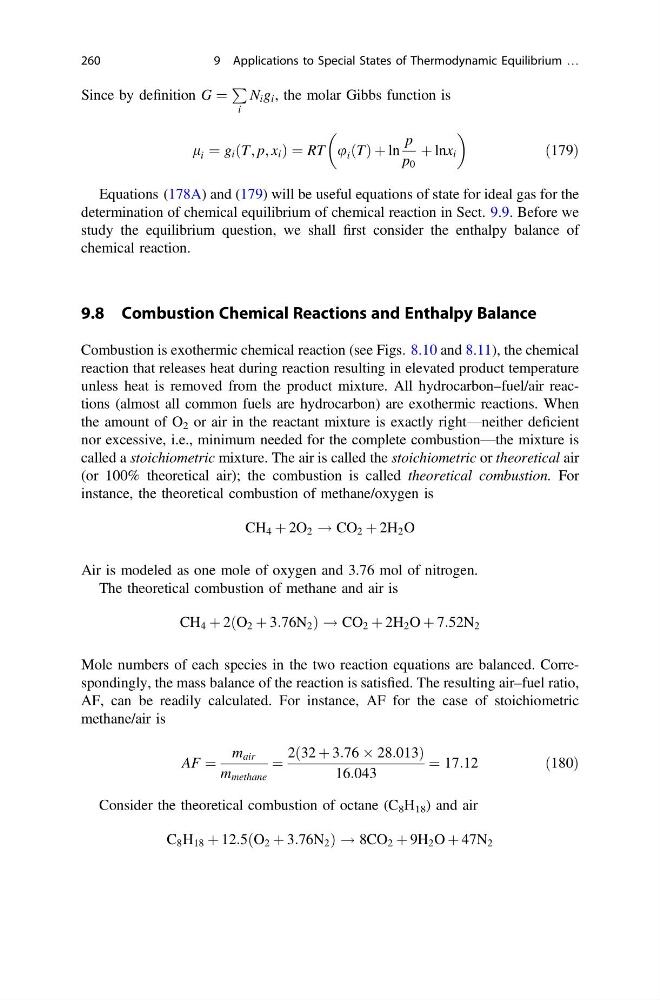
Since by definition G ¼
P
i
N i g i , the molar Gibbs function is
l i ¼ g i T; p; x i
ð
Þ¼RT u i T
ð Þ þ ln
p
p 0
þ lnx i
ð179Þ
Equations (178A) and (179) will be useful equations of state for ideal gas for the
determination of chemical equilibrium of chemical reaction in Sect. 9.9. Before we
study the equilibrium question, we shall first consider the enthalpy balance of
chemical reaction.
9.8 Combustion Chemical Reactions and Enthalpy Balance
Combustion is exothermic chemical reaction (see Figs. 8.10 and 8.11), the chemical
reaction that releases heat during reaction resulting in elevated product temperature
unless heat is removed from the product mixture. All hydrocarbon–fuel/air reactions (almost all common fuels are hydrocarbon) are exothermic reactions. When
the amount of O 2 or air in the reactant mixture is exactly right—neither deficient
nor excessive, i.e., minimum needed for the complete combustion—the mixture is
called a stoichiometric mixture. The air is called the stoichiometric or theoretical air
(or 100% theoretical air); the combustion is called theoretical combustion. For
instance, the theoretical combustion of methane/oxygen is
CH 4 þ 2O 2 ! CO 2 þ 2H 2 O
Air is modeled as one mole of oxygen and 3.76 mol of nitrogen.
The theoretical combustion of methane and air is
CH 4 þ 2 O 2 þ 3:76N 2
ð
Þ!CO 2 þ 2H 2 O þ 7:52N 2
Mole numbers of each species in the two reaction equations are balanced. Correspondingly, the mass balance of the reaction is satisfied. The resulting air–fuel ratio,
AF, can be readily calculated. For instance, AF for the case of stoichiometric
methane/air is
AF ¼
m air
m methane
¼
2 32 þ 3:76 Â 28:013
ð
Þ
16:043
¼ 17:12
ð180Þ
Consider the theoretical combustion of octane (C 8 H 18 ) and air
C 8 H 18 þ 12:5 O 2 þ 3:76N 2
ð
Þ!8CO 2 þ 9H 2 O þ 47N 2
260
9 Applications to Special States of Thermodynamic Equilibrium …
P
i
N i g i , the molar Gibbs function is
l i ¼ g i T; p; x i
ð
Þ¼RT u i T
ð Þ þ ln
p
p 0
þ lnx i
ð179Þ
Equations (178A) and (179) will be useful equations of state for ideal gas for the
determination of chemical equilibrium of chemical reaction in Sect. 9.9. Before we
study the equilibrium question, we shall first consider the enthalpy balance of
chemical reaction.
9.8 Combustion Chemical Reactions and Enthalpy Balance
Combustion is exothermic chemical reaction (see Figs. 8.10 and 8.11), the chemical
reaction that releases heat during reaction resulting in elevated product temperature
unless heat is removed from the product mixture. All hydrocarbon–fuel/air reactions (almost all common fuels are hydrocarbon) are exothermic reactions. When
the amount of O 2 or air in the reactant mixture is exactly right—neither deficient
nor excessive, i.e., minimum needed for the complete combustion—the mixture is
called a stoichiometric mixture. The air is called the stoichiometric or theoretical air
(or 100% theoretical air); the combustion is called theoretical combustion. For
instance, the theoretical combustion of methane/oxygen is
CH 4 þ 2O 2 ! CO 2 þ 2H 2 O
Air is modeled as one mole of oxygen and 3.76 mol of nitrogen.
The theoretical combustion of methane and air is
CH 4 þ 2 O 2 þ 3:76N 2
ð
Þ!CO 2 þ 2H 2 O þ 7:52N 2
Mole numbers of each species in the two reaction equations are balanced. Correspondingly, the mass balance of the reaction is satisfied. The resulting air–fuel ratio,
AF, can be readily calculated. For instance, AF for the case of stoichiometric
methane/air is
AF ¼
m air
m methane
¼
2 32 þ 3:76 Â 28:013
ð
Þ
16:043
¼ 17:12
ð180Þ
Consider the theoretical combustion of octane (C 8 H 18 ) and air
C 8 H 18 þ 12:5 O 2 þ 3:76N 2
ð
Þ!8CO 2 þ 9H 2 O þ 47N 2
260
9 Applications to Special States of Thermodynamic Equilibrium …