

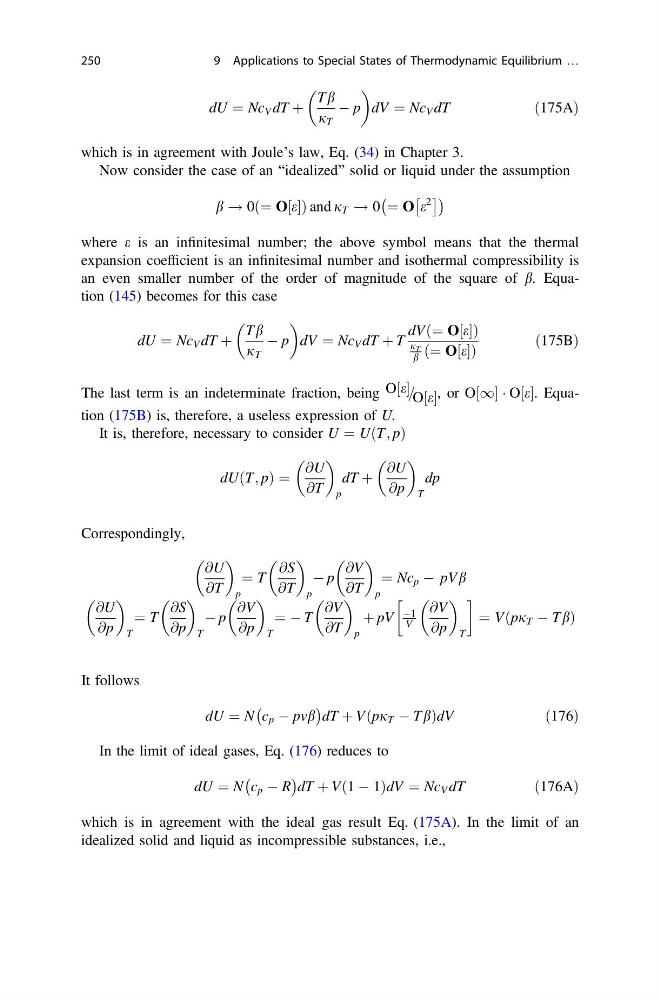
dU ¼ Nc V dT þ
Tb
j T
À p
dV ¼ Nc V dT
ð175AÞ
which is in agreement with Joule’s law, Eq. (34) in Chapter 3.
Now consider the case of an “idealized” solid or liquid under the assumption
b ! 0 ¼ O e
½
ð
Þand j T ! 0 ¼ O e
2
 Ã
À
Á
where e is an infinitesimal number; the above symbol means that the thermal
expansion coefficient is an infinitesimal number and isothermal compressibility is
an even smaller number of the order of magnitude of the square of b. Equation (145) becomes for this case
dU ¼ Nc V dT þ
Tb
j T
À p
dV ¼ Nc V dT þ T
dV ¼ O e
½
ð
Þ
j T
b ¼ O e
½
ð
Þ
ð175BÞ
The last term is an indeterminate fraction, being O½e = O½e , or O½1 Á O½e. Equation (175B) is, therefore, a useless expression of U.
It is, therefore, necessary to consider U ¼ U T; p
ð
Þ
dU T; p
ð
Þ ¼
@U
@T
p
dT þ
@U
@p
T
dp
Correspondingly,
@U
@T
p
¼ T
@S
@T
p
À p
@V
@T
p
¼ Nc p À pVb
@U
@p
T
¼ T
@S
@p
T
À p
@V
@p
T
¼ À T
@V
@T
p
þ pV
À1
V
@V
@p
T
!
¼ V pj T À Tb
ð
Þ
It follows
dU ¼ N c p À pvb
À
Á
dT þ V pj T À Tb
ð
Þ dV
ð176Þ
In the limit of ideal gases, Eq. (176) reduces to
dU ¼ N c p À R
À
Á
dT þ V 1 À 1
ð
ÞdV ¼ Nc V dT
ð176AÞ
which is in agreement with the ideal gas result Eq. (175A). In the limit of an
idealized solid and liquid as incompressible substances, i.e.,
250
9 Applications to Special States of Thermodynamic Equilibrium …
Tb
j T
À p
dV ¼ Nc V dT
ð175AÞ
which is in agreement with Joule’s law, Eq. (34) in Chapter 3.
Now consider the case of an “idealized” solid or liquid under the assumption
b ! 0 ¼ O e
½
ð
Þand j T ! 0 ¼ O e
2
 Ã
À
Á
where e is an infinitesimal number; the above symbol means that the thermal
expansion coefficient is an infinitesimal number and isothermal compressibility is
an even smaller number of the order of magnitude of the square of b. Equation (145) becomes for this case
dU ¼ Nc V dT þ
Tb
j T
À p
dV ¼ Nc V dT þ T
dV ¼ O e
½
ð
Þ
j T
b ¼ O e
½
ð
Þ
ð175BÞ
The last term is an indeterminate fraction, being O½e = O½e , or O½1 Á O½e. Equation (175B) is, therefore, a useless expression of U.
It is, therefore, necessary to consider U ¼ U T; p
ð
Þ
dU T; p
ð
Þ ¼
@U
@T
p
dT þ
@U
@p
T
dp
Correspondingly,
@U
@T
p
¼ T
@S
@T
p
À p
@V
@T
p
¼ Nc p À pVb
@U
@p
T
¼ T
@S
@p
T
À p
@V
@p
T
¼ À T
@V
@T
p
þ pV
À1
V
@V
@p
T
!
¼ V pj T À Tb
ð
Þ
It follows
dU ¼ N c p À pvb
À
Á
dT þ V pj T À Tb
ð
Þ dV
ð176Þ
In the limit of ideal gases, Eq. (176) reduces to
dU ¼ N c p À R
À
Á
dT þ V 1 À 1
ð
ÞdV ¼ Nc V dT
ð176AÞ
which is in agreement with the ideal gas result Eq. (175A). In the limit of an
idealized solid and liquid as incompressible substances, i.e.,
250
9 Applications to Special States of Thermodynamic Equilibrium …