

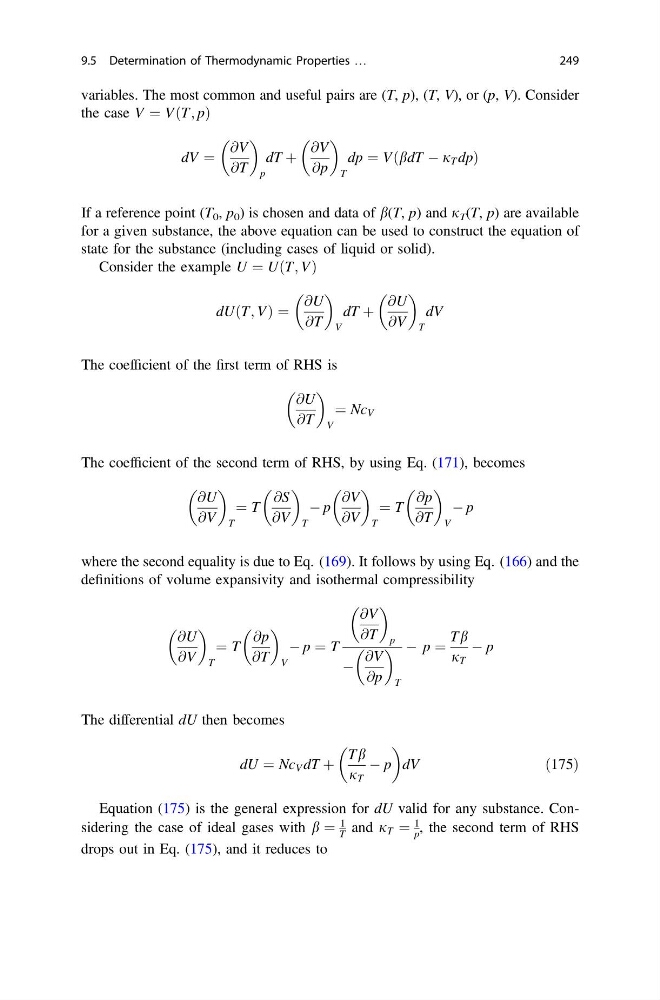
variables. The most common and useful pairs are (T, p), (T, V), or (p, V). Consider
the case V ¼ VðT; pÞ
dV ¼
@V
@T
p
dT þ
@V
@p
T
dp ¼ V bdT À j T dp
ð
Þ
If a reference point (T 0 , p 0 ) is chosen and data of b(T, p) and j T (T, p) are available
for a given substance, the above equation can be used to construct the equation of
state for the substance (including cases of liquid or solid).
Consider the example U ¼ U T; V
ð
Þ
dU T; V
ð
Þ¼
@U
@T
V
dT þ
@U
@V
T
dV
The coefficient of the first term of RHS is
@U
@T
V
¼ Nc V
The coefficient of the second term of RHS, by using Eq. (171), becomes
@U
@V
T
¼ T
@S
@V
T
À p
@V
@V
T
¼ T
@p
@T
V
À p
where the second equality is due to Eq. (169). It follows by using Eq. (166) and the
definitions of volume expansivity and isothermal compressibility
@U
@V
T
¼ T
@p
@T
V
À p ¼ T
@V
@T
p
À
@V
@p
T
À p ¼
Tb
j T
À p
The differential dU then becomes
dU ¼ Nc V dT þ
Tb
j T
À p
dV
ð175Þ
Equation (175) is the general expression for dU valid for any substance. Considering the case of ideal gases with b ¼
1
T and j T ¼
1
p , the second term of RHS
drops out in Eq. (175), and it reduces to
9.5 Determination of Thermodynamic Properties …
249
the case V ¼ VðT; pÞ
dV ¼
@V
@T
p
dT þ
@V
@p
T
dp ¼ V bdT À j T dp
ð
Þ
If a reference point (T 0 , p 0 ) is chosen and data of b(T, p) and j T (T, p) are available
for a given substance, the above equation can be used to construct the equation of
state for the substance (including cases of liquid or solid).
Consider the example U ¼ U T; V
ð
Þ
dU T; V
ð
Þ¼
@U
@T
V
dT þ
@U
@V
T
dV
The coefficient of the first term of RHS is
@U
@T
V
¼ Nc V
The coefficient of the second term of RHS, by using Eq. (171), becomes
@U
@V
T
¼ T
@S
@V
T
À p
@V
@V
T
¼ T
@p
@T
V
À p
where the second equality is due to Eq. (169). It follows by using Eq. (166) and the
definitions of volume expansivity and isothermal compressibility
@U
@V
T
¼ T
@p
@T
V
À p ¼ T
@V
@T
p
À
@V
@p
T
À p ¼
Tb
j T
À p
The differential dU then becomes
dU ¼ Nc V dT þ
Tb
j T
À p
dV
ð175Þ
Equation (175) is the general expression for dU valid for any substance. Considering the case of ideal gases with b ¼
1
T and j T ¼
1
p , the second term of RHS
drops out in Eq. (175), and it reduces to
9.5 Determination of Thermodynamic Properties …
249