

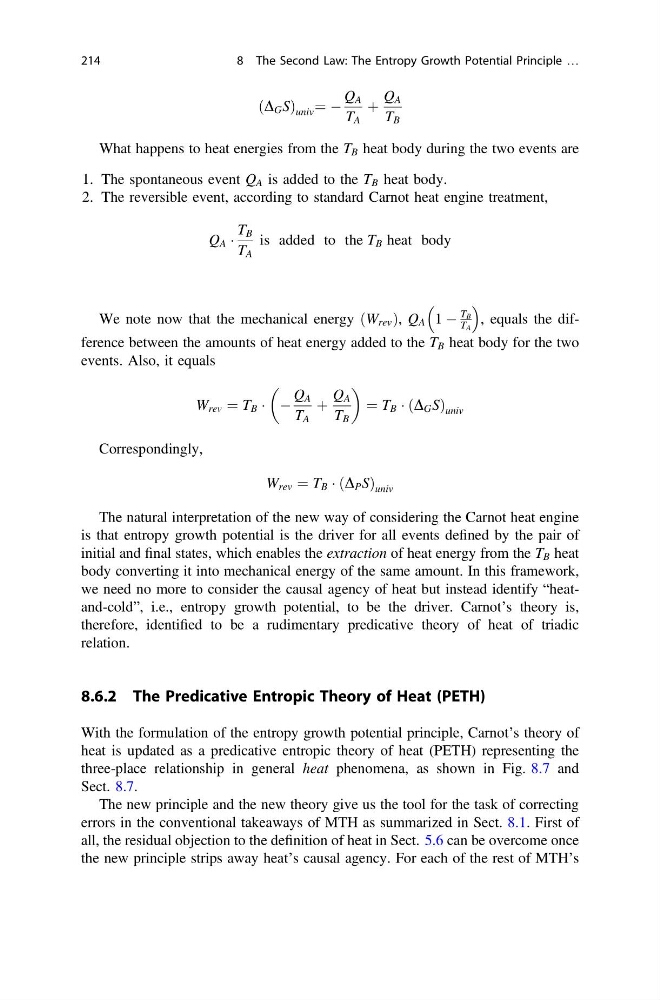
D G S
ð
Þ univ ¼ À
Q A
T A
þ
Q A
T B
What happens to heat energies from the T B heat body during the two events are
1. The spontaneous event Q A is added to the T B heat body.
2. The reversible event, according to standard Carnot heat engine treatment,
Q A Á
T B
T A
is added to the T B heat body
We note now that the mechanical energy W rev
ð
Þ, Q A 1 À
T B
T A
, equals the difference between the amounts of heat energy added to the T B heat body for the two
events. Also, it equals
W rev ¼ T B Á À
Q A
T A
þ
Q A
T B
¼ T B Á D G S
ð
Þ univ
Correspondingly,
W rev ¼ T B Á D P S
ð
Þ univ
The natural interpretation of the new way of considering the Carnot heat engine
is that entropy growth potential is the driver for all events defined by the pair of
initial and final states, which enables the extraction of heat energy from the T B heat
body converting it into mechanical energy of the same amount. In this framework,
we need no more to consider the causal agency of heat but instead identify “heatand-cold”, i.e., entropy growth potential, to be the driver. Carnot’s theory is,
therefore, identified to be a rudimentary predicative theory of heat of triadic
relation.
8.6.2 The Predicative Entropic Theory of Heat (PETH)
With the formulation of the entropy growth potential principle, Carnot’s theory of
heat is updated as a predicative entropic theory of heat (PETH) representing the
three-place relationship in general heat phenomena, as shown in Fig. 8.7 and
Sect. 8.7.
The new principle and the new theory give us the tool for the task of correcting
errors in the conventional takeaways of MTH as summarized in Sect. 8.1. First of
all, the residual objection to the definition of heat in Sect. 5.6 can be overcome once
the new principle strips away heat’s causal agency. For each of the rest of MTH’s
214
8 The Second Law: The Entropy Growth Potential Principle …
ð
Þ univ ¼ À
Q A
T A
þ
Q A
T B
What happens to heat energies from the T B heat body during the two events are
1. The spontaneous event Q A is added to the T B heat body.
2. The reversible event, according to standard Carnot heat engine treatment,
Q A Á
T B
T A
is added to the T B heat body
We note now that the mechanical energy W rev
ð
Þ, Q A 1 À
T B
T A
, equals the difference between the amounts of heat energy added to the T B heat body for the two
events. Also, it equals
W rev ¼ T B Á À
Q A
T A
þ
Q A
T B
¼ T B Á D G S
ð
Þ univ
Correspondingly,
W rev ¼ T B Á D P S
ð
Þ univ
The natural interpretation of the new way of considering the Carnot heat engine
is that entropy growth potential is the driver for all events defined by the pair of
initial and final states, which enables the extraction of heat energy from the T B heat
body converting it into mechanical energy of the same amount. In this framework,
we need no more to consider the causal agency of heat but instead identify “heatand-cold”, i.e., entropy growth potential, to be the driver. Carnot’s theory is,
therefore, identified to be a rudimentary predicative theory of heat of triadic
relation.
8.6.2 The Predicative Entropic Theory of Heat (PETH)
With the formulation of the entropy growth potential principle, Carnot’s theory of
heat is updated as a predicative entropic theory of heat (PETH) representing the
three-place relationship in general heat phenomena, as shown in Fig. 8.7 and
Sect. 8.7.
The new principle and the new theory give us the tool for the task of correcting
errors in the conventional takeaways of MTH as summarized in Sect. 8.1. First of
all, the residual objection to the definition of heat in Sect. 5.6 can be overcome once
the new principle strips away heat’s causal agency. For each of the rest of MTH’s
214
8 The Second Law: The Entropy Growth Potential Principle …