

thermodynamic variables can be defined within every elemental volume of the
system. All thermodynamic relations remain valid for relating local variables, both
intensive variables and molar-based or mass-based specific extensive variables. An
extensive variable of the system is specified by the integrals of local, e.g., molar,
extensive variables. Consider the molar entropy,
s ¼ s T½x; y; z; t; p½x; y; z; t
ð
Þ or s ¼ s T½x; y; z; t; v½x; y; z; t
ð
Þ
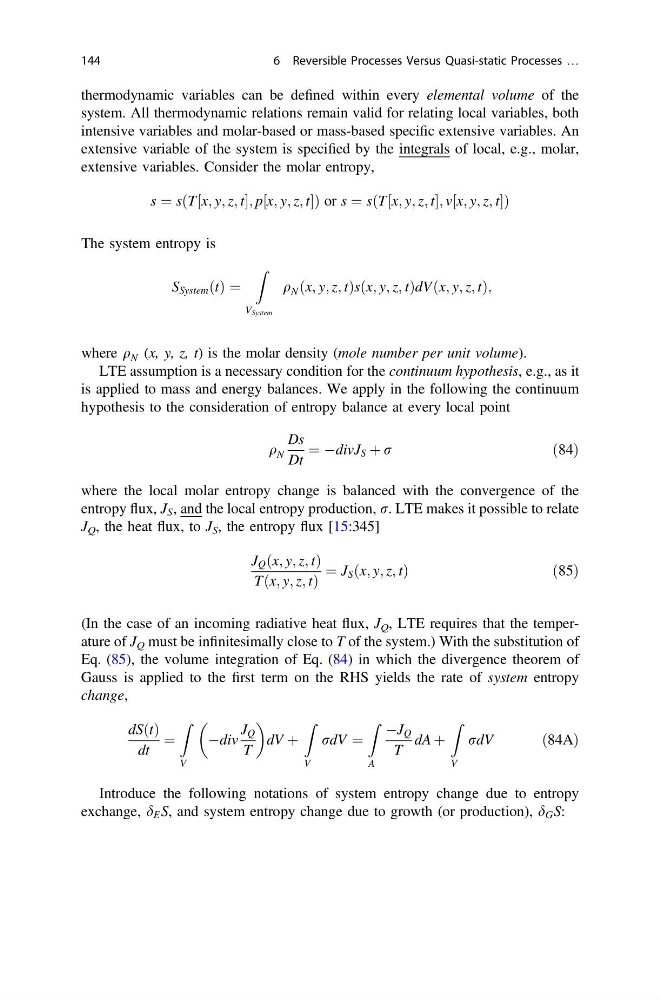
The system entropy is
S System ðtÞ ¼
Z
V System
q N ðx; y; z; tÞsðx; y; z; tÞdVðx; y; z; tÞ;
where q N (x, y, z, t) is the molar density (mole number per unit volume).
LTE assumption is a necessary condition for the continuum hypothesis, e.g., as it
is applied to mass and energy balances. We apply in the following the continuum
hypothesis to the consideration of entropy balance at every local point
q N
Ds
Dt
¼ ÀdivJ S þ r
ð84Þ
where the local molar entropy change is balanced with the convergence of the
entropy flux, J S , and the local entropy production, r. LTE makes it possible to relate
J Q , the heat flux, to J S , the entropy flux [15:345]
J Q ðx; y; z; tÞ
Tðx; y; z; tÞ
¼ J S ðx; y; z; tÞ
ð 85Þ
(In the case of an incoming radiative heat flux, J Q , LTE requires that the temperature of J Q must be infinitesimally close to T of the system.) With the substitution of
Eq. (85), the volume integration of Eq. (84) in which the divergence theorem of
Gauss is applied to the first term on the RHS yields the rate of system entropy
change,
dS t
ð Þ
dt
¼
Z
V
Àdiv
J Q
T
dV þ
Z
V
rdV ¼
Z
A
ÀJ Q
T
dA þ
Z
V
rdV
ð84AÞ
Introduce the following notations of system entropy change due to entropy
exchange, d E S, and system entropy change due to growth (or production), d G S:
144
6 Reversible Processes Versus Quasi-static Processes …
system. All thermodynamic relations remain valid for relating local variables, both
intensive variables and molar-based or mass-based specific extensive variables. An
extensive variable of the system is specified by the integrals of local, e.g., molar,
extensive variables. Consider the molar entropy,
s ¼ s T½x; y; z; t; p½x; y; z; t
ð
Þ or s ¼ s T½x; y; z; t; v½x; y; z; t
ð
Þ
The system entropy is
S System ðtÞ ¼
Z
V System
q N ðx; y; z; tÞsðx; y; z; tÞdVðx; y; z; tÞ;
where q N (x, y, z, t) is the molar density (mole number per unit volume).
LTE assumption is a necessary condition for the continuum hypothesis, e.g., as it
is applied to mass and energy balances. We apply in the following the continuum
hypothesis to the consideration of entropy balance at every local point
q N
Ds
Dt
¼ ÀdivJ S þ r
ð84Þ
where the local molar entropy change is balanced with the convergence of the
entropy flux, J S , and the local entropy production, r. LTE makes it possible to relate
J Q , the heat flux, to J S , the entropy flux [15:345]
J Q ðx; y; z; tÞ
Tðx; y; z; tÞ
¼ J S ðx; y; z; tÞ
ð 85Þ
(In the case of an incoming radiative heat flux, J Q , LTE requires that the temperature of J Q must be infinitesimally close to T of the system.) With the substitution of
Eq. (85), the volume integration of Eq. (84) in which the divergence theorem of
Gauss is applied to the first term on the RHS yields the rate of system entropy
change,
dS t
ð Þ
dt
¼
Z
V
Àdiv
J Q
T
dV þ
Z
V
rdV ¼
Z
A
ÀJ Q
T
dA þ
Z
V
rdV
ð84AÞ
Introduce the following notations of system entropy change due to entropy
exchange, d E S, and system entropy change due to growth (or production), d G S:
144
6 Reversible Processes Versus Quasi-static Processes …