

satisfactorily into thermodynamic theory remained unresolved in both the CKP
approach and the classical formalism approach. The step taken by “modern thermodynamics”—the classical formalism of thermodynamics of Gibbs [10], Carathéodory [3], and Callen [5]—actually represented a step backward by removing
the importance of universal irreversibility’s role in thermodynamic theory [1] and
its corresponding implication in engineering applications.
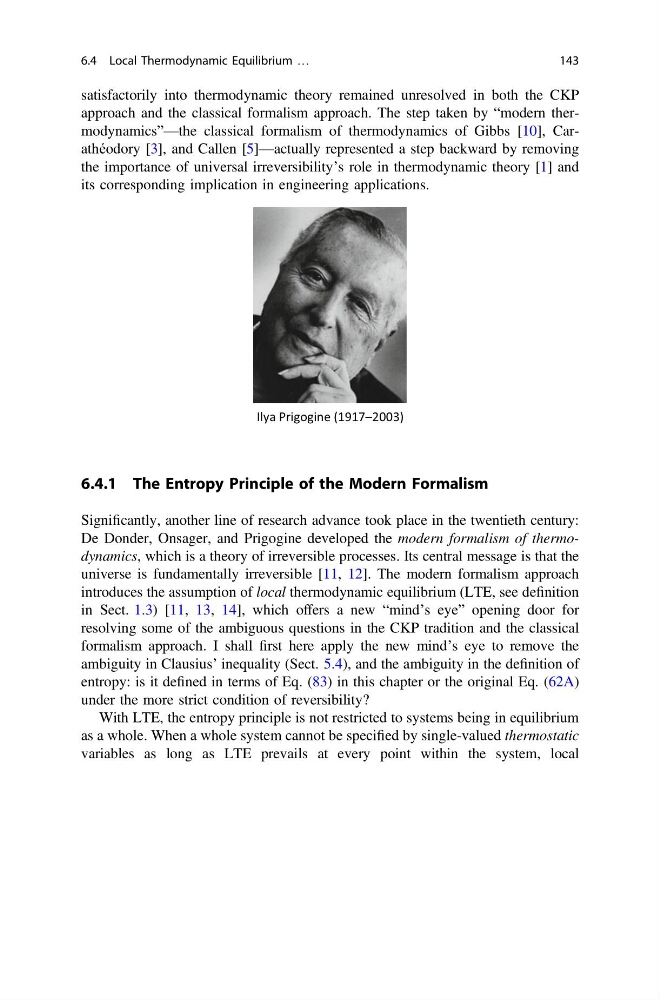
Ilya Prigogine (1917–2003)
6.4.1 The Entropy Principle of the Modern Formalism
Significantly, another line of research advance took place in the twentieth century:
De Donder, Onsager, and Prigogine developed the modern formalism of thermodynamics, which is a theory of irreversible processes. Its central message is that the
universe is fundamentally irreversible [11, 12]. The modern formalism approach
introduces the assumption of local thermodynamic equilibrium (LTE, see definition
in Sect. 1.3) [11, 13, 14], which offers a new “mind’s eye” opening door for
resolving some of the ambiguous questions in the CKP tradition and the classical
formalism approach. I shall first here apply the new mind’s eye to remove the
ambiguity in Clausius’ inequality (Sect. 5.4), and the ambiguity in the definition of
entropy: is it defined in terms of Eq. (83) in this chapter or the original Eq. (62A)
under the more strict condition of reversibility?
With LTE, the entropy principle is not restricted to systems being in equilibrium
as a whole. When a whole system cannot be specified by single-valued thermostatic
variables as long as LTE prevails at every point within the system, local
6.4 Local Thermodynamic Equilibrium …
143
approach and the classical formalism approach. The step taken by “modern thermodynamics”—the classical formalism of thermodynamics of Gibbs [10], Carathéodory [3], and Callen [5]—actually represented a step backward by removing
the importance of universal irreversibility’s role in thermodynamic theory [1] and
its corresponding implication in engineering applications.
Ilya Prigogine (1917–2003)
6.4.1 The Entropy Principle of the Modern Formalism
Significantly, another line of research advance took place in the twentieth century:
De Donder, Onsager, and Prigogine developed the modern formalism of thermodynamics, which is a theory of irreversible processes. Its central message is that the
universe is fundamentally irreversible [11, 12]. The modern formalism approach
introduces the assumption of local thermodynamic equilibrium (LTE, see definition
in Sect. 1.3) [11, 13, 14], which offers a new “mind’s eye” opening door for
resolving some of the ambiguous questions in the CKP tradition and the classical
formalism approach. I shall first here apply the new mind’s eye to remove the
ambiguity in Clausius’ inequality (Sect. 5.4), and the ambiguity in the definition of
entropy: is it defined in terms of Eq. (83) in this chapter or the original Eq. (62A)
under the more strict condition of reversibility?
With LTE, the entropy principle is not restricted to systems being in equilibrium
as a whole. When a whole system cannot be specified by single-valued thermostatic
variables as long as LTE prevails at every point within the system, local
6.4 Local Thermodynamic Equilibrium …
143