

By “quasi-static” he meant, “A process that occurs so slowly that the difference
between the work performed externally and the preceding limit, pdV, is smaller than
the uncertainty of our measurements” [3:238]. A quasi-static process is an infinitely
slow process.
On the same page, however, he added, “a quasistatic adiabatic process can be
regarded as a series of [infinitely dense succession of] equilibrium states” [3:238].
Callen [5:96] also defined quasi-static processes to be “in terms of a dense succession of equilibrium states.” I make the interpretation here that both Carathéodory
and Callen equated infinitely dense processes with infinitely slow processes as
synonymous terms. In the following, a restated version is used for discussion in this
chapter as the definition of QUASI-STATIC PROCESS (QUASI-EQUILIBRIUM PROCESS) set:
The set consists of a subset-series of infinitely dense succession of equilibrium states and
the corresponding subsets of all spontaneous transient states between each pairs of equilibrium states in the series.
The inclusion in the above definition of “transient states” will become clear, the
existence of which in fact was pointed out by Callen in his penetrating but
inconsistent treatment (see below).
Furthermore, Carathéodory added “quasistatic adiabatic processes of a simple
system are ‘reversible’” [3:239]. I shall come back to both issues of whether infinitely dense is the same as infinitely slow (in Sect. 6.3) and whether quasi-static
processes are reversible (in Sect. 6.5). For the purpose of summarizing the rest of
Carathéodory’s reasoning, let us accept for now the crucial assertion of Carathéodory, Born, and in fact almost all physicists with one notable exception, [6]
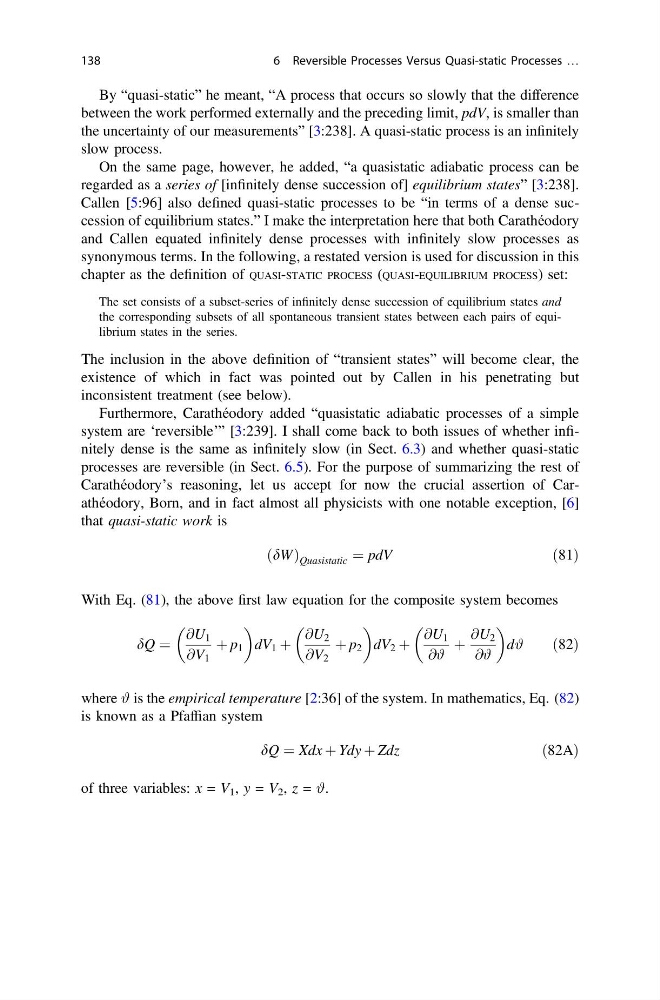
that quasi-static work is
ðdWÞ Quasistatic ¼ pdV
ð81Þ
With Eq. (81), the above first law equation for the composite system becomes
dQ ¼
@U 1
@V 1
þ p 1
dV 1 þ
@U 2
@V 2
þ p 2
dV 2 þ
@U 1
@#
þ
@U 2
@#
d#
ð82Þ
where # is the empirical temperature [2:36] of the system. In mathematics, Eq. (82)
is known as a Pfaffian system
dQ ¼ Xdx þ Ydy þ Zdz
ð82AÞ
of three variables: x = V 1 , y = V 2 , z = #.
138
6 Reversible Processes Versus Quasi-static Processes …
between the work performed externally and the preceding limit, pdV, is smaller than
the uncertainty of our measurements” [3:238]. A quasi-static process is an infinitely
slow process.
On the same page, however, he added, “a quasistatic adiabatic process can be
regarded as a series of [infinitely dense succession of] equilibrium states” [3:238].
Callen [5:96] also defined quasi-static processes to be “in terms of a dense succession of equilibrium states.” I make the interpretation here that both Carathéodory
and Callen equated infinitely dense processes with infinitely slow processes as
synonymous terms. In the following, a restated version is used for discussion in this
chapter as the definition of QUASI-STATIC PROCESS (QUASI-EQUILIBRIUM PROCESS) set:
The set consists of a subset-series of infinitely dense succession of equilibrium states and
the corresponding subsets of all spontaneous transient states between each pairs of equilibrium states in the series.
The inclusion in the above definition of “transient states” will become clear, the
existence of which in fact was pointed out by Callen in his penetrating but
inconsistent treatment (see below).
Furthermore, Carathéodory added “quasistatic adiabatic processes of a simple
system are ‘reversible’” [3:239]. I shall come back to both issues of whether infinitely dense is the same as infinitely slow (in Sect. 6.3) and whether quasi-static
processes are reversible (in Sect. 6.5). For the purpose of summarizing the rest of
Carathéodory’s reasoning, let us accept for now the crucial assertion of Carathéodory, Born, and in fact almost all physicists with one notable exception, [6]
that quasi-static work is
ðdWÞ Quasistatic ¼ pdV
ð81Þ
With Eq. (81), the above first law equation for the composite system becomes
dQ ¼
@U 1
@V 1
þ p 1
dV 1 þ
@U 2
@V 2
þ p 2
dV 2 þ
@U 1
@#
þ
@U 2
@#
d#
ð82Þ
where # is the empirical temperature [2:36] of the system. In mathematics, Eq. (82)
is known as a Pfaffian system
dQ ¼ Xdx þ Ydy þ Zdz
ð82AÞ
of three variables: x = V 1 , y = V 2 , z = #.
138
6 Reversible Processes Versus Quasi-static Processes …