

Gibbsian thermodynamics, by limiting consideration to quasi-equilibrium processes
as “idealized reversible processes”, can serve as the starting point of the theoretical
development toward understanding irreversibility. This limitation does succeed in
achieving a high degree of elegance in Gibbsian thermodynamics as well as making
it highly useful in thermo-physics and physical chemistry (Chap. 9). However, it
will be shown in this chapter that quasi-equilibrium processes, or quasi-static
processes, cannot represent idealized reversible processes, and therefore Gibbsian
thermodynamics cannot be the platform toward understanding irreversibility.
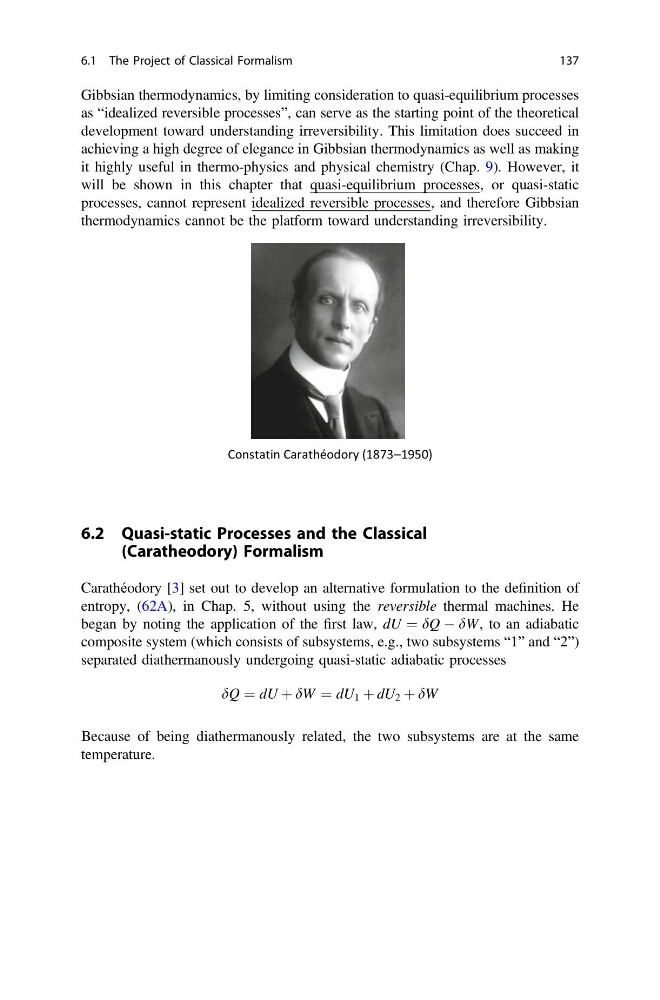
Constatin Carathéodory (1873–1950)
6.2 Quasi-static Processes and the Classical
(Caratheodory) Formalism
Carathéodory [3] set out to develop an alternative formulation to the definition of
entropy, (62A), in Chap. 5, without using the reversible thermal machines. He
began by noting the application of the first law, dU ¼ dQ À dW, to an adiabatic
composite system (which consists of subsystems, e.g., two subsystems “1” and “2”)
separated diathermanously undergoing quasi-static adiabatic processes
dQ ¼ dU þ dW ¼ dU 1 þ dU 2 þ dW
Because of being diathermanously related, the two subsystems are at the same
temperature.
6.1 The Project of Classical Formalism
137
as “idealized reversible processes”, can serve as the starting point of the theoretical
development toward understanding irreversibility. This limitation does succeed in
achieving a high degree of elegance in Gibbsian thermodynamics as well as making
it highly useful in thermo-physics and physical chemistry (Chap. 9). However, it
will be shown in this chapter that quasi-equilibrium processes, or quasi-static
processes, cannot represent idealized reversible processes, and therefore Gibbsian
thermodynamics cannot be the platform toward understanding irreversibility.
Constatin Carathéodory (1873–1950)
6.2 Quasi-static Processes and the Classical
(Caratheodory) Formalism
Carathéodory [3] set out to develop an alternative formulation to the definition of
entropy, (62A), in Chap. 5, without using the reversible thermal machines. He
began by noting the application of the first law, dU ¼ dQ À dW, to an adiabatic
composite system (which consists of subsystems, e.g., two subsystems “1” and “2”)
separated diathermanously undergoing quasi-static adiabatic processes
dQ ¼ dU þ dW ¼ dU 1 þ dU 2 þ dW
Because of being diathermanously related, the two subsystems are at the same
temperature.
6.1 The Project of Classical Formalism
137