

70
Methanol has a low theoretical oxidation potential (0.03 V) comparable to that of
hydrogen (0.00 V), and thus, in principle, it can be an efficient fuel at low temperatures. The mechanism of the CH 3 OH oxidation pathway has been the subject of
numerous research. The general agreement is that in the first step in the oxidation
pathway of methanol at Pt-based catalysts is dissociative adsorption by cleavage of
two C–H bonds, leading to the formation of the intermediate adsorbed formyl species, –CHO ads . On pure Pt, the favored reaction is the fast, spontaneous oxidation to
adsorbed carbon monoxide, –CO ads , which occurs even at low potentials and does
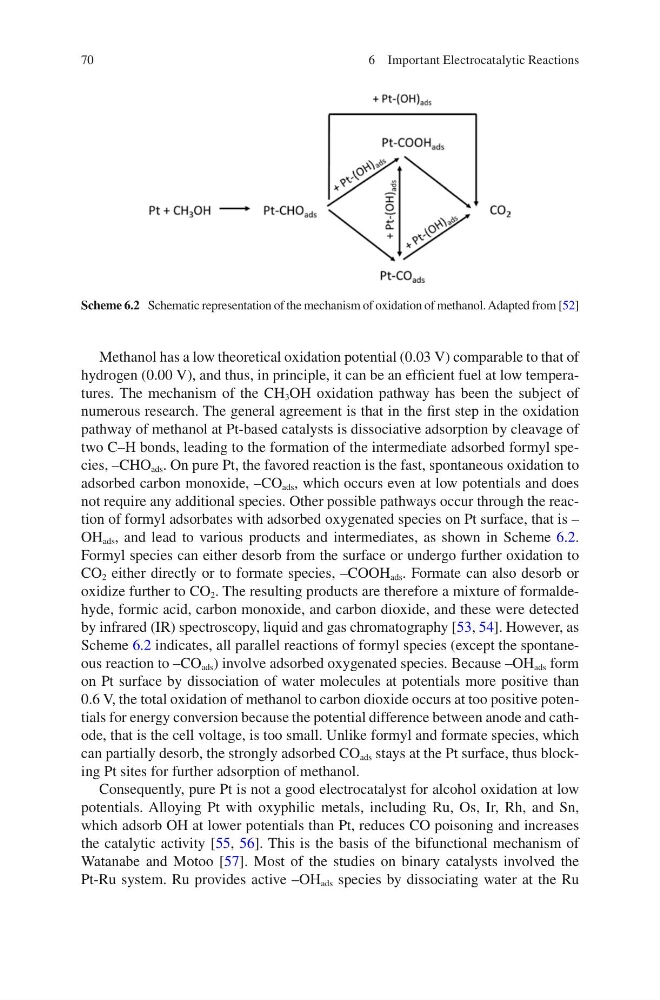
not require any additional species. Other possible pathways occur through the reaction of formyl adsorbates with adsorbed oxygenated species on Pt surface, that is –
OH ads , and lead to various products and intermediates, as shown in Scheme 6.2.
Formyl species can either desorb from the surface or undergo further oxidation to
CO 2 either directly or to formate species, –COOH ads . Formate can also desorb or
oxidize further to CO 2 . The resulting products are therefore a mixture of formaldehyde, formic acid, carbon monoxide, and carbon dioxide, and these were detected
by infrared (IR) spectroscopy, liquid and gas chromatography [53, 54]. However, as
Scheme 6.2 indicates, all parallel reactions of formyl species (except the spontaneous reaction to –CO ads ) involve adsorbed oxygenated species. Because –OH ads form
on Pt surface by dissociation of water molecules at potentials more positive than
0.6 V, the total oxidation of methanol to carbon dioxide occurs at too positive potentials for energy conversion because the potential difference between anode and cathode, that is the cell voltage, is too small. Unlike formyl and formate species, which
can partially desorb, the strongly adsorbed CO ads stays at the Pt surface, thus blocking Pt sites for further adsorption of methanol.
Consequently, pure Pt is not a good electrocatalyst for alcohol oxidation at low
potentials. Alloying Pt with oxyphilic metals, including Ru, Os, Ir, Rh, and Sn,
which adsorb OH at lower potentials than Pt, reduces CO poisoning and increases
the catalytic activity [55, 56]. This is the basis of the bifunctional mechanism of
Watanabe and Motoo [57]. Most of the studies on binary catalysts involved the
Pt-Ru system. Ru provides active –OH ads species by dissociating water at the Ru
Scheme 6.2 Schematic representation of the mechanism of oxidation of methanol. Adapted from [52]
6 Important Electrocatalytic Reactions
Methanol has a low theoretical oxidation potential (0.03 V) comparable to that of
hydrogen (0.00 V), and thus, in principle, it can be an efficient fuel at low temperatures. The mechanism of the CH 3 OH oxidation pathway has been the subject of
numerous research. The general agreement is that in the first step in the oxidation
pathway of methanol at Pt-based catalysts is dissociative adsorption by cleavage of
two C–H bonds, leading to the formation of the intermediate adsorbed formyl species, –CHO ads . On pure Pt, the favored reaction is the fast, spontaneous oxidation to
adsorbed carbon monoxide, –CO ads , which occurs even at low potentials and does
not require any additional species. Other possible pathways occur through the reaction of formyl adsorbates with adsorbed oxygenated species on Pt surface, that is –
OH ads , and lead to various products and intermediates, as shown in Scheme 6.2.
Formyl species can either desorb from the surface or undergo further oxidation to
CO 2 either directly or to formate species, –COOH ads . Formate can also desorb or
oxidize further to CO 2 . The resulting products are therefore a mixture of formaldehyde, formic acid, carbon monoxide, and carbon dioxide, and these were detected
by infrared (IR) spectroscopy, liquid and gas chromatography [53, 54]. However, as
Scheme 6.2 indicates, all parallel reactions of formyl species (except the spontaneous reaction to –CO ads ) involve adsorbed oxygenated species. Because –OH ads form
on Pt surface by dissociation of water molecules at potentials more positive than
0.6 V, the total oxidation of methanol to carbon dioxide occurs at too positive potentials for energy conversion because the potential difference between anode and cathode, that is the cell voltage, is too small. Unlike formyl and formate species, which
can partially desorb, the strongly adsorbed CO ads stays at the Pt surface, thus blocking Pt sites for further adsorption of methanol.
Consequently, pure Pt is not a good electrocatalyst for alcohol oxidation at low
potentials. Alloying Pt with oxyphilic metals, including Ru, Os, Ir, Rh, and Sn,
which adsorb OH at lower potentials than Pt, reduces CO poisoning and increases
the catalytic activity [55, 56]. This is the basis of the bifunctional mechanism of
Watanabe and Motoo [57]. Most of the studies on binary catalysts involved the
Pt-Ru system. Ru provides active –OH ads species by dissociating water at the Ru
Scheme 6.2 Schematic representation of the mechanism of oxidation of methanol. Adapted from [52]
6 Important Electrocatalytic Reactions