

69
been known for their high CO tolerance, and the Pt 3 Sn alloy is one of the most
active surfaces for CO oxidation. However, even better CO tolerance can be obtained
with Pt-Sn nanostructured particles, as it is found that intermetallic systems, and
especially Pt-shell/Sn-core systems, have exceptional tolerance towards CO [48].
An interesting way of designing a catalyst with Pt-shell/3d metal-core by thermal
treatment of their alloys has also shown high activity and good CO tolerance [49].
Even though Pt-based catalysts are still considered to be the most viable for the
HOR anodic reaction in acidic media, the drawback is the price and limiting reserves
of the noble metal. Ultimate reduction in Pt is obtained with Pt submonolayer or
monolayer approach as all Pt atoms participate in the reaction. In addition, the
nanoscale architecture plays a role on reactivity and durability as found in the
contraction in Pt-shell induced by a metal core having a smaller interatomic distance (e.g. Pt/Ru, Pt/Ir), which can considerably alter the performance of the
catalyst.
Efforts to replace Pt with cheaper and more abundant alternatives have so far
failed to produce an efficient catalyst for the HOR in an acidic solution that exceeds
the activity of Pt catalysts. Pd and Ir have much lower activity towards the HOR
than Pt, but alloying Pd with a small amount of Pt can attain the activity of Pt alone
[50]. Diatomic shell layer of Ir on Ni-core was found to have a slightly enhanced
activity of the HOR with respect to a commercial Pt/C catalyst [51], presumably due
to the Ni core-induced contraction in the Ir shell, which suppresses the Ir-OH formation, and the resulting more metallic Ir surface becomes more active for the HOR.
6.4 Methanol Oxidation Reaction
Methanol and ethanol are potential alternatives to hydrogen fuel in PEMFCs since
they have high energy density, can be produced from renewable sources, and have
simple logistics. The interest in direct methanol fuel cells (DMFCs) as power
sources for portable electronic devices and for transportation applications has been
present for decades, and now it is being revived. Methanol is a liquid fuel, thus more
easily handled and stored than hydrogen. It is the simplest alcohol having only one
carbon atom, and its electrocatalysis is also the simplest [52].
The development of PEM facilitates great simplification of DMFC by avoiding
reforming methanol to H 2 with a small amount of CO, which causes a big problem
in using reformate as a fuel. Electrons formed by methanol oxidation at the anode
pass through the external electrical circuit, where they do the work, and flow onto
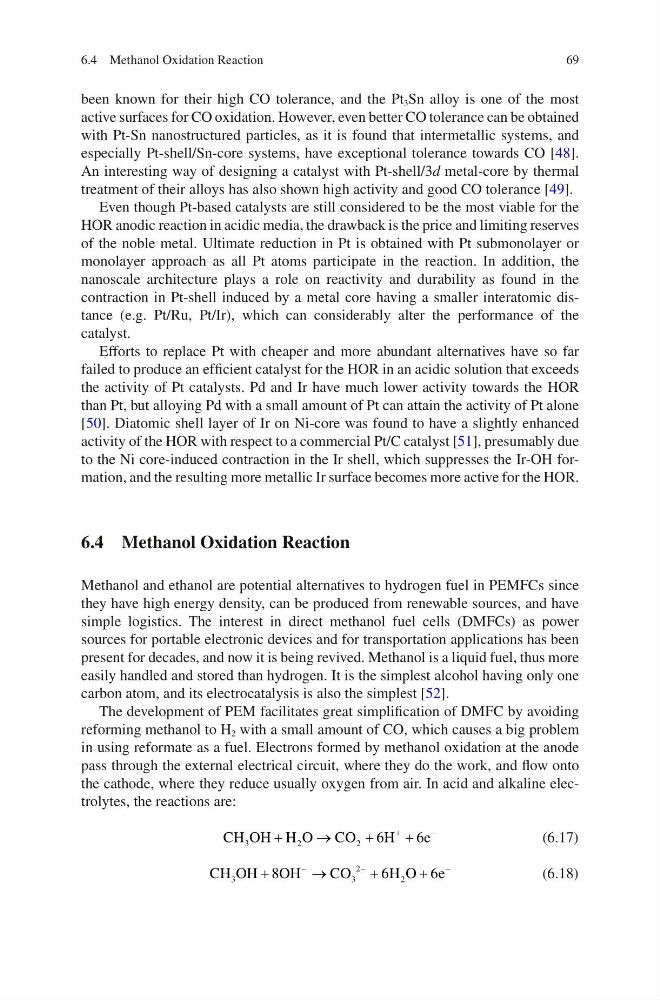
the cathode, where they reduce usually oxygen from air. In acid and alkaline electrolytes, the reactions are:
CH OH H O CO
H
e
3
2
2
6
6
+
→
+
+
+
−
(6.17)
CH OH OH
CO
H O e
3
3
2
2
8
6
6
+
→
+
+
−
−
−
(6.18)
6.4 Methanol Oxidation Reaction
been known for their high CO tolerance, and the Pt 3 Sn alloy is one of the most
active surfaces for CO oxidation. However, even better CO tolerance can be obtained
with Pt-Sn nanostructured particles, as it is found that intermetallic systems, and
especially Pt-shell/Sn-core systems, have exceptional tolerance towards CO [48].
An interesting way of designing a catalyst with Pt-shell/3d metal-core by thermal
treatment of their alloys has also shown high activity and good CO tolerance [49].
Even though Pt-based catalysts are still considered to be the most viable for the
HOR anodic reaction in acidic media, the drawback is the price and limiting reserves
of the noble metal. Ultimate reduction in Pt is obtained with Pt submonolayer or
monolayer approach as all Pt atoms participate in the reaction. In addition, the
nanoscale architecture plays a role on reactivity and durability as found in the
contraction in Pt-shell induced by a metal core having a smaller interatomic distance (e.g. Pt/Ru, Pt/Ir), which can considerably alter the performance of the
catalyst.
Efforts to replace Pt with cheaper and more abundant alternatives have so far
failed to produce an efficient catalyst for the HOR in an acidic solution that exceeds
the activity of Pt catalysts. Pd and Ir have much lower activity towards the HOR
than Pt, but alloying Pd with a small amount of Pt can attain the activity of Pt alone
[50]. Diatomic shell layer of Ir on Ni-core was found to have a slightly enhanced
activity of the HOR with respect to a commercial Pt/C catalyst [51], presumably due
to the Ni core-induced contraction in the Ir shell, which suppresses the Ir-OH formation, and the resulting more metallic Ir surface becomes more active for the HOR.
6.4 Methanol Oxidation Reaction
Methanol and ethanol are potential alternatives to hydrogen fuel in PEMFCs since
they have high energy density, can be produced from renewable sources, and have
simple logistics. The interest in direct methanol fuel cells (DMFCs) as power
sources for portable electronic devices and for transportation applications has been
present for decades, and now it is being revived. Methanol is a liquid fuel, thus more
easily handled and stored than hydrogen. It is the simplest alcohol having only one
carbon atom, and its electrocatalysis is also the simplest [52].
The development of PEM facilitates great simplification of DMFC by avoiding
reforming methanol to H 2 with a small amount of CO, which causes a big problem
in using reformate as a fuel. Electrons formed by methanol oxidation at the anode
pass through the external electrical circuit, where they do the work, and flow onto
the cathode, where they reduce usually oxygen from air. In acid and alkaline electrolytes, the reactions are:
CH OH H O CO
H
e
3
2
2
6
6
+
→
+
+
+
−
(6.17)
CH OH OH
CO
H O e
3
3
2
2
8
6
6
+
→
+
+
−
−
−
(6.18)
6.4 Methanol Oxidation Reaction