

50
they also have practical significance in promoting sorption of H into some metals,
altering selectivity for some hydrogenation reactions. Corrosion inhibition is possible when O 2 reduction is not enhanced by metal adlayers.
For Pt, the inhibion has been ascribed to geometric blocking, decrease in the
number of pairs of uncovered Pt atoms, which decreases the recombination reaction, and a change of electronic states of uncovered Pt atoms. For several Pt/M ad
systems, considerable H 2 evolution takes place when the UPD of H is completely
blocked. This provides an additional proof that there is no connection between the
UPD H and the intermediates in H 2 evolution. Pb, Tl, and Cd at small coverages
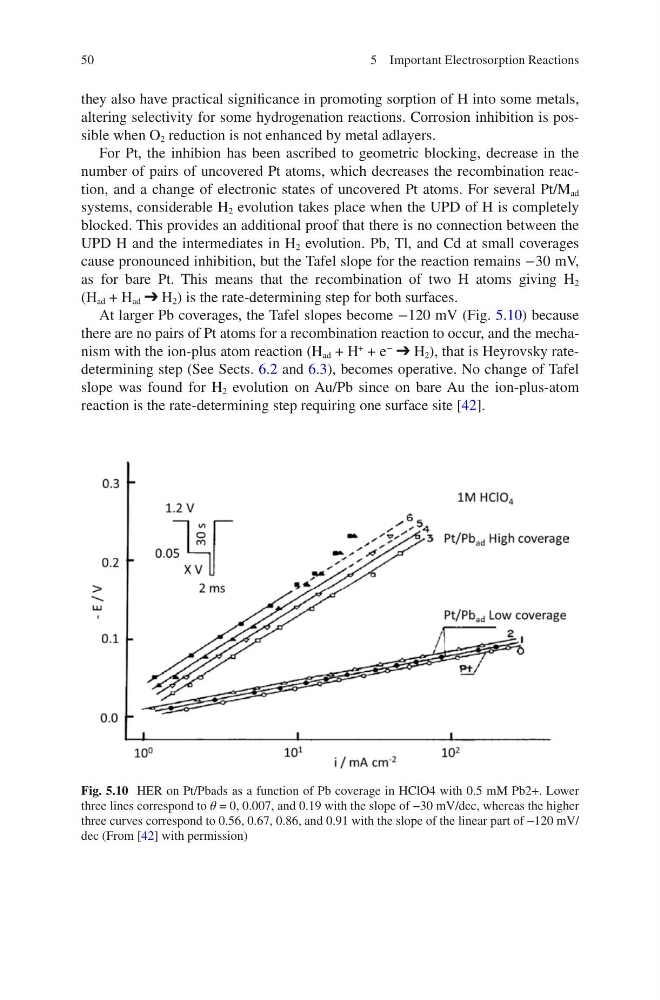
cause pronounced inhibition, but the Tafel slope for the reaction remains −30 mV,
as for bare Pt. This means that the recombination of two H atoms giving H 2
(H ad + H ad ➔ H 2 ) is the rate-determining step for both surfaces.
At larger Pb coverages, the Tafel slopes become −120 mV (Fig. 5.10) because
there are no pairs of Pt atoms for a recombination reaction to occur, and the mechanism with the ion-plus atom reaction (H ad + H
+
+ e
−
➔ H 2 ), that is Heyrovsky ratedetermining step (See Sects. 6.2 and 6.3), becomes operative. No change of Tafel
slope was found for H 2 evolution on Au/Pb since on bare Au the ion-plus-atom
reaction is the rate- determining step requiring one surface site [42].
Fig. 5.10 HER on Pt/Pbads as a function of Pb coverage in HClO4 with 0.5 mM Pb2+. Lower
three lines correspond to θ = 0, 0.007, and 0.19 with the slope of −30 mV/dec, whereas the higher
three curves correspond to 0.56, 0.67, 0.86, and 0.91 with the slope of the linear part of −120 mV/
dec (From [42] with permission)
5 Important Electrosorption Reactions
they also have practical significance in promoting sorption of H into some metals,
altering selectivity for some hydrogenation reactions. Corrosion inhibition is possible when O 2 reduction is not enhanced by metal adlayers.
For Pt, the inhibion has been ascribed to geometric blocking, decrease in the
number of pairs of uncovered Pt atoms, which decreases the recombination reaction, and a change of electronic states of uncovered Pt atoms. For several Pt/M ad
systems, considerable H 2 evolution takes place when the UPD of H is completely
blocked. This provides an additional proof that there is no connection between the
UPD H and the intermediates in H 2 evolution. Pb, Tl, and Cd at small coverages
cause pronounced inhibition, but the Tafel slope for the reaction remains −30 mV,
as for bare Pt. This means that the recombination of two H atoms giving H 2
(H ad + H ad ➔ H 2 ) is the rate-determining step for both surfaces.
At larger Pb coverages, the Tafel slopes become −120 mV (Fig. 5.10) because
there are no pairs of Pt atoms for a recombination reaction to occur, and the mechanism with the ion-plus atom reaction (H ad + H
+
+ e
−
➔ H 2 ), that is Heyrovsky ratedetermining step (See Sects. 6.2 and 6.3), becomes operative. No change of Tafel
slope was found for H 2 evolution on Au/Pb since on bare Au the ion-plus-atom
reaction is the rate- determining step requiring one surface site [42].
Fig. 5.10 HER on Pt/Pbads as a function of Pb coverage in HClO4 with 0.5 mM Pb2+. Lower
three lines correspond to θ = 0, 0.007, and 0.19 with the slope of −30 mV/dec, whereas the higher
three curves correspond to 0.56, 0.67, 0.86, and 0.91 with the slope of the linear part of −120 mV/
dec (From [42] with permission)
5 Important Electrosorption Reactions