

49
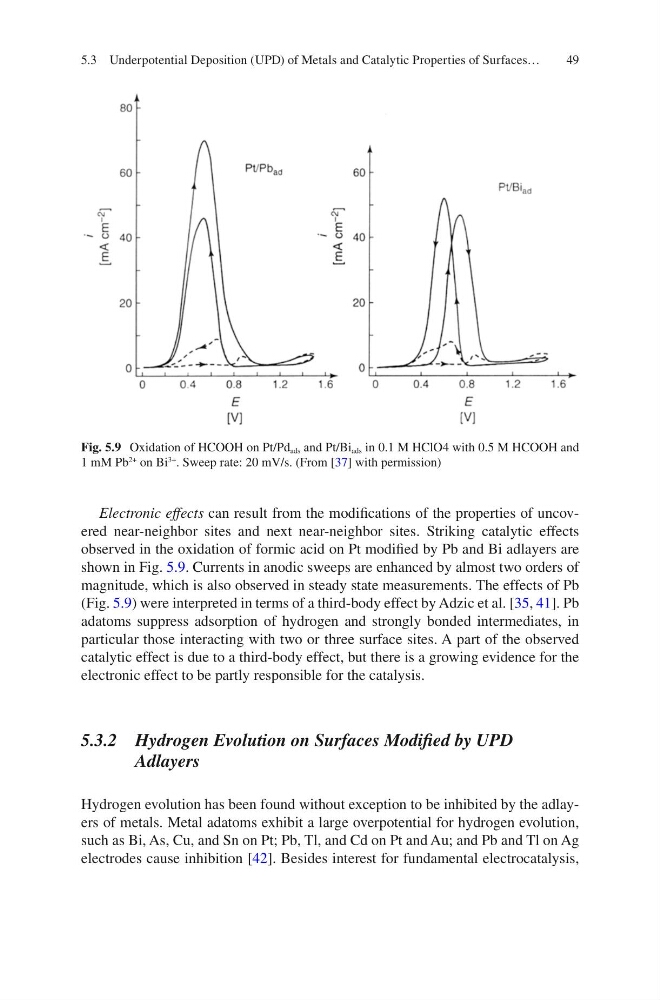
Electronic effects can result from the modifications of the properties of uncovered near-neighbor sites and next near-neighbor sites. Striking catalytic effects
observed in the oxidation of formic acid on Pt modified by Pb and Bi adlayers are
shown in Fig. 5.9. Currents in anodic sweeps are enhanced by almost two orders of
magnitude, which is also observed in steady state measurements. The effects of Pb
(Fig. 5.9) were interpreted in terms of a third-body effect by Adzic et al. [35, 41]. Pb
adatoms suppress adsorption of hydrogen and strongly bonded intermediates, in
particular those interacting with two or three surface sites. A part of the observed
catalytic effect is due to a third-body effect, but there is a growing evidence for the
electronic effect to be partly responsible for the catalysis.
5.3.2 Hydrogen Evolution on Surfaces Modified by UPD
Adlayers
Hydrogen evolution has been found without exception to be inhibited by the adlayers of metals. Metal adatoms exhibit a large overpotential for hydrogen evolution,
such as Bi, As, Cu, and Sn on Pt; Pb, Tl, and Cd on Pt and Au; and Pb and Tl on Ag
electrodes cause inhibition [42]. Besides interest for fundamental electrocatalysis,
Fig. 5.9 Oxidation of HCOOH on Pt/Pd ads and Pt/Bi ads in 0.1 M HClO4 with 0.5 M HCOOH and
1 mM Pb
2+ on Bi
3+
. Sweep rate: 20 mV/s. (From [37] with permission)
5.3 Underpotential Deposition (UPD) of Metals and Catalytic Properties of Surfaces…
Electronic effects can result from the modifications of the properties of uncovered near-neighbor sites and next near-neighbor sites. Striking catalytic effects
observed in the oxidation of formic acid on Pt modified by Pb and Bi adlayers are
shown in Fig. 5.9. Currents in anodic sweeps are enhanced by almost two orders of
magnitude, which is also observed in steady state measurements. The effects of Pb
(Fig. 5.9) were interpreted in terms of a third-body effect by Adzic et al. [35, 41]. Pb
adatoms suppress adsorption of hydrogen and strongly bonded intermediates, in
particular those interacting with two or three surface sites. A part of the observed
catalytic effect is due to a third-body effect, but there is a growing evidence for the
electronic effect to be partly responsible for the catalysis.
5.3.2 Hydrogen Evolution on Surfaces Modified by UPD
Adlayers
Hydrogen evolution has been found without exception to be inhibited by the adlayers of metals. Metal adatoms exhibit a large overpotential for hydrogen evolution,
such as Bi, As, Cu, and Sn on Pt; Pb, Tl, and Cd on Pt and Au; and Pb and Tl on Ag
electrodes cause inhibition [42]. Besides interest for fundamental electrocatalysis,
Fig. 5.9 Oxidation of HCOOH on Pt/Pd ads and Pt/Bi ads in 0.1 M HClO4 with 0.5 M HCOOH and
1 mM Pb
2+ on Bi
3+
. Sweep rate: 20 mV/s. (From [37] with permission)
5.3 Underpotential Deposition (UPD) of Metals and Catalytic Properties of Surfaces…