

43
In the electrodeposition of metals onto foreign metal substrates, for example Pb
on Pt, the formation of a monolayer of metal may take place at potentials more positive than the potential required for the reversible deposition. This occurrence of
UPD implies that the chemical potential of the adatoms deposited in the UPD layer
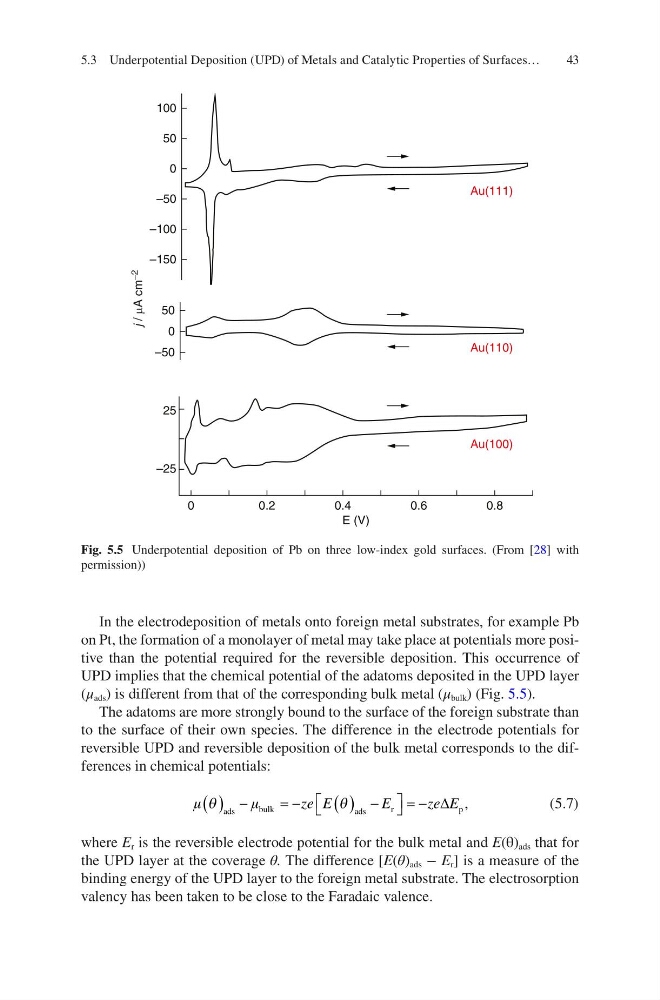
(μ ads ) is different from that of the corresponding bulk metal (μ bulk ) (Fig. 5.5).
The adatoms are more strongly bound to the surface of the foreign substrate than
to the surface of their own species. The difference in the electrode potentials for
reversible UPD and reversible deposition of the bulk metal corresponds to the differences in chemical potentials:
µ
µ
ze E
E
ze E
θ
θ
( ) −
=−
( ) −
= −
ads
bulk
ads
r
p
∆ ,
(5.7)
where E r is the reversible electrode potential for the bulk metal and E(θ) ads that for
the UPD layer at the coverage θ. The difference [E(θ) ads − E r ] is a measure of the
binding energy of the UPD layer to the foreign metal substrate. The electrosorption
valency has been taken to be close to the Faradaic valence.
100
50
0
–50
50
0
–50
25
–25
–100
–150
0
0.2
0.4
0.6
0.8
E (V)
j / µA
cm –2
Au(111)
Au(110)
Au(100)
Fig. 5.5 Underpotential deposition of Pb on three low-index gold surfaces. (From [28] with
permission))
5.3 Underpotential Deposition (UPD) of Metals and Catalytic Properties of Surfaces…
In the electrodeposition of metals onto foreign metal substrates, for example Pb
on Pt, the formation of a monolayer of metal may take place at potentials more positive than the potential required for the reversible deposition. This occurrence of
UPD implies that the chemical potential of the adatoms deposited in the UPD layer
(μ ads ) is different from that of the corresponding bulk metal (μ bulk ) (Fig. 5.5).
The adatoms are more strongly bound to the surface of the foreign substrate than
to the surface of their own species. The difference in the electrode potentials for
reversible UPD and reversible deposition of the bulk metal corresponds to the differences in chemical potentials:
µ
µ
ze E
E
ze E
θ
θ
( ) −
=−
( ) −
= −
ads
bulk
ads
r
p
∆ ,
(5.7)
where E r is the reversible electrode potential for the bulk metal and E(θ) ads that for
the UPD layer at the coverage θ. The difference [E(θ) ads − E r ] is a measure of the
binding energy of the UPD layer to the foreign metal substrate. The electrosorption
valency has been taken to be close to the Faradaic valence.
100
50
0
–50
50
0
–50
25
–25
–100
–150
0
0.2
0.4
0.6
0.8
E (V)
j / µA
cm –2
Au(111)
Au(110)
Au(100)
Fig. 5.5 Underpotential deposition of Pb on three low-index gold surfaces. (From [28] with
permission))
5.3 Underpotential Deposition (UPD) of Metals and Catalytic Properties of Surfaces…