

42
5.3 Underpotential Deposition (UPD) of Metals and
Catalytic Properties of Surfaces Modified by Metal
Adlayers
The underpotential deposition of metals on foreign metal substrates is an interesting
topic, which initially attracted limited attention. That was reversed with advances in
surface electrochemistry and surface methodologies. It has been observed, but not
understood, in radio-tracers experiment as an activity remaining at the electrode at
potentials positive to bulk metal dissolution [26]. In the late 1940s, some cations
undergoing UPD were used as the addition to plating baths to produce brightening
effects. With the discovery of organic brighteners, the interest was lost. In the 1970s,
using cyclic voltammetry and reflectance spectroscopy techniques, more information was gathered and the large increase of the interest for UPD followed the study
on single-crystal electrodes showing pronounced structural effects [27]. Further
studies demonstrated important catalytic effects on several key catalytic reactions
that caused a new increase of interest, which remains unabated till today [28].
0.1M NaOH
0.1M H 2 SO 4
0.1M H 2 SO 4 + 0.1M Na 2 CO 3
Pt (332)
50
0
–50
0
0.2
0.4
0.5
0.8 E/V
j / µA
cm
–2
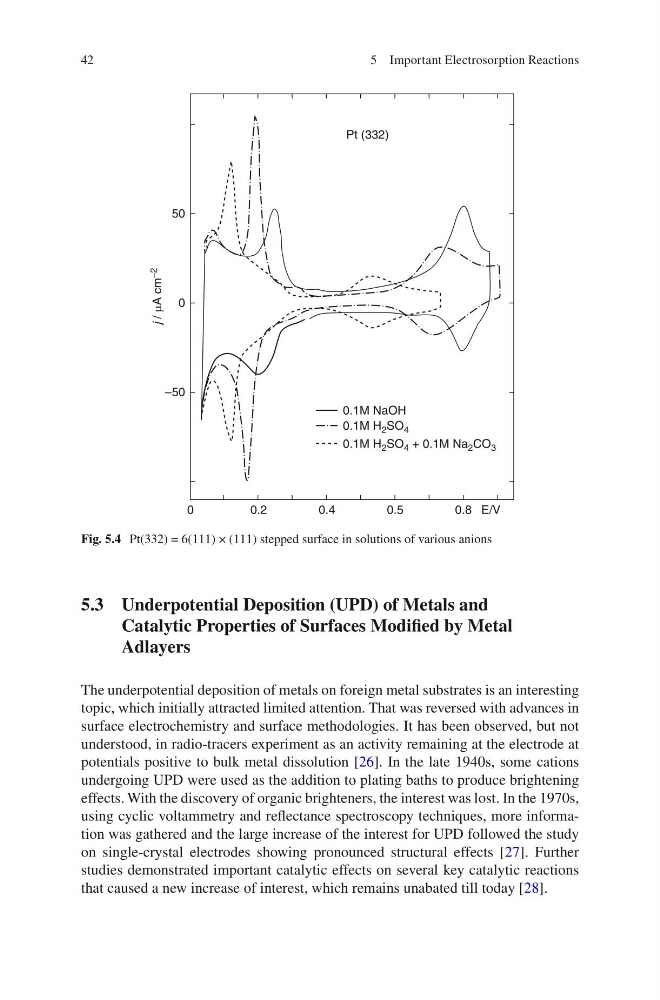
Fig. 5.4 Pt(332) = 6(111) × (111) stepped surface in solutions of various anions
5 Important Electrosorption Reactions
5.3 Underpotential Deposition (UPD) of Metals and
Catalytic Properties of Surfaces Modified by Metal
Adlayers
The underpotential deposition of metals on foreign metal substrates is an interesting
topic, which initially attracted limited attention. That was reversed with advances in
surface electrochemistry and surface methodologies. It has been observed, but not
understood, in radio-tracers experiment as an activity remaining at the electrode at
potentials positive to bulk metal dissolution [26]. In the late 1940s, some cations
undergoing UPD were used as the addition to plating baths to produce brightening
effects. With the discovery of organic brighteners, the interest was lost. In the 1970s,
using cyclic voltammetry and reflectance spectroscopy techniques, more information was gathered and the large increase of the interest for UPD followed the study
on single-crystal electrodes showing pronounced structural effects [27]. Further
studies demonstrated important catalytic effects on several key catalytic reactions
that caused a new increase of interest, which remains unabated till today [28].
0.1M NaOH
0.1M H 2 SO 4
0.1M H 2 SO 4 + 0.1M Na 2 CO 3
Pt (332)
50
0
–50
0
0.2
0.4
0.5
0.8 E/V
j / µA
cm
–2
Fig. 5.4 Pt(332) = 6(111) × (111) stepped surface in solutions of various anions
5 Important Electrosorption Reactions