

36
Electrochemical process of hydrogen adsorption is different from that in gas
phase as hydrogen exists as a cation in acidic solution (hydronium ion, H 3 O
+
) or
within a molecule of water that adsorbs on the surface in basic solutions. It was
shown that the hydronium ion is further stabilized by hydration with another three
water molecules [2]. Upon establishing electric field, the hydrated hydronium ion
travels towards the cathode, where it is discharged, and adsorbs at the metallic surface. It is shown that this process can proceed in a potential region positive to the
standard potential of the H
+
/H 2 redox couple (0.00 V) for certain transition metals
of the platinum group, namely Pt, Pd, Rh, and Ir. The phenomenon of hydrogen
adsorption is similar in nature to underpotential deposition (UPD) of metallic cations on the substrate of another metal, which is known to occur if the interaction of
the electrodepositing metal M with the substrate (M–S) is energetically favorable in
comparison to the M–M interaction in the crystal lattice of the pure metal M [3].
The preparation of polycrystalline surfaces of platinum in aqueous solutions was
initially done by cycling the potential of the Pt surface between the onsets of hydrogen and oxygen evolutions (0.00 and 1.23 V, respectively) as the oxygen-containing
species adsorbed on the Pt electrode easily oxidize organic impurities. However, it
was found that the potential cycling produces surface roughness at the platinum
electrode as the diatomic Pt-O formed during the anodic scan can invert upon
reversing the potential cathodically, producing O-Pt. Preparation in ultrahigh vacuum experienced problems with cleanliness of the single-crystal surface during the
consequent transfer into an electrochemical cell through air. Newer methods for
obtaining a clean and atomically flat Pt surface were introduced from 1980, as
described in Sect. 4.3.
Although the complete understanding of the H adsorption process (or H UPD ) is
still lacking, it is known that the adsorbed hydrogen does not participate in the process of hydrogen evolution reaction (HER), which means that the hydrogen
60
40
0
–30
–60
–90
0.0
0.2
0.4
0.6
0.8
1.0
1.2
1.4
1.6
j / µA
cm
–2
E (vs. RHE) / V
H UPD adsorption
H UPD desorption
PtO formation
PtO reduction
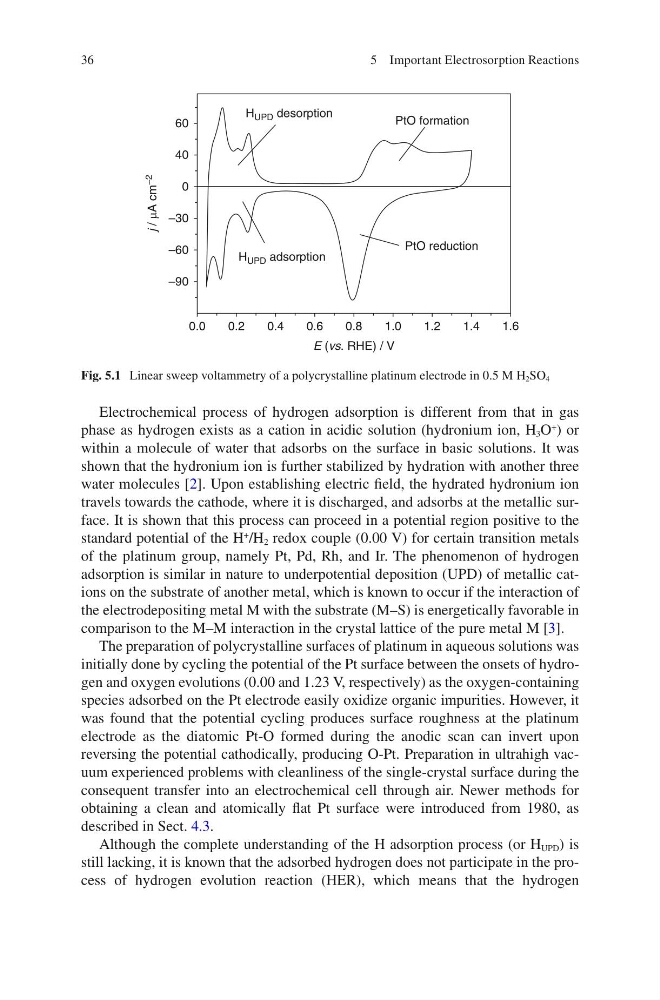
Fig. 5.1 Linear sweep voltammetry of a polycrystalline platinum electrode in 0.5 M H 2 SO 4
5 Important Electrosorption Reactions
Electrochemical process of hydrogen adsorption is different from that in gas
phase as hydrogen exists as a cation in acidic solution (hydronium ion, H 3 O
+
) or
within a molecule of water that adsorbs on the surface in basic solutions. It was
shown that the hydronium ion is further stabilized by hydration with another three
water molecules [2]. Upon establishing electric field, the hydrated hydronium ion
travels towards the cathode, where it is discharged, and adsorbs at the metallic surface. It is shown that this process can proceed in a potential region positive to the
standard potential of the H
+
/H 2 redox couple (0.00 V) for certain transition metals
of the platinum group, namely Pt, Pd, Rh, and Ir. The phenomenon of hydrogen
adsorption is similar in nature to underpotential deposition (UPD) of metallic cations on the substrate of another metal, which is known to occur if the interaction of
the electrodepositing metal M with the substrate (M–S) is energetically favorable in
comparison to the M–M interaction in the crystal lattice of the pure metal M [3].
The preparation of polycrystalline surfaces of platinum in aqueous solutions was
initially done by cycling the potential of the Pt surface between the onsets of hydrogen and oxygen evolutions (0.00 and 1.23 V, respectively) as the oxygen-containing
species adsorbed on the Pt electrode easily oxidize organic impurities. However, it
was found that the potential cycling produces surface roughness at the platinum
electrode as the diatomic Pt-O formed during the anodic scan can invert upon
reversing the potential cathodically, producing O-Pt. Preparation in ultrahigh vacuum experienced problems with cleanliness of the single-crystal surface during the
consequent transfer into an electrochemical cell through air. Newer methods for
obtaining a clean and atomically flat Pt surface were introduced from 1980, as
described in Sect. 4.3.
Although the complete understanding of the H adsorption process (or H UPD ) is
still lacking, it is known that the adsorbed hydrogen does not participate in the process of hydrogen evolution reaction (HER), which means that the hydrogen
60
40
0
–30
–60
–90
0.0
0.2
0.4
0.6
0.8
1.0
1.2
1.4
1.6
j / µA
cm
–2
E (vs. RHE) / V
H UPD adsorption
H UPD desorption
PtO formation
PtO reduction
Fig. 5.1 Linear sweep voltammetry of a polycrystalline platinum electrode in 0.5 M H 2 SO 4
5 Important Electrosorption Reactions