

148
producing these adsorbates. On the other hand, a surface with a lower- lying ε d tends
to bind adsorbates more weakly and facilitates the formation of bonds towards
larger intermediates. The Pt ML on Pd is compressed, but the position of the ε d for the
Pt ML depends both on the strain (geometric effects) and on the electronic interaction
between the Pt ML and its substrate (ligand effect) [6]. Introducing subsurface Ir
causes a small contraction of the Pd surface layer due to the smaller atomic size of
Ir compared to Pd. As a consequence, the Pt ML put on top of the Pd surface covering
the PdIr subsurface will be further compressed, causing an additional downshift in
ε d , which is manifested by a weaker Pt–OH interaction, leading to the reduced oxidation of this ternary system. Since the intrinsic ORR activity is largely determined
by the binding energy of OH, weaker Pt–OH interaction should result in enhanced
ORR activity. To directly demonstrate the destabilization of OH on Pt ML PdIr (as
compared to Pt ML Pd or Pt), density functional theory calculations were performed
on representative close-packed (111) facets of the appropriate model systems. The
calculations show that depositing a monolayer of Pt on a Pd substrate destabilizes
OH binding.
8.4.3 Reducing the Number of Low-Coordination Sites
on Cores
The Pd(111) surface is the best support for Pt monolayer possessing an oxygen
binding energy close to the optimum value. The Pd nanoparticle, however, exhibits
a considerable drawback in removing of OH species from the surface due to the
existence of considerable amount of low-coordination sites, edges, defects, adatoms,
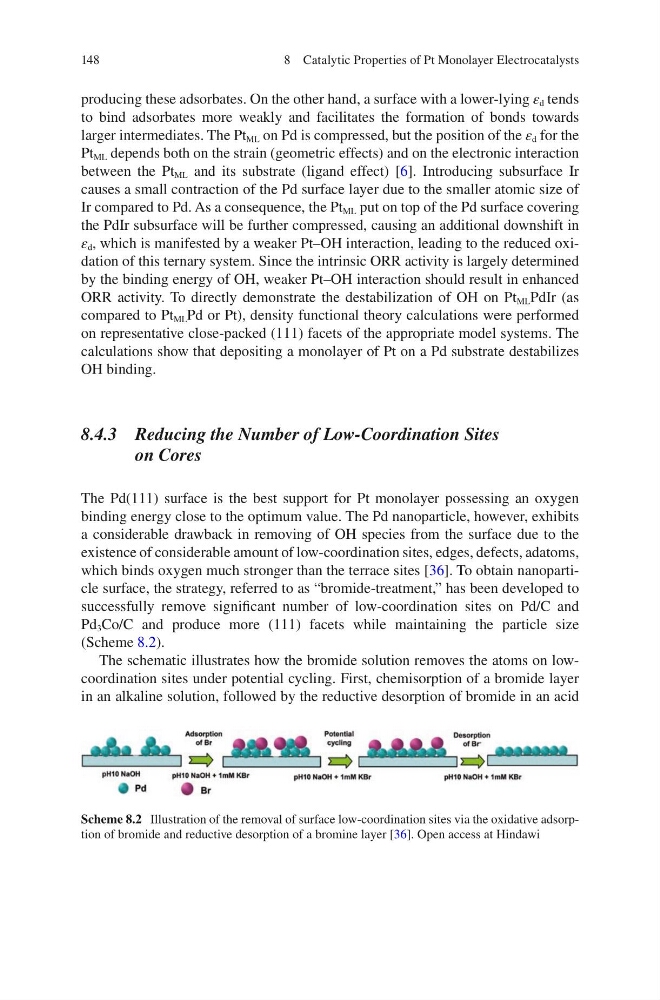
which binds oxygen much stronger than the terrace sites [36]. To obtain nanoparticle surface, the strategy, referred to as “bromide-treatment,” has been developed to
successfully remove significant number of low-coordination sites on Pd/C and
Pd 3 Co/C and produce more (111) facets while maintaining the particle size
(Scheme 8.2).
The schematic illustrates how the bromide solution removes the atoms on lowcoordination sites under potential cycling. First, chemisorption of a bromide layer
in an alkaline solution, followed by the reductive desorption of bromide in an acid
Scheme 8.2 Illustration of the removal of surface low-coordination sites via the oxidative adsorption of bromide and reductive desorption of a bromine layer [36]. Open access at Hindawi
8 Catalytic Properties of Pt Monolayer Electrocatalysts
producing these adsorbates. On the other hand, a surface with a lower- lying ε d tends
to bind adsorbates more weakly and facilitates the formation of bonds towards
larger intermediates. The Pt ML on Pd is compressed, but the position of the ε d for the
Pt ML depends both on the strain (geometric effects) and on the electronic interaction
between the Pt ML and its substrate (ligand effect) [6]. Introducing subsurface Ir
causes a small contraction of the Pd surface layer due to the smaller atomic size of
Ir compared to Pd. As a consequence, the Pt ML put on top of the Pd surface covering
the PdIr subsurface will be further compressed, causing an additional downshift in
ε d , which is manifested by a weaker Pt–OH interaction, leading to the reduced oxidation of this ternary system. Since the intrinsic ORR activity is largely determined
by the binding energy of OH, weaker Pt–OH interaction should result in enhanced
ORR activity. To directly demonstrate the destabilization of OH on Pt ML PdIr (as
compared to Pt ML Pd or Pt), density functional theory calculations were performed
on representative close-packed (111) facets of the appropriate model systems. The
calculations show that depositing a monolayer of Pt on a Pd substrate destabilizes
OH binding.
8.4.3 Reducing the Number of Low-Coordination Sites
on Cores
The Pd(111) surface is the best support for Pt monolayer possessing an oxygen
binding energy close to the optimum value. The Pd nanoparticle, however, exhibits
a considerable drawback in removing of OH species from the surface due to the
existence of considerable amount of low-coordination sites, edges, defects, adatoms,
which binds oxygen much stronger than the terrace sites [36]. To obtain nanoparticle surface, the strategy, referred to as “bromide-treatment,” has been developed to
successfully remove significant number of low-coordination sites on Pd/C and
Pd 3 Co/C and produce more (111) facets while maintaining the particle size
(Scheme 8.2).
The schematic illustrates how the bromide solution removes the atoms on lowcoordination sites under potential cycling. First, chemisorption of a bromide layer
in an alkaline solution, followed by the reductive desorption of bromide in an acid
Scheme 8.2 Illustration of the removal of surface low-coordination sites via the oxidative adsorption of bromide and reductive desorption of a bromine layer [36]. Open access at Hindawi
8 Catalytic Properties of Pt Monolayer Electrocatalysts