

137
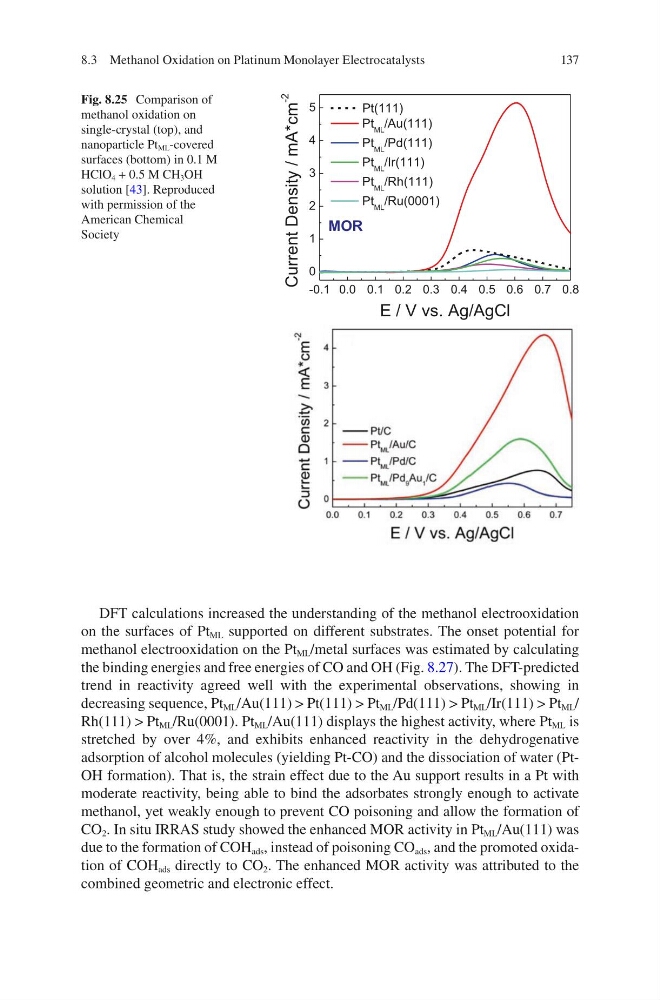
DFT calculations increased the understanding of the methanol electrooxidation
on the surfaces of Pt ML supported on different substrates. The onset potential for
methanol electrooxidation on the Pt ML /metal surfaces was estimated by calculating
the binding energies and free energies of CO and OH (Fig. 8.27). The DFT-predicted
trend in reactivity agreed well with the experimental observations, showing in
decreasing sequence, Pt ML /Au(111) > Pt(111) > Pt ML /Pd(111) > Pt ML /Ir(111) > Pt ML /
Rh(111) > Pt ML /Ru(0001). Pt ML /Au(111) displays the highest activity, where Pt ML is
stretched by over 4%, and exhibits enhanced reactivity in the dehydrogenative
adsorption of alcohol molecules (yielding Pt-CO) and the dissociation of water (PtOH formation). That is, the strain effect due to the Au support results in a Pt with
moderate reactivity, being able to bind the adsorbates strongly enough to activate
methanol, yet weakly enough to prevent CO poisoning and allow the formation of
CO 2 . In situ IRRAS study showed the enhanced MOR activity in Pt ML /Au(111) was
due to the formation of COH ads , instead of poisoning CO ads , and the promoted oxidation of COH ads directly to CO 2 . The enhanced MOR activity was attributed to the
combined geometric and electronic effect.
-0.1 0.0 0.1 0.2 0.3 0.4 0.5 0.6 0.7 0.8
0
1
2
3
4
5
m
c
*
A
m
/
y
t
i
s
n
e
D
t
n
e
r
r
u
C
-2
E / V vs. Ag/AgCl
Pt(111)
Pt ML /Au(111)
Pt ML /Pd(111)
Pt ML /Ir(111)
Pt ML /Rh(111)
Pt ML /Ru(0001)
MOR
Fig. 8.25 Comparison of
methanol oxidation on
single-crystal (top), and
nanoparticle Pt ML -covered
surfaces (bottom) in 0.1 M
HClO 4 + 0.5 M CH 3 OH
solution [43]. Reproduced
with permission of the
American Chemical
Society
8.3 Methanol Oxidation on Platinum Monolayer Electrocatalysts
DFT calculations increased the understanding of the methanol electrooxidation
on the surfaces of Pt ML supported on different substrates. The onset potential for
methanol electrooxidation on the Pt ML /metal surfaces was estimated by calculating
the binding energies and free energies of CO and OH (Fig. 8.27). The DFT-predicted
trend in reactivity agreed well with the experimental observations, showing in
decreasing sequence, Pt ML /Au(111) > Pt(111) > Pt ML /Pd(111) > Pt ML /Ir(111) > Pt ML /
Rh(111) > Pt ML /Ru(0001). Pt ML /Au(111) displays the highest activity, where Pt ML is
stretched by over 4%, and exhibits enhanced reactivity in the dehydrogenative
adsorption of alcohol molecules (yielding Pt-CO) and the dissociation of water (PtOH formation). That is, the strain effect due to the Au support results in a Pt with
moderate reactivity, being able to bind the adsorbates strongly enough to activate
methanol, yet weakly enough to prevent CO poisoning and allow the formation of
CO 2 . In situ IRRAS study showed the enhanced MOR activity in Pt ML /Au(111) was
due to the formation of COH ads , instead of poisoning CO ads , and the promoted oxidation of COH ads directly to CO 2 . The enhanced MOR activity was attributed to the
combined geometric and electronic effect.
-0.1 0.0 0.1 0.2 0.3 0.4 0.5 0.6 0.7 0.8
0
1
2
3
4
5
m
c
*
A
m
/
y
t
i
s
n
e
D
t
n
e
r
r
u
C
-2
E / V vs. Ag/AgCl
Pt(111)
Pt ML /Au(111)
Pt ML /Pd(111)
Pt ML /Ir(111)
Pt ML /Rh(111)
Pt ML /Ru(0001)
MOR
Fig. 8.25 Comparison of
methanol oxidation on
single-crystal (top), and
nanoparticle Pt ML -covered
surfaces (bottom) in 0.1 M
HClO 4 + 0.5 M CH 3 OH
solution [43]. Reproduced
with permission of the
American Chemical
Society
8.3 Methanol Oxidation on Platinum Monolayer Electrocatalysts