

136
Methanol, containing only one carbon atom, is the simplest alcohol, and its electrocatalysis is also the simplest; therefore, there is a rising interest in direct methanol
fuel cells (DMFCs) as potential power sources for portable electronic devices and
for transportation applications. Introduction to the MOR and fuel cell anodic oxidation of this fuel is given in Sect. 6.4.
Recently, Lee et al. reported a study of methanol oxidation on Pt monolayers on
several single-crystal surfaces and on some nanoparticle supports [43]. Pt ML was
deposited on different substrates via the galvanic displacement of a Cu UPD monolayer employing five single-crystal surfaces with hexagonal surface symmetry,
which include (Au(111), Pd(111), Ir(111), Rh(111), and Ru(0001)) as substrates.
For a Pt ML /Au(111) surface, where Au exerts on Pt a tensile strain, and a Pt ML /
Pd(111) surface, where Pt is under compressive strain, a significant enhancement in
the catalytic activity associated with the tensile strain and decreased activity associates with the compressive strain were observed. During methanol oxidation
(Fig. 8.25a), Pt ML /Au(111) exhibited a negatively shifted potential at the onset of the
reaction and over sevenfold enhancement in peak current density with respect to
Pt(111) (the most active low-index plane of Pt). Along with more electrochemical
studies, a trend is observable, indicating that increased lattice compression lowers
reactivity.
In situ infrared reflection absorption spectroscopy (IRRAS) study was carried
out to identify the reaction intermediates and products during methanol oxidation
on Pt ML /Au(111), to gain insights into the substrate-induced change in the selectivity of Pt ML and into the mechanism of the greatly enhanced reaction kinetics.
Figure 8.26 displays the in situ IRRAS spectra recorded on Pt ML /Au(111) during
methanol oxidation; the enhanced MOR activity in Pt ML /Au(111) was due to the
formation of COH ads , instead of poisoning CO ads .
0
200
400
600
800
0
2000 4000 6000 8000 10000
I, µA
t, s
Pt
Ru
PtRu 20
1 µg Pt/cm 2
10 µg Ru/cm 2
Pt 2 Ru 3
4 µg Pt/cm 2
3 µg Ru/cm 2
997 ppm CO/H 2
60 o C, 0.5 M H 2 SO 4
2500 rpm, 0.05V (RHE)
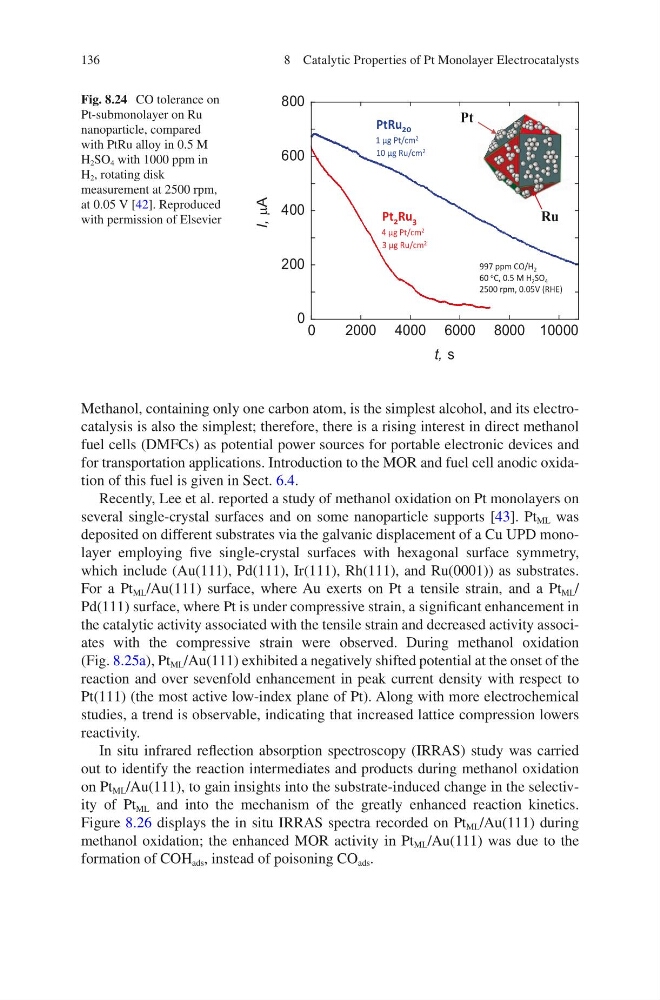
Fig. 8.24 CO tolerance on
Pt-submonolayer on Ru
nanoparticle, compared
with PtRu alloy in 0.5 M
H 2 SO 4 with 1000 ppm in
H 2 , rotating disk
measurement at 2500 rpm,
at 0.05 V [42]. Reproduced
with permission of Elsevier
8 Catalytic Properties of Pt Monolayer Electrocatalysts
Methanol, containing only one carbon atom, is the simplest alcohol, and its electrocatalysis is also the simplest; therefore, there is a rising interest in direct methanol
fuel cells (DMFCs) as potential power sources for portable electronic devices and
for transportation applications. Introduction to the MOR and fuel cell anodic oxidation of this fuel is given in Sect. 6.4.
Recently, Lee et al. reported a study of methanol oxidation on Pt monolayers on
several single-crystal surfaces and on some nanoparticle supports [43]. Pt ML was
deposited on different substrates via the galvanic displacement of a Cu UPD monolayer employing five single-crystal surfaces with hexagonal surface symmetry,
which include (Au(111), Pd(111), Ir(111), Rh(111), and Ru(0001)) as substrates.
For a Pt ML /Au(111) surface, where Au exerts on Pt a tensile strain, and a Pt ML /
Pd(111) surface, where Pt is under compressive strain, a significant enhancement in
the catalytic activity associated with the tensile strain and decreased activity associates with the compressive strain were observed. During methanol oxidation
(Fig. 8.25a), Pt ML /Au(111) exhibited a negatively shifted potential at the onset of the
reaction and over sevenfold enhancement in peak current density with respect to
Pt(111) (the most active low-index plane of Pt). Along with more electrochemical
studies, a trend is observable, indicating that increased lattice compression lowers
reactivity.
In situ infrared reflection absorption spectroscopy (IRRAS) study was carried
out to identify the reaction intermediates and products during methanol oxidation
on Pt ML /Au(111), to gain insights into the substrate-induced change in the selectivity of Pt ML and into the mechanism of the greatly enhanced reaction kinetics.
Figure 8.26 displays the in situ IRRAS spectra recorded on Pt ML /Au(111) during
methanol oxidation; the enhanced MOR activity in Pt ML /Au(111) was due to the
formation of COH ads , instead of poisoning CO ads .
0
200
400
600
800
0
2000 4000 6000 8000 10000
I, µA
t, s
Pt
Ru
PtRu 20
1 µg Pt/cm 2
10 µg Ru/cm 2
Pt 2 Ru 3
4 µg Pt/cm 2
3 µg Ru/cm 2
997 ppm CO/H 2
60 o C, 0.5 M H 2 SO 4
2500 rpm, 0.05V (RHE)
Fig. 8.24 CO tolerance on
Pt-submonolayer on Ru
nanoparticle, compared
with PtRu alloy in 0.5 M
H 2 SO 4 with 1000 ppm in
H 2 , rotating disk
measurement at 2500 rpm,
at 0.05 V [42]. Reproduced
with permission of Elsevier
8 Catalytic Properties of Pt Monolayer Electrocatalysts