

3
H
H
e
2
2
2
=
++
−
(1.4)
Thus, a conventional electrochemical scale has E SHE = E
0 H2/H+ = 0.
1.2 Electrical Double Layer
To a first approximation, the electrode–electrolyte interface can be represented as a
parallel plate condenser with one plate through the centers of the ions separated by
a monolayer of solvent molecules from the electrode surface and the second plate at
the metal surface. The solvated ions, whose centers define the outer Helmholtz
plane (OHP), interact with the electrode surface through electrostatic forces only.
Most of the cations, e.g., Na
+
, K
+
, and Li
+
, and anions, e.g., F
−
and ClO 4
−
, which
have solvation shells, generally do not approach the electrode surface closer than
the OHP.
Some weakly solvated anions, such as C1
−
, Br
−
, and I
−
, are chemisorbed on the
electrode surface, undergoing a chemical bonding to the surface. A partial charge
transfer takes place in this interaction. The coverage of these “specifically” adsorbed
ions can be substantial if a large charge transfer takes place and strong chemical
bonding occurs. Their centers define the inner Helmholtz plane (IHP). The coverage
of electrostatically adsorbed ions does not usually exceed 0.1–0.2 of a full monolayer.
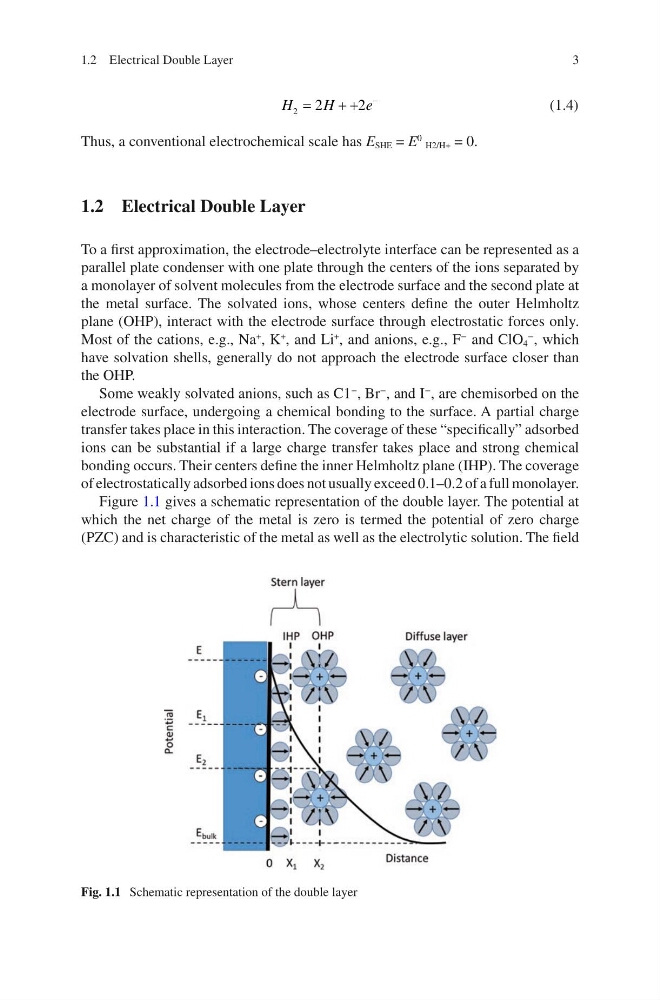
Figure 1.1 gives a schematic representation of the double layer. The potential at
which the net charge of the metal is zero is termed the potential of zero charge
(PZC) and is characteristic of the metal as well as the electrolytic solution. The field
Fig. 1.1 Schematic representation of the double layer
1.2 Electrical Double Layer
H
H
e
2
2
2
=
++
−
(1.4)
Thus, a conventional electrochemical scale has E SHE = E
0 H2/H+ = 0.
1.2 Electrical Double Layer
To a first approximation, the electrode–electrolyte interface can be represented as a
parallel plate condenser with one plate through the centers of the ions separated by
a monolayer of solvent molecules from the electrode surface and the second plate at
the metal surface. The solvated ions, whose centers define the outer Helmholtz
plane (OHP), interact with the electrode surface through electrostatic forces only.
Most of the cations, e.g., Na
+
, K
+
, and Li
+
, and anions, e.g., F
−
and ClO 4
−
, which
have solvation shells, generally do not approach the electrode surface closer than
the OHP.
Some weakly solvated anions, such as C1
−
, Br
−
, and I
−
, are chemisorbed on the
electrode surface, undergoing a chemical bonding to the surface. A partial charge
transfer takes place in this interaction. The coverage of these “specifically” adsorbed
ions can be substantial if a large charge transfer takes place and strong chemical
bonding occurs. Their centers define the inner Helmholtz plane (IHP). The coverage
of electrostatically adsorbed ions does not usually exceed 0.1–0.2 of a full monolayer.
Figure 1.1 gives a schematic representation of the double layer. The potential at
which the net charge of the metal is zero is termed the potential of zero charge
(PZC) and is characteristic of the metal as well as the electrolytic solution. The field
Fig. 1.1 Schematic representation of the double layer
1.2 Electrical Double Layer