

2
1.1 Potential at Electrode–Electrolyte Interfaces
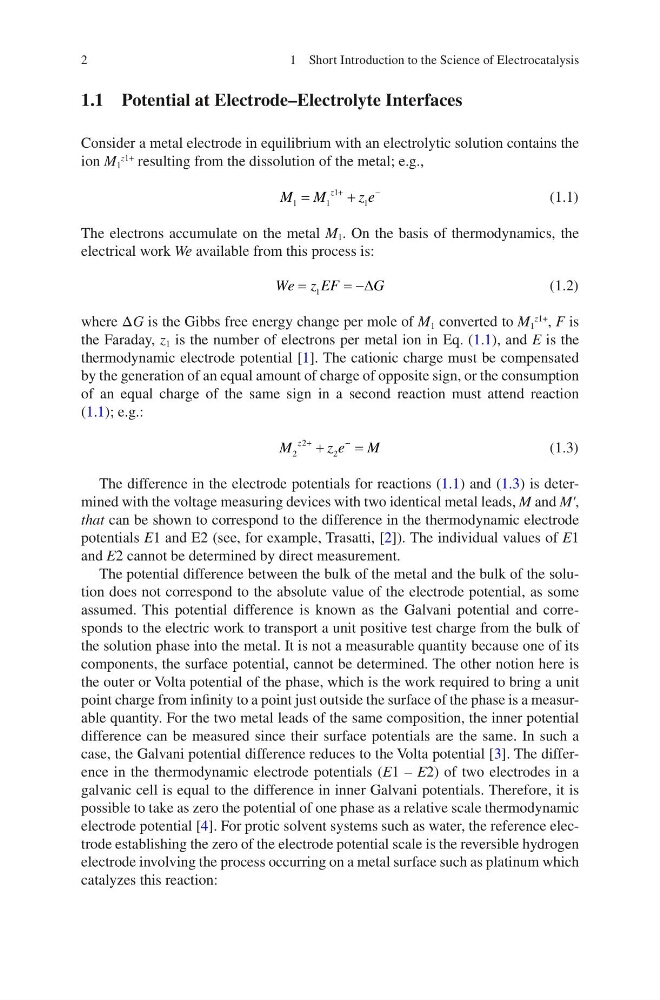
Consider a metal electrode in equilibrium with an electrolytic solution contains the
ion M 1
z1+
resulting from the dissolution of the metal; e.g.,
M M
z e
z
1
1
1
1
=
+
+
−
(1.1)
The electrons accumulate on the metal M 1 . On the basis of thermodynamics, the
electrical work We available from this process is:
We z EF
G
=
=−
1
∆
(1.2)
where ΔG is the Gibbs free energy change per mole of M 1 converted to M 1
z1+
, F is
the Faraday, z 1 is the number of electrons per metal ion in Eq. (1.1), and E is the
thermodynamic electrode potential [1]. The cationic charge must be compensated
by the generation of an equal amount of charge of opposite sign, or the consumption
of an equal charge of the same sign in a second reaction must attend reaction
(1.1); e.g.:
M
z e
M
z
2
2
2
+
−
+
=
(1.3)
The difference in the electrode potentials for reactions (1.1) and (1.3) is determined with the voltage measuring devices with two identical metal leads, M and M',
that can be shown to correspond to the difference in the thermodynamic electrode
potentials E1 and E2 (see, for example, Trasatti, [2]). The individual values of E1
and E2 cannot be determined by direct measurement.
The potential difference between the bulk of the metal and the bulk of the solution does not correspond to the absolute value of the electrode potential, as some
assumed. This potential difference is known as the Galvani potential and corresponds to the electric work to transport a unit positive test charge from the bulk of
the solution phase into the metal. It is not a measurable quantity because one of its
components, the surface potential, cannot be determined. The other notion here is
the outer or Volta potential of the phase, which is the work required to bring a unit
point charge from infinity to a point just outside the surface of the phase is a measurable quantity. For the two metal leads of the same composition, the inner potential
difference can be measured since their surface potentials are the same. In such a
case, the Galvani potential difference reduces to the Volta potential [3]. The difference in the thermodynamic electrode potentials (E1 – E2) of two electrodes in a
galvanic cell is equal to the difference in inner Galvani potentials. Therefore, it is
possible to take as zero the potential of one phase as a relative scale thermodynamic
electrode potential [4]. For protic solvent systems such as water, the reference electrode establishing the zero of the electrode potential scale is the reversible hydrogen
electrode involving the process occurring on a metal surface such as platinum which
catalyzes this reaction:
1 Short Introduction to the Science of Electrocatalysis
1.1 Potential at Electrode–Electrolyte Interfaces
Consider a metal electrode in equilibrium with an electrolytic solution contains the
ion M 1
z1+
resulting from the dissolution of the metal; e.g.,
M M
z e
z
1
1
1
1
=
+
+
−
(1.1)
The electrons accumulate on the metal M 1 . On the basis of thermodynamics, the
electrical work We available from this process is:
We z EF
G
=
=−
1
∆
(1.2)
where ΔG is the Gibbs free energy change per mole of M 1 converted to M 1
z1+
, F is
the Faraday, z 1 is the number of electrons per metal ion in Eq. (1.1), and E is the
thermodynamic electrode potential [1]. The cationic charge must be compensated
by the generation of an equal amount of charge of opposite sign, or the consumption
of an equal charge of the same sign in a second reaction must attend reaction
(1.1); e.g.:
M
z e
M
z
2
2
2
+
−
+
=
(1.3)
The difference in the electrode potentials for reactions (1.1) and (1.3) is determined with the voltage measuring devices with two identical metal leads, M and M',
that can be shown to correspond to the difference in the thermodynamic electrode
potentials E1 and E2 (see, for example, Trasatti, [2]). The individual values of E1
and E2 cannot be determined by direct measurement.
The potential difference between the bulk of the metal and the bulk of the solution does not correspond to the absolute value of the electrode potential, as some
assumed. This potential difference is known as the Galvani potential and corresponds to the electric work to transport a unit positive test charge from the bulk of
the solution phase into the metal. It is not a measurable quantity because one of its
components, the surface potential, cannot be determined. The other notion here is
the outer or Volta potential of the phase, which is the work required to bring a unit
point charge from infinity to a point just outside the surface of the phase is a measurable quantity. For the two metal leads of the same composition, the inner potential
difference can be measured since their surface potentials are the same. In such a
case, the Galvani potential difference reduces to the Volta potential [3]. The difference in the thermodynamic electrode potentials (E1 – E2) of two electrodes in a
galvanic cell is equal to the difference in inner Galvani potentials. Therefore, it is
possible to take as zero the potential of one phase as a relative scale thermodynamic
electrode potential [4]. For protic solvent systems such as water, the reference electrode establishing the zero of the electrode potential scale is the reversible hydrogen
electrode involving the process occurring on a metal surface such as platinum which
catalyzes this reaction:
1 Short Introduction to the Science of Electrocatalysis