

113
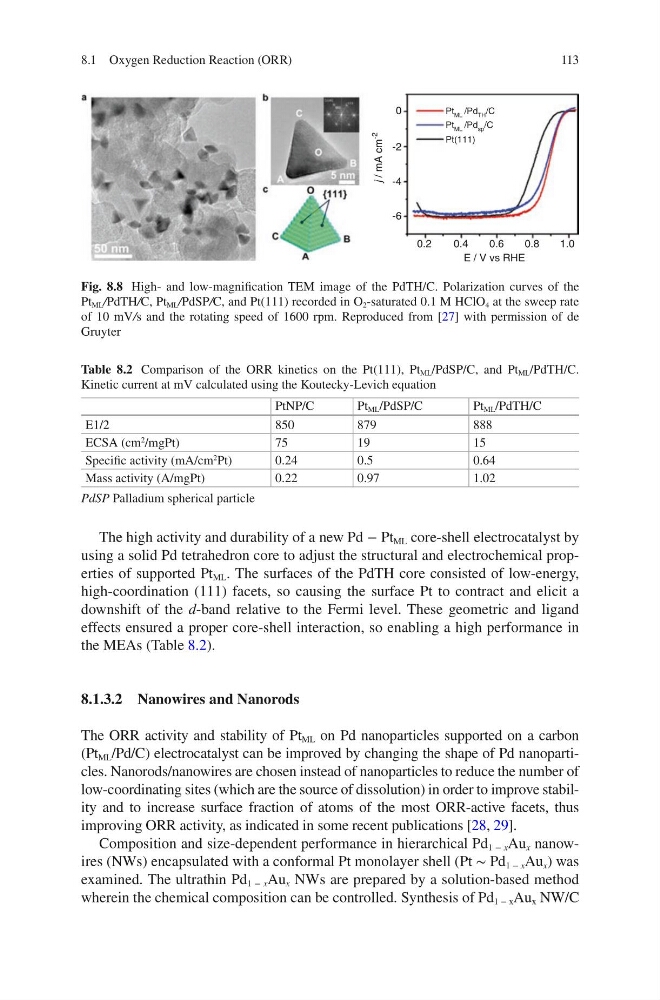
The high activity and durability of a new Pd − Pt ML core-shell electrocatalyst by
using a solid Pd tetrahedron core to adjust the structural and electrochemical properties of supported Pt ML . The surfaces of the PdTH core consisted of low- energy,
high-coordination (111) facets, so causing the surface Pt to contract and elicit a
downshift of the d-band relative to the Fermi level. These geometric and ligand
effects ensured a proper core-shell interaction, so enabling a high performance in
the MEAs (Table 8.2).
8.1.3.2 Nanowires and Nanorods
The ORR activity and stability of Pt ML on Pd nanoparticles supported on a carbon
(Pt ML /Pd/C) electrocatalyst can be improved by changing the shape of Pd nanoparticles. Nanorods/nanowires are chosen instead of nanoparticles to reduce the number of
low-coordinating sites (which are the source of dissolution) in order to improve stability and to increase surface fraction of atoms of the most ORR- active facets, thus
improving ORR activity, as indicated in some recent publications [28, 29].
Composition and size-dependent performance in hierarchical Pd 1 − x Au x nanowires (NWs) encapsulated with a conformal Pt monolayer shell (Pt ∼ Pd 1 − x Au x ) was
examined. The ultrathin Pd 1 − x Au x NWs are prepared by a solution-based method
wherein the chemical composition can be controlled. Synthesis of Pd 1 − x Au x NW/C
Pt ML /Pd TH /C
Pt ML /Pd sp /C
Pt(111)
0.2
-6
-4
-2
0
0.4
0.6
E / V vs RHE
0.8
1.0
j / mA cm
-2
Fig. 8.8 High- and low-magnification TEM image of the PdTH/C. Polarization curves of the
Pt ML /PdTH/C, Pt ML /PdSP/C, and Pt(111) recorded in O 2 -saturated 0.1 M HClO 4 at the sweep rate
of 10 mV/s and the rotating speed of 1600 rpm. Reproduced from [27] with permission of de
Gruyter
Table 8.2 Comparison of the ORR kinetics on the Pt(111), Pt ML /PdSP/C, and Pt ML /PdTH/C.
Kinetic current at mV calculated using the Koutecky-Levich equation
PtNP/C
Pt ML /PdSP/C
Pt ML /PdTH/C
E1/2
850
879
888
ECSA (cm
2
/mgPt)
75
19
15
Specific activity (mA/cm
2 Pt)
0.24
0.5
0.64
Mass activity (A/mgPt)
0.22
0.97
1.02
PdSP Palladium spherical particle
8.1 Oxygen Reduction Reaction (ORR)
The high activity and durability of a new Pd − Pt ML core-shell electrocatalyst by
using a solid Pd tetrahedron core to adjust the structural and electrochemical properties of supported Pt ML . The surfaces of the PdTH core consisted of low- energy,
high-coordination (111) facets, so causing the surface Pt to contract and elicit a
downshift of the d-band relative to the Fermi level. These geometric and ligand
effects ensured a proper core-shell interaction, so enabling a high performance in
the MEAs (Table 8.2).
8.1.3.2 Nanowires and Nanorods
The ORR activity and stability of Pt ML on Pd nanoparticles supported on a carbon
(Pt ML /Pd/C) electrocatalyst can be improved by changing the shape of Pd nanoparticles. Nanorods/nanowires are chosen instead of nanoparticles to reduce the number of
low-coordinating sites (which are the source of dissolution) in order to improve stability and to increase surface fraction of atoms of the most ORR- active facets, thus
improving ORR activity, as indicated in some recent publications [28, 29].
Composition and size-dependent performance in hierarchical Pd 1 − x Au x nanowires (NWs) encapsulated with a conformal Pt monolayer shell (Pt ∼ Pd 1 − x Au x ) was
examined. The ultrathin Pd 1 − x Au x NWs are prepared by a solution-based method
wherein the chemical composition can be controlled. Synthesis of Pd 1 − x Au x NW/C
Pt ML /Pd TH /C
Pt ML /Pd sp /C
Pt(111)
0.2
-6
-4
-2
0
0.4
0.6
E / V vs RHE
0.8
1.0
j / mA cm
-2
Fig. 8.8 High- and low-magnification TEM image of the PdTH/C. Polarization curves of the
Pt ML /PdTH/C, Pt ML /PdSP/C, and Pt(111) recorded in O 2 -saturated 0.1 M HClO 4 at the sweep rate
of 10 mV/s and the rotating speed of 1600 rpm. Reproduced from [27] with permission of de
Gruyter
Table 8.2 Comparison of the ORR kinetics on the Pt(111), Pt ML /PdSP/C, and Pt ML /PdTH/C.
Kinetic current at mV calculated using the Koutecky-Levich equation
PtNP/C
Pt ML /PdSP/C
Pt ML /PdTH/C
E1/2
850
879
888
ECSA (cm
2
/mgPt)
75
19
15
Specific activity (mA/cm
2 Pt)
0.24
0.5
0.64
Mass activity (A/mgPt)
0.22
0.97
1.02
PdSP Palladium spherical particle
8.1 Oxygen Reduction Reaction (ORR)