

112
defects and a high content of the shape-determined high-coordinated facets [27].
The ORR kinetics of Pt ML /TH Pd/C is improved significantly.
The surfaces of the PdTH core are composed of (111) facets wherein the Pd
atoms are highly coordinated and have low surface energy. In comparison with
spherical Pd/C-supported Pt ML or pure Pt, the PdTH-supported Pt ML features more
surface contraction and a downshift of the d-band relative to the Fermi level. The
Pt ML /PdTH produced a specific and mass activity of 0.64 mA/cm
2
Pt and 1.02 A/
mg Pt , which are higher than that of the Pt NPs consisting of (110) and (111) facets.
These geometric and electronic effects determine the higher activity of Pt ML /PdTH/C
for the ORR compared to that of Pt ML /Pd/C. This shape-property interdependence
opens up a new approach in research on Pt-based ORR electrocatalysts that may be
important for future catalyst development.
The success in synthesizing clean tetrahedral palladium (PdTH) nanocrystals
allowed the evaluation of their facet-specific electrochemical properties as a new
support of platinum monolayer (Pt ML ) catalysts.
Tetrahedral Pd nanoparticles synthesized via a combination of a hydrothermal
route and a CO-adsorption-induced cleaning procedure are shown in Fig. 8.9.
Details of the synthesis are given in Ref. [27].
To remove organic adsorbates, the PdTH/C-modified electrode immersed in a
CO-blanketed 0.1 M HClO 4 solution for about 30 min while applying a triangular
potential from 0.5 V to −0.55 V versus RHE (reversible hydrogen electrode) at the
scan rate 50 mV/s until a stable rectangular voltammetric response is obtained. At
this stage, the surface organics were replaced by CO, which can be subsequently
stripped away by its oxidation at ∼ 1.0 V (Fig. 8.8).
On the basis of calculations for icosahedrons, increasing the particle size should
theoretically lower mass activity. Therefore, the dominant role of the (111) surface
of the Pd tetrahedrons was demonstrated, since the ORR activity varied with particle size in accord with the relative fraction of the surface low-index atoms.
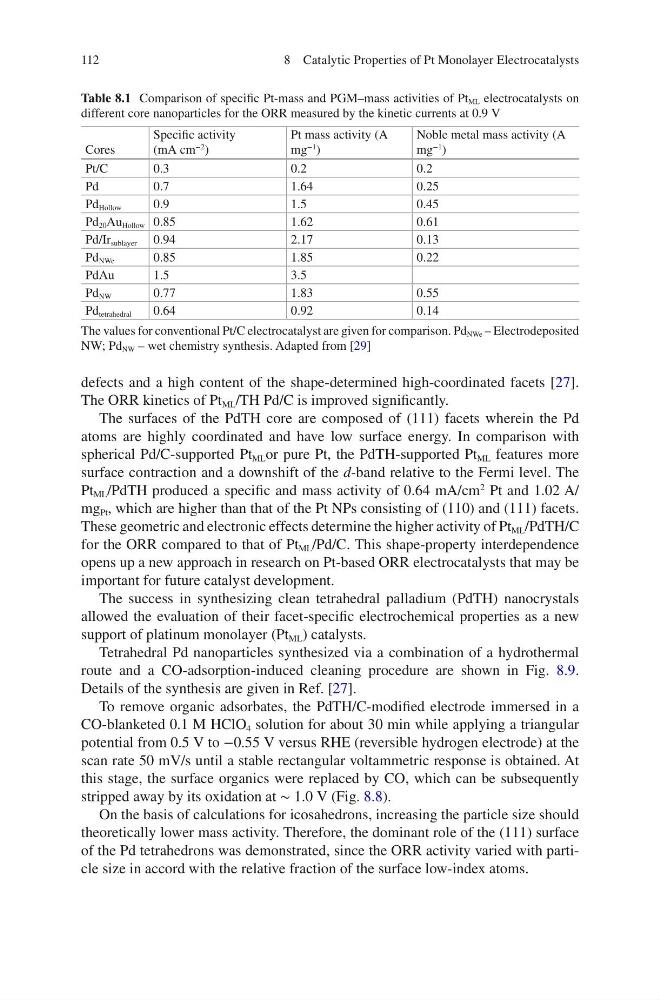
Table 8.1 Comparison of specific Pt-mass and PGM–mass activities of Pt ML electrocatalysts on
different core nanoparticles for the ORR measured by the kinetic currents at 0.9 V
Cores
Specific activity
(mA cm
−2 )
Pt mass activity (A
mg
−1
)
Noble metal mass activity (A
mg
−1 )
Pt/C
0.3
0.2
0.2
Pd
0.7
1.64
0.25
Pd Hollow
0.9
1.5
0.45
Pd 20 Au Hollow 0.85
1.62
0.61
Pd/Ir sublayer 0.94
2.17
0.13
Pd NWe
0.85
1.85
0.22
PdAu
1.5
3.5
Pd NW
0.77
1.83
0.55
Pd tetrahedral
0.64
0.92
0.14
The values for conventional Pt/C electrocatalyst are given for comparison. Pd NWe – Electrodeposited
NW; Pd NW – wet chemistry synthesis. Adapted from [29]
8 Catalytic Properties of Pt Monolayer Electrocatalysts
defects and a high content of the shape-determined high-coordinated facets [27].
The ORR kinetics of Pt ML /TH Pd/C is improved significantly.
The surfaces of the PdTH core are composed of (111) facets wherein the Pd
atoms are highly coordinated and have low surface energy. In comparison with
spherical Pd/C-supported Pt ML or pure Pt, the PdTH-supported Pt ML features more
surface contraction and a downshift of the d-band relative to the Fermi level. The
Pt ML /PdTH produced a specific and mass activity of 0.64 mA/cm
2
Pt and 1.02 A/
mg Pt , which are higher than that of the Pt NPs consisting of (110) and (111) facets.
These geometric and electronic effects determine the higher activity of Pt ML /PdTH/C
for the ORR compared to that of Pt ML /Pd/C. This shape-property interdependence
opens up a new approach in research on Pt-based ORR electrocatalysts that may be
important for future catalyst development.
The success in synthesizing clean tetrahedral palladium (PdTH) nanocrystals
allowed the evaluation of their facet-specific electrochemical properties as a new
support of platinum monolayer (Pt ML ) catalysts.
Tetrahedral Pd nanoparticles synthesized via a combination of a hydrothermal
route and a CO-adsorption-induced cleaning procedure are shown in Fig. 8.9.
Details of the synthesis are given in Ref. [27].
To remove organic adsorbates, the PdTH/C-modified electrode immersed in a
CO-blanketed 0.1 M HClO 4 solution for about 30 min while applying a triangular
potential from 0.5 V to −0.55 V versus RHE (reversible hydrogen electrode) at the
scan rate 50 mV/s until a stable rectangular voltammetric response is obtained. At
this stage, the surface organics were replaced by CO, which can be subsequently
stripped away by its oxidation at ∼ 1.0 V (Fig. 8.8).
On the basis of calculations for icosahedrons, increasing the particle size should
theoretically lower mass activity. Therefore, the dominant role of the (111) surface
of the Pd tetrahedrons was demonstrated, since the ORR activity varied with particle size in accord with the relative fraction of the surface low-index atoms.
Table 8.1 Comparison of specific Pt-mass and PGM–mass activities of Pt ML electrocatalysts on
different core nanoparticles for the ORR measured by the kinetic currents at 0.9 V
Cores
Specific activity
(mA cm
−2 )
Pt mass activity (A
mg
−1
)
Noble metal mass activity (A
mg
−1 )
Pt/C
0.3
0.2
0.2
Pd
0.7
1.64
0.25
Pd Hollow
0.9
1.5
0.45
Pd 20 Au Hollow 0.85
1.62
0.61
Pd/Ir sublayer 0.94
2.17
0.13
Pd NWe
0.85
1.85
0.22
PdAu
1.5
3.5
Pd NW
0.77
1.83
0.55
Pd tetrahedral
0.64
0.92
0.14
The values for conventional Pt/C electrocatalyst are given for comparison. Pd NWe – Electrodeposited
NW; Pd NW – wet chemistry synthesis. Adapted from [29]
8 Catalytic Properties of Pt Monolayer Electrocatalysts