

106
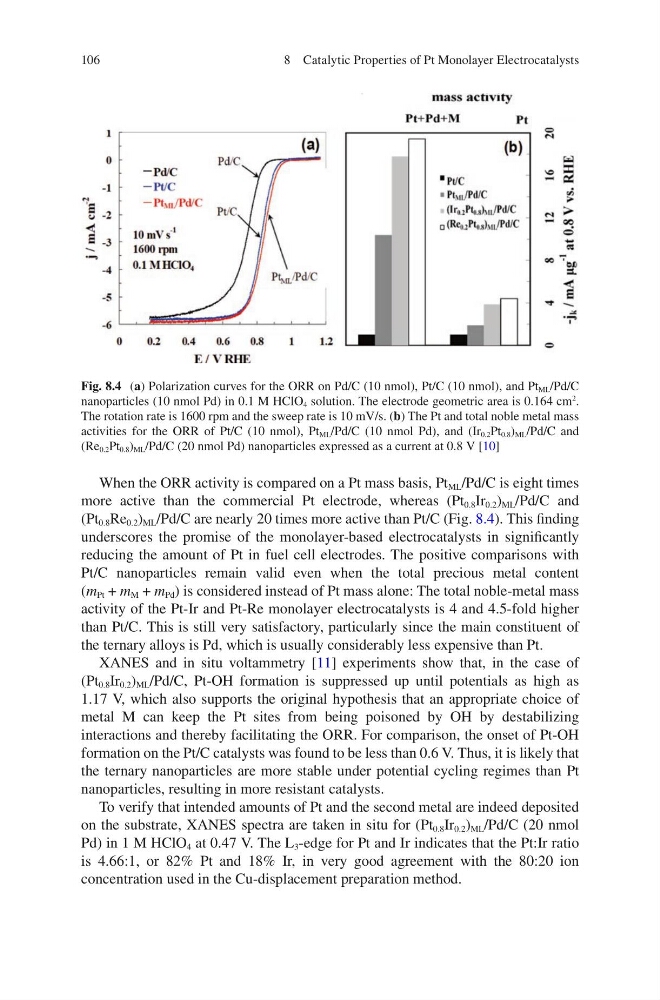
When the ORR activity is compared on a Pt mass basis, Pt ML /Pd/C is eight times
more active than the commercial Pt electrode, whereas (Pt 0.8 Ir 0.2 ) ML /Pd/C and
(Pt 0.8 Re 0.2 ) ML /Pd/C are nearly 20 times more active than Pt/C (Fig. 8.4). This finding
underscores the promise of the monolayer-based electrocatalysts in significantly
reducing the amount of Pt in fuel cell electrodes. The positive comparisons with
Pt/C nanoparticles remain valid even when the total precious metal content
(m Pt + m M + m Pd ) is considered instead of Pt mass alone: The total noble-metal mass
activity of the Pt-Ir and Pt-Re monolayer electrocatalysts is 4 and 4.5-fold higher
than Pt/C. This is still very satisfactory, particularly since the main constituent of
the ternary alloys is Pd, which is usually considerably less expensive than Pt.
XANES and in situ voltammetry [11] experiments show that, in the case of
(Pt 0.8 Ir 0.2 ) ML /Pd/C, Pt-OH formation is suppressed up until potentials as high as
1.17 V, which also supports the original hypothesis that an appropriate choice of
metal M can keep the Pt sites from being poisoned by OH by destabilizing
interactions and thereby facilitating the ORR. For comparison, the onset of Pt-OH
formation on the Pt/C catalysts was found to be less than 0.6 V. Thus, it is likely that
the ternary nanoparticles are more stable under potential cycling regimes than Pt
nanoparticles, resulting in more resistant catalysts.
To verify that intended amounts of Pt and the second metal are indeed deposited
on the substrate, XANES spectra are taken in situ for (Pt 0.8 Ir 0.2 ) ML /Pd/C (20 nmol
Pd) in 1 M HClO 4 at 0.47 V. The L 3 -edge for Pt and Ir indicates that the Pt:Ir ratio
is 4.66:1, or 82% Pt and 18% Ir, in very good agreement with the 80:20 ion
concentration used in the Cu-displacement preparation method.
Fig. 8.4 (a) Polarization curves for the ORR on Pd/C (10 nmol), Pt/C (10 nmol), and Pt ML /Pd/C
nanoparticles (10 nmol Pd) in 0.1 M HClO 4 solution. The electrode geometric area is 0.164 cm
2 .
The rotation rate is 1600 rpm and the sweep rate is 10 mV/s. (b) The Pt and total noble metal mass
activities for the ORR of Pt/C (10 nmol), Pt ML /Pd/C (10 nmol Pd), and (Ir 0.2 Pt 0.8 ) ML /Pd/C and
(Re 0.2 Pt 0.8 ) ML /Pd/C (20 nmol Pd) nanoparticles expressed as a current at 0.8 V [10]
8 Catalytic Properties of Pt Monolayer Electrocatalysts
When the ORR activity is compared on a Pt mass basis, Pt ML /Pd/C is eight times
more active than the commercial Pt electrode, whereas (Pt 0.8 Ir 0.2 ) ML /Pd/C and
(Pt 0.8 Re 0.2 ) ML /Pd/C are nearly 20 times more active than Pt/C (Fig. 8.4). This finding
underscores the promise of the monolayer-based electrocatalysts in significantly
reducing the amount of Pt in fuel cell electrodes. The positive comparisons with
Pt/C nanoparticles remain valid even when the total precious metal content
(m Pt + m M + m Pd ) is considered instead of Pt mass alone: The total noble-metal mass
activity of the Pt-Ir and Pt-Re monolayer electrocatalysts is 4 and 4.5-fold higher
than Pt/C. This is still very satisfactory, particularly since the main constituent of
the ternary alloys is Pd, which is usually considerably less expensive than Pt.
XANES and in situ voltammetry [11] experiments show that, in the case of
(Pt 0.8 Ir 0.2 ) ML /Pd/C, Pt-OH formation is suppressed up until potentials as high as
1.17 V, which also supports the original hypothesis that an appropriate choice of
metal M can keep the Pt sites from being poisoned by OH by destabilizing
interactions and thereby facilitating the ORR. For comparison, the onset of Pt-OH
formation on the Pt/C catalysts was found to be less than 0.6 V. Thus, it is likely that
the ternary nanoparticles are more stable under potential cycling regimes than Pt
nanoparticles, resulting in more resistant catalysts.
To verify that intended amounts of Pt and the second metal are indeed deposited
on the substrate, XANES spectra are taken in situ for (Pt 0.8 Ir 0.2 ) ML /Pd/C (20 nmol
Pd) in 1 M HClO 4 at 0.47 V. The L 3 -edge for Pt and Ir indicates that the Pt:Ir ratio
is 4.66:1, or 82% Pt and 18% Ir, in very good agreement with the 80:20 ion
concentration used in the Cu-displacement preparation method.
Fig. 8.4 (a) Polarization curves for the ORR on Pd/C (10 nmol), Pt/C (10 nmol), and Pt ML /Pd/C
nanoparticles (10 nmol Pd) in 0.1 M HClO 4 solution. The electrode geometric area is 0.164 cm
2 .
The rotation rate is 1600 rpm and the sweep rate is 10 mV/s. (b) The Pt and total noble metal mass
activities for the ORR of Pt/C (10 nmol), Pt ML /Pd/C (10 nmol Pd), and (Ir 0.2 Pt 0.8 ) ML /Pd/C and
(Re 0.2 Pt 0.8 ) ML /Pd/C (20 nmol Pd) nanoparticles expressed as a current at 0.8 V [10]
8 Catalytic Properties of Pt Monolayer Electrocatalysts