

105
8.1.2 Pt Monolayer Shell on Nanoparticle Cores
The results of the study of the behavior of Pd nanoparticles coated with Pt or with
mixed Pt plus M monolayer, which more closely reflect the morphology of actual
catalyst particles, are shown in Fig. 8.4a. It displays the polarization curves for the
ORR on commercial carbon-supported Pt nanoparticles (Pt/C), Pd nanoparticles
(Pd/C), a monolayer of Pt on Pd/C (Pt ML /Pd/C), and mixed (Pt 0.8 Ir 0.2 ) ML /Pd/C and
(Pt 0.8 Re 0.2 ) ML /Pd/C. Although comparing the activity of the Pt/C electrocatalyst with
an average particle size of 3.1 nm with that of Pt ML /Pd/C electrocatalyst of 9 nm [9]
does not provide an adequate activity assessment because of their different surface
areas, this does not adversely affect the main conclusions derived from experiments
on single-crystal surfaces.
The ORR activity of the Pt ML /Pd/C is much higher compared to that of Pd/C, but
more importantly, it is also higher than that of Pt/C. The amounts of Pt in Pt ML /Pd/C
and Pt/C are 1.7 and 12 μg Pt /cm
2
, respectively. The amount of Pt corresponding to
Pt ML /Pd/C can be obtained by calculating the charge associated with the deposition
of a Cu monolayer at underpotentials (after correcting for the double-layer charging)
on Pd/C, assuming there is a one-to-one ratio between the Cu and Pd atoms.
Therefore, even though Pt/C has higher surface area and a Pt loading that is seven
times larger, its ORR activity is lower than that of Pt ML /Pd/C.
10
8
6
4
0
0
2 0
4 0
6 0
8 0
100
M (Ru or Ir) molar percentage %
100
80
60
40
20
0
Pt molar percentage %
-j
k / mAcm
2
at 0.85V RHE
(Ru x Pt 1-x ) ML / PD (111)
(Ir x Pt 1-x ) ML / PD (111)
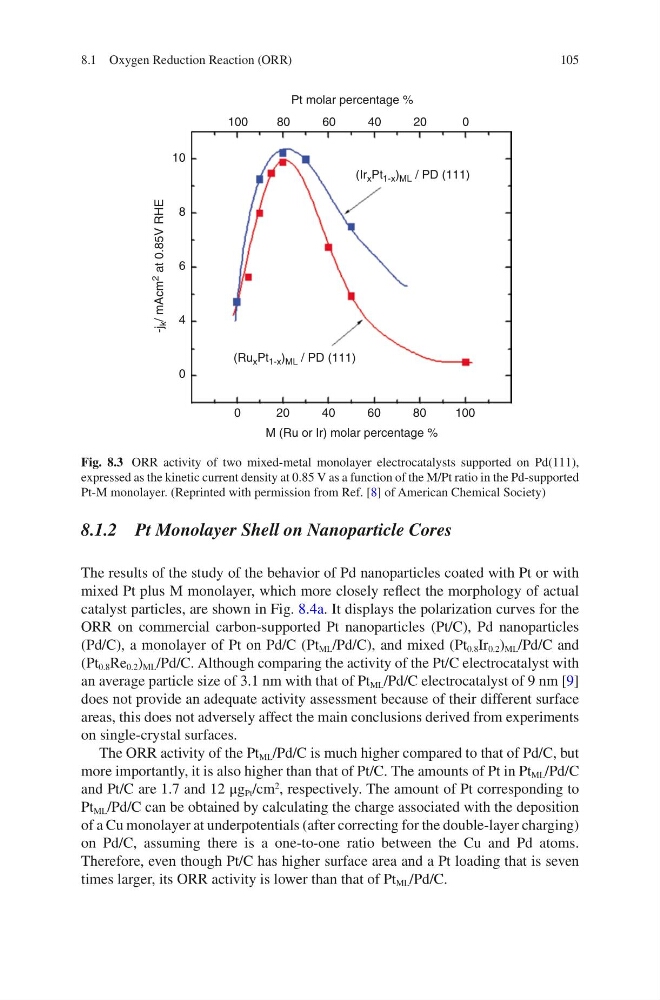
Fig. 8.3 ORR activity of two mixed-metal monolayer electrocatalysts supported on Pd(111),
expressed as the kinetic current density at 0.85 V as a function of the M/Pt ratio in the Pd-supported
Pt-M monolayer. (Reprinted with permission from Ref. [8] of American Chemical Society)
8.1 Oxygen Reduction Reaction (ORR)
8.1.2 Pt Monolayer Shell on Nanoparticle Cores
The results of the study of the behavior of Pd nanoparticles coated with Pt or with
mixed Pt plus M monolayer, which more closely reflect the morphology of actual
catalyst particles, are shown in Fig. 8.4a. It displays the polarization curves for the
ORR on commercial carbon-supported Pt nanoparticles (Pt/C), Pd nanoparticles
(Pd/C), a monolayer of Pt on Pd/C (Pt ML /Pd/C), and mixed (Pt 0.8 Ir 0.2 ) ML /Pd/C and
(Pt 0.8 Re 0.2 ) ML /Pd/C. Although comparing the activity of the Pt/C electrocatalyst with
an average particle size of 3.1 nm with that of Pt ML /Pd/C electrocatalyst of 9 nm [9]
does not provide an adequate activity assessment because of their different surface
areas, this does not adversely affect the main conclusions derived from experiments
on single-crystal surfaces.
The ORR activity of the Pt ML /Pd/C is much higher compared to that of Pd/C, but
more importantly, it is also higher than that of Pt/C. The amounts of Pt in Pt ML /Pd/C
and Pt/C are 1.7 and 12 μg Pt /cm
2
, respectively. The amount of Pt corresponding to
Pt ML /Pd/C can be obtained by calculating the charge associated with the deposition
of a Cu monolayer at underpotentials (after correcting for the double-layer charging)
on Pd/C, assuming there is a one-to-one ratio between the Cu and Pd atoms.
Therefore, even though Pt/C has higher surface area and a Pt loading that is seven
times larger, its ORR activity is lower than that of Pt ML /Pd/C.
10
8
6
4
0
0
2 0
4 0
6 0
8 0
100
M (Ru or Ir) molar percentage %
100
80
60
40
20
0
Pt molar percentage %
-j
k / mAcm
2
at 0.85V RHE
(Ru x Pt 1-x ) ML / PD (111)
(Ir x Pt 1-x ) ML / PD (111)
Fig. 8.3 ORR activity of two mixed-metal monolayer electrocatalysts supported on Pd(111),
expressed as the kinetic current density at 0.85 V as a function of the M/Pt ratio in the Pd-supported
Pt-M monolayer. (Reprinted with permission from Ref. [8] of American Chemical Society)
8.1 Oxygen Reduction Reaction (ORR)