

103
reflects the disk current. The more active is the catalyst, the larger is the disk current, less hydrogen peroxide is generated resulting in the smaller ring current. When
the ORR kinetic currents obtained from Koutecky-Levich plots are plotted against
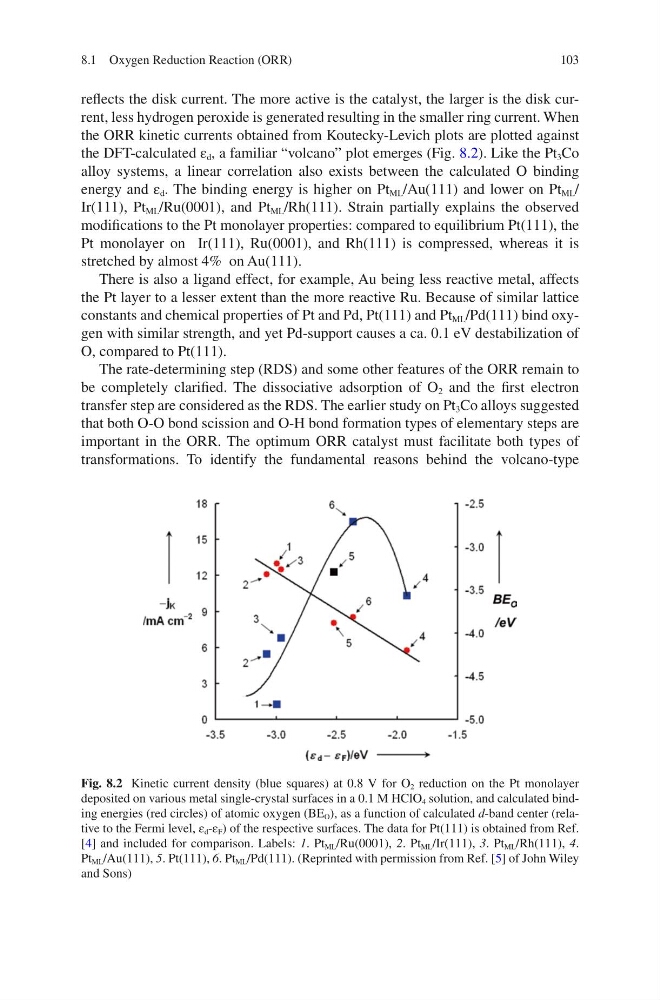
the DFT-calculated ε d , a familiar “volcano” plot emerges (Fig. 8.2). Like the Pt 3 Co
alloy systems, a linear correlation also exists between the calculated O binding
energy and ε d . The binding energy is higher on Pt ML /Au(111) and lower on Pt ML /
Ir(111), Pt ML /Ru(0001), and Pt ML /Rh(111). Strain partially explains the observed
modifications to the Pt monolayer properties: compared to equilibrium Pt(111), the
Pt monolayer on Ir(111), Ru(0001), and Rh(111) is compressed, whereas it is
stretched by almost 4% on Au(111).
There is also a ligand effect, for example, Au being less reactive metal, affects
the Pt layer to a lesser extent than the more reactive Ru. Because of similar lattice
constants and chemical properties of Pt and Pd, Pt(111) and Pt ML /Pd(111) bind oxygen with similar strength, and yet Pd-support causes a ca. 0.1 eV destabilization of
O, compared to Pt(111).
The rate-determining step (RDS) and some other features of the ORR remain to
be completely clarified. The dissociative adsorption of O 2 and the first electron
transfer step are considered as the RDS. The earlier study on Pt 3 Co alloys suggested
that both O-O bond scission and O-H bond formation types of elementary steps are
important in the ORR. The optimum ORR catalyst must facilitate both types of
transformations. To identify the fundamental reasons behind the volcano-type
Fig. 8.2 Kinetic current density (blue squares) at 0.8 V for O 2 reduction on the Pt monolayer
deposited on various metal single-crystal surfaces in a 0.1 M HClO 4 solution, and calculated binding energies (red circles) of atomic oxygen (BE O ), as a function of calculated d-band center (relative to the Fermi level, ε d -ε F ) of the respective surfaces. The data for Pt(111) is obtained from Ref.
[4] and included for comparison. Labels: 1. Pt ML /Ru(0001), 2. Pt ML /Ir(111), 3. Pt ML /Rh(111), 4.
Pt ML /Au(111), 5. Pt(111), 6. Pt ML /Pd(111). (Reprinted with permission from Ref. [5] of John Wiley
and Sons)
8.1 Oxygen Reduction Reaction (ORR)
reflects the disk current. The more active is the catalyst, the larger is the disk current, less hydrogen peroxide is generated resulting in the smaller ring current. When
the ORR kinetic currents obtained from Koutecky-Levich plots are plotted against
the DFT-calculated ε d , a familiar “volcano” plot emerges (Fig. 8.2). Like the Pt 3 Co
alloy systems, a linear correlation also exists between the calculated O binding
energy and ε d . The binding energy is higher on Pt ML /Au(111) and lower on Pt ML /
Ir(111), Pt ML /Ru(0001), and Pt ML /Rh(111). Strain partially explains the observed
modifications to the Pt monolayer properties: compared to equilibrium Pt(111), the
Pt monolayer on Ir(111), Ru(0001), and Rh(111) is compressed, whereas it is
stretched by almost 4% on Au(111).
There is also a ligand effect, for example, Au being less reactive metal, affects
the Pt layer to a lesser extent than the more reactive Ru. Because of similar lattice
constants and chemical properties of Pt and Pd, Pt(111) and Pt ML /Pd(111) bind oxygen with similar strength, and yet Pd-support causes a ca. 0.1 eV destabilization of
O, compared to Pt(111).
The rate-determining step (RDS) and some other features of the ORR remain to
be completely clarified. The dissociative adsorption of O 2 and the first electron
transfer step are considered as the RDS. The earlier study on Pt 3 Co alloys suggested
that both O-O bond scission and O-H bond formation types of elementary steps are
important in the ORR. The optimum ORR catalyst must facilitate both types of
transformations. To identify the fundamental reasons behind the volcano-type
Fig. 8.2 Kinetic current density (blue squares) at 0.8 V for O 2 reduction on the Pt monolayer
deposited on various metal single-crystal surfaces in a 0.1 M HClO 4 solution, and calculated binding energies (red circles) of atomic oxygen (BE O ), as a function of calculated d-band center (relative to the Fermi level, ε d -ε F ) of the respective surfaces. The data for Pt(111) is obtained from Ref.
[4] and included for comparison. Labels: 1. Pt ML /Ru(0001), 2. Pt ML /Ir(111), 3. Pt ML /Rh(111), 4.
Pt ML /Au(111), 5. Pt(111), 6. Pt ML /Pd(111). (Reprinted with permission from Ref. [5] of John Wiley
and Sons)
8.1 Oxygen Reduction Reaction (ORR)