

102
which is close to 524 μC/cm
2
, needed for depositing a pseudomorphic monolayer of
Cu on an ideal Rh(111) surface. The most negative peak is very close to the bulk
deposition of Cu, which calls for careful establishing of the negative potential limit.
Studies were carried out on Pt monolayers on Ru(0001), Ir(111), Rh(111), Au(111),
and Pd(111) single crystals. The oxygen reduction reaction (ORR) activity obtained
using rotating disk and rotating ring-disk measurements, and density functional
theory (DFT) calculations helped greatly the subsequent investigations of this
system [3–5].
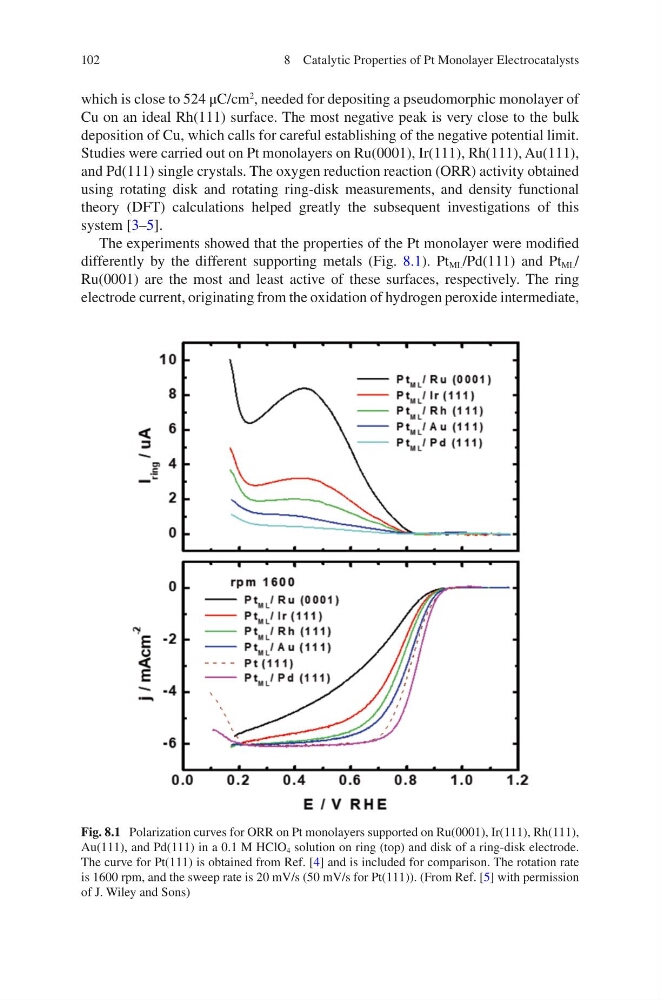
The experiments showed that the properties of the Pt monolayer were modified
differently by the different supporting metals (Fig. 8.1). Pt ML /Pd(111) and Pt ML /
Ru(0001) are the most and least active of these surfaces, respectively. The ring
electrode current, originating from the oxidation of hydrogen peroxide intermediate,
Fig. 8.1 Polarization curves for ORR on Pt monolayers supported on Ru(0001), Ir(111), Rh(111),
Au(111), and Pd(111) in a 0.1 M HClO 4 solution on ring (top) and disk of a ring-disk electrode.
The curve for Pt(111) is obtained from Ref. [4] and is included for comparison. The rotation rate
is 1600 rpm, and the sweep rate is 20 mV/s (50 mV/s for Pt(111)). (From Ref. [5] with permission
of J. Wiley and Sons)
8 Catalytic Properties of Pt Monolayer Electrocatalysts
which is close to 524 μC/cm
2
, needed for depositing a pseudomorphic monolayer of
Cu on an ideal Rh(111) surface. The most negative peak is very close to the bulk
deposition of Cu, which calls for careful establishing of the negative potential limit.
Studies were carried out on Pt monolayers on Ru(0001), Ir(111), Rh(111), Au(111),
and Pd(111) single crystals. The oxygen reduction reaction (ORR) activity obtained
using rotating disk and rotating ring-disk measurements, and density functional
theory (DFT) calculations helped greatly the subsequent investigations of this
system [3–5].
The experiments showed that the properties of the Pt monolayer were modified
differently by the different supporting metals (Fig. 8.1). Pt ML /Pd(111) and Pt ML /
Ru(0001) are the most and least active of these surfaces, respectively. The ring
electrode current, originating from the oxidation of hydrogen peroxide intermediate,
Fig. 8.1 Polarization curves for ORR on Pt monolayers supported on Ru(0001), Ir(111), Rh(111),
Au(111), and Pd(111) in a 0.1 M HClO 4 solution on ring (top) and disk of a ring-disk electrode.
The curve for Pt(111) is obtained from Ref. [4] and is included for comparison. The rotation rate
is 1600 rpm, and the sweep rate is 20 mV/s (50 mV/s for Pt(111)). (From Ref. [5] with permission
of J. Wiley and Sons)
8 Catalytic Properties of Pt Monolayer Electrocatalysts