

4.2 Face sheets
63
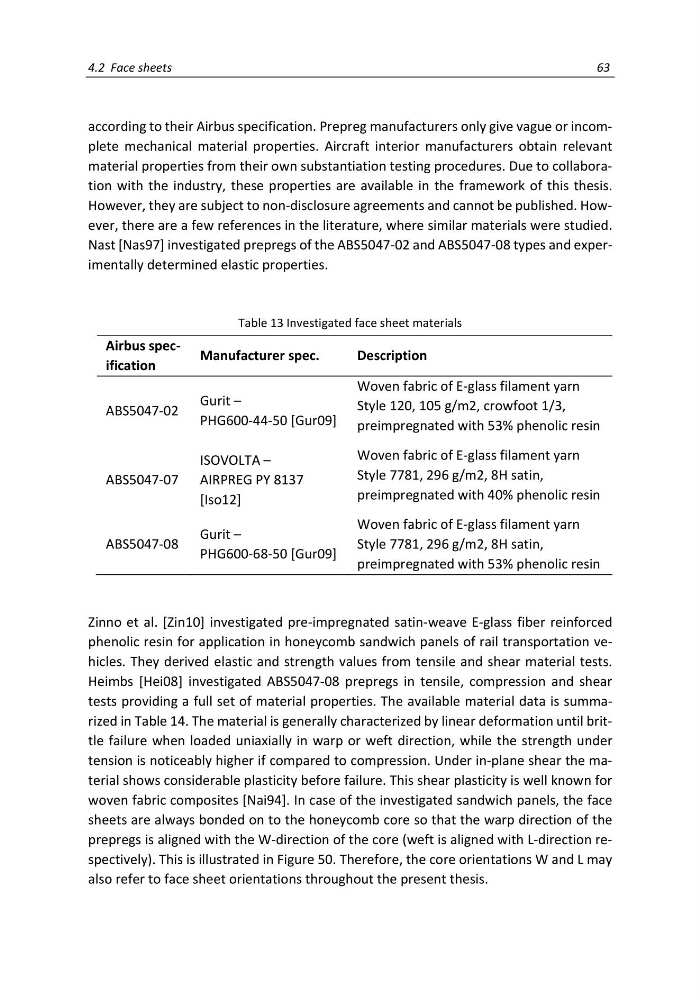
according to their Airbus specification. Prepreg manufacturers only give vague or incomplete mechanical material properties. Aircraft interior manufacturers obtain relevant
material properties from their own substantiation testing procedures. Due to collaboration with the industry, these properties are available in the framework of this thesis.
However, they are subject to non-disclosure agreements and cannot be published. However, there are a few references in the literature, where similar materials were studied.
Nast [Nas97] investigated prepregs of the ABS5047-02 and ABS5047-08 types and experimentally determined elastic properties.
Table 13 Investigated face sheet materials
Airbus specification
Manufacturer spec.
Description
ABS5047-02
Gurit –
PHG600-44-50 [Gur09]
Woven fabric of E-glass filament yarn
Style 120, 105 g/m2, crowfoot 1/3,
preimpregnated with 53% phenolic resin
ABS5047-07
ISOVOLTA –
AIRPREG PY 8137
[Iso12]
Woven fabric of E-glass filament yarn
Style 7781, 296 g/m2, 8H satin,
preimpregnated with 40% phenolic resin
ABS5047-08
Gurit –
PHG600-68-50 [Gur09]
Woven fabric of E-glass filament yarn
Style 7781, 296 g/m2, 8H satin,
preimpregnated with 53% phenolic resin
Zinno et al. [Zin10] investigated pre-impregnated satin-weave E-glass fiber reinforced
phenolic resin for application in honeycomb sandwich panels of rail transportation vehicles. They derived elastic and strength values from tensile and shear material tests.
Heimbs [Hei08] investigated ABS5047-08 prepregs in tensile, compression and shear
tests providing a full set of material properties. The available material data is summarized in Table 14. The material is generally characterized by linear deformation until brittle failure when loaded uniaxially in warp or weft direction, while the strength under
tension is noticeably higher if compared to compression. Under in-plane shear the material shows considerable plasticity before failure. This shear plasticity is well known for
woven fabric composites [Nai94]. In case of the investigated sandwich panels, the face
sheets are always bonded on to the honeycomb core so that the warp direction of the
prepregs is aligned with the W-direction of the core (weft is aligned with L-direction respectively). This is illustrated in Figure 50. Therefore, the core orientations W and L may
also refer to face sheet orientations throughout the present thesis.
63
according to their Airbus specification. Prepreg manufacturers only give vague or incomplete mechanical material properties. Aircraft interior manufacturers obtain relevant
material properties from their own substantiation testing procedures. Due to collaboration with the industry, these properties are available in the framework of this thesis.
However, they are subject to non-disclosure agreements and cannot be published. However, there are a few references in the literature, where similar materials were studied.
Nast [Nas97] investigated prepregs of the ABS5047-02 and ABS5047-08 types and experimentally determined elastic properties.
Table 13 Investigated face sheet materials
Airbus specification
Manufacturer spec.
Description
ABS5047-02
Gurit –
PHG600-44-50 [Gur09]
Woven fabric of E-glass filament yarn
Style 120, 105 g/m2, crowfoot 1/3,
preimpregnated with 53% phenolic resin
ABS5047-07
ISOVOLTA –
AIRPREG PY 8137
[Iso12]
Woven fabric of E-glass filament yarn
Style 7781, 296 g/m2, 8H satin,
preimpregnated with 40% phenolic resin
ABS5047-08
Gurit –
PHG600-68-50 [Gur09]
Woven fabric of E-glass filament yarn
Style 7781, 296 g/m2, 8H satin,
preimpregnated with 53% phenolic resin
Zinno et al. [Zin10] investigated pre-impregnated satin-weave E-glass fiber reinforced
phenolic resin for application in honeycomb sandwich panels of rail transportation vehicles. They derived elastic and strength values from tensile and shear material tests.
Heimbs [Hei08] investigated ABS5047-08 prepregs in tensile, compression and shear
tests providing a full set of material properties. The available material data is summarized in Table 14. The material is generally characterized by linear deformation until brittle failure when loaded uniaxially in warp or weft direction, while the strength under
tension is noticeably higher if compared to compression. Under in-plane shear the material shows considerable plasticity before failure. This shear plasticity is well known for
woven fabric composites [Nai94]. In case of the investigated sandwich panels, the face
sheets are always bonded on to the honeycomb core so that the warp direction of the
prepregs is aligned with the W-direction of the core (weft is aligned with L-direction respectively). This is illustrated in Figure 50. Therefore, the core orientations W and L may
also refer to face sheet orientations throughout the present thesis.