

50
4 Mechanical characterization on constituent level
Implementation of different modelling approaches
In the preliminary studies, appropriate unit cells, boundary conditions, model scales and
hexagon geometries have been determined. Based on this, the material and element
section definition have been established. As previously described, there are three prevailing approaches for modeling Nomex honeycomb cores evident in the literature.
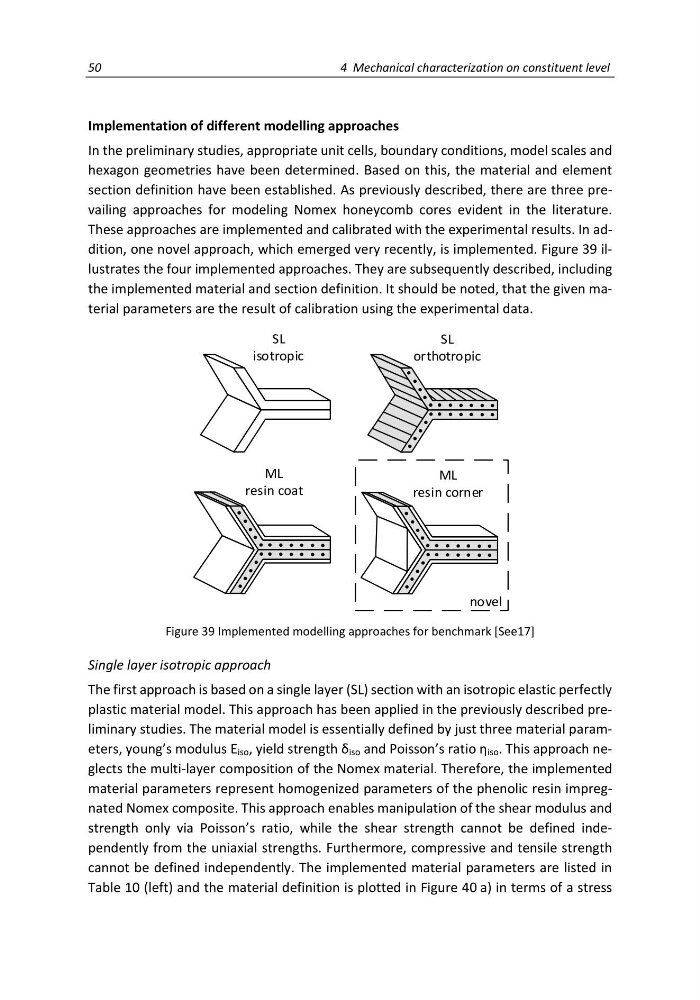
These approaches are implemented and calibrated with the experimental results. In addition, one novel approach, which emerged very recently, is implemented. Figure 39 illustrates the four implemented approaches. They are subsequently described, including
the implemented material and section definition. It should be noted, that the given material parameters are the result of calibration using the experimental data.
Single layer isotropic approach
The first approach is based on a single layer (SL) section with an isotropic elastic perfectly
plastic material model. This approach has been applied in the previously described preliminary studies. The material model is essentially defined by just three material parameters, young’s modulus E iso , yield strength δ iso and Poisson’s ratio η iso . This approach neglects the multi-layer composition of the Nomex material. Therefore, the implemented
material parameters represent homogenized parameters of the phenolic resin impregnated Nomex composite. This approach enables manipulation of the shear modulus and
strength only via Poisson’s ratio, while the shear strength cannot be defined independently from the uniaxial strengths. Furthermore, compressive and tensile strength
cannot be defined independently. The implemented material parameters are listed in
Table 10 (left) and the material definition is plotted in Figure 40 a) in terms of a stress
SL
isotropic
SL
orthotropic
ML
resin coat
ML
resin corner
novel
Figure 39 Implemented modelling approaches for benchmark [See17]
4 Mechanical characterization on constituent level
Implementation of different modelling approaches
In the preliminary studies, appropriate unit cells, boundary conditions, model scales and
hexagon geometries have been determined. Based on this, the material and element
section definition have been established. As previously described, there are three prevailing approaches for modeling Nomex honeycomb cores evident in the literature.
These approaches are implemented and calibrated with the experimental results. In addition, one novel approach, which emerged very recently, is implemented. Figure 39 illustrates the four implemented approaches. They are subsequently described, including
the implemented material and section definition. It should be noted, that the given material parameters are the result of calibration using the experimental data.
Single layer isotropic approach
The first approach is based on a single layer (SL) section with an isotropic elastic perfectly
plastic material model. This approach has been applied in the previously described preliminary studies. The material model is essentially defined by just three material parameters, young’s modulus E iso , yield strength δ iso and Poisson’s ratio η iso . This approach neglects the multi-layer composition of the Nomex material. Therefore, the implemented
material parameters represent homogenized parameters of the phenolic resin impregnated Nomex composite. This approach enables manipulation of the shear modulus and
strength only via Poisson’s ratio, while the shear strength cannot be defined independently from the uniaxial strengths. Furthermore, compressive and tensile strength
cannot be defined independently. The implemented material parameters are listed in
Table 10 (left) and the material definition is plotted in Figure 40 a) in terms of a stress
SL
isotropic
SL
orthotropic
ML
resin coat
ML
resin corner
novel
Figure 39 Implemented modelling approaches for benchmark [See17]