

4.1 Sandwich core
49
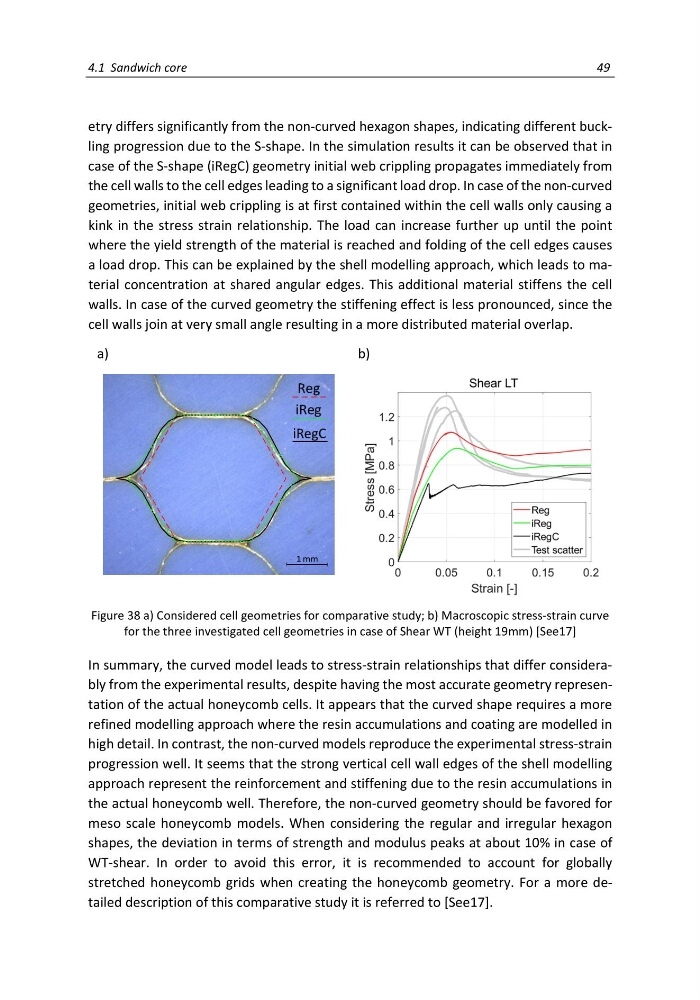
etry differs significantly from the non-curved hexagon shapes, indicating different buckling progression due to the S-shape. In the simulation results it can be observed that in
case of the S-shape (iRegC) geometry initial web crippling propagates immediately from
the cell walls to the cell edges leading to a significant load drop. In case of the non-curved
geometries, initial web crippling is at first contained within the cell walls only causing a
kink in the stress strain relationship. The load can increase further up until the point
where the yield strength of the material is reached and folding of the cell edges causes
a load drop. This can be explained by the shell modelling approach, which leads to material concentration at shared angular edges. This additional material stiffens the cell
walls. In case of the curved geometry the stiffening effect is less pronounced, since the
cell walls join at very small angle resulting in a more distributed material overlap.
a)
b)
Figure 38 a) Considered cell geometries for comparative study; b) Macroscopic stress-strain curve
for the three investigated cell geometries in case of Shear WT (height 19mm) [See17]
In summary, the curved model leads to stress-strain relationships that differ considerably from the experimental results, despite having the most accurate geometry representation of the actual honeycomb cells. It appears that the curved shape requires a more
refined modelling approach where the resin accumulations and coating are modelled in
high detail. In contrast, the non-curved models reproduce the experimental stress-strain
progression well. It seems that the strong vertical cell wall edges of the shell modelling
approach represent the reinforcement and stiffening due to the resin accumulations in
the actual honeycomb well. Therefore, the non-curved geometry should be favored for
meso scale honeycomb models. When considering the regular and irregular hexagon
shapes, the deviation in terms of strength and modulus peaks at about 10% in case of
WT-shear. In order to avoid this error, it is recommended to account for globally
stretched honeycomb grids when creating the honeycomb geometry. For a more detailed description of this comparative study it is referred to [See17].
49
etry differs significantly from the non-curved hexagon shapes, indicating different buckling progression due to the S-shape. In the simulation results it can be observed that in
case of the S-shape (iRegC) geometry initial web crippling propagates immediately from
the cell walls to the cell edges leading to a significant load drop. In case of the non-curved
geometries, initial web crippling is at first contained within the cell walls only causing a
kink in the stress strain relationship. The load can increase further up until the point
where the yield strength of the material is reached and folding of the cell edges causes
a load drop. This can be explained by the shell modelling approach, which leads to material concentration at shared angular edges. This additional material stiffens the cell
walls. In case of the curved geometry the stiffening effect is less pronounced, since the
cell walls join at very small angle resulting in a more distributed material overlap.
a)
b)
Figure 38 a) Considered cell geometries for comparative study; b) Macroscopic stress-strain curve
for the three investigated cell geometries in case of Shear WT (height 19mm) [See17]
In summary, the curved model leads to stress-strain relationships that differ considerably from the experimental results, despite having the most accurate geometry representation of the actual honeycomb cells. It appears that the curved shape requires a more
refined modelling approach where the resin accumulations and coating are modelled in
high detail. In contrast, the non-curved models reproduce the experimental stress-strain
progression well. It seems that the strong vertical cell wall edges of the shell modelling
approach represent the reinforcement and stiffening due to the resin accumulations in
the actual honeycomb well. Therefore, the non-curved geometry should be favored for
meso scale honeycomb models. When considering the regular and irregular hexagon
shapes, the deviation in terms of strength and modulus peaks at about 10% in case of
WT-shear. In order to avoid this error, it is recommended to account for globally
stretched honeycomb grids when creating the honeycomb geometry. For a more detailed description of this comparative study it is referred to [See17].