

Appendix A – Constituent level
187
A3 Implemented material models for adhesives
The adhesive material models were implemented based on experimental data of standardized tension and compression tests on plastic materials. Since, FE-solvers typically
require the input of true yield stress and strain data, the experimentally determined engineering stress and strain have to be converted. This process is described in the following before the determined material models for the three investigated adhesives are
given in ABAQUS input format.
Extraction of true yield stress and strain from test data
In the following a brief overview on how to determine the true stress as function of plastic strain based on uniaxial test data. Relevant materials mechanics relationships are introduced. For a more detailed derivation of the given equations it is referred to material
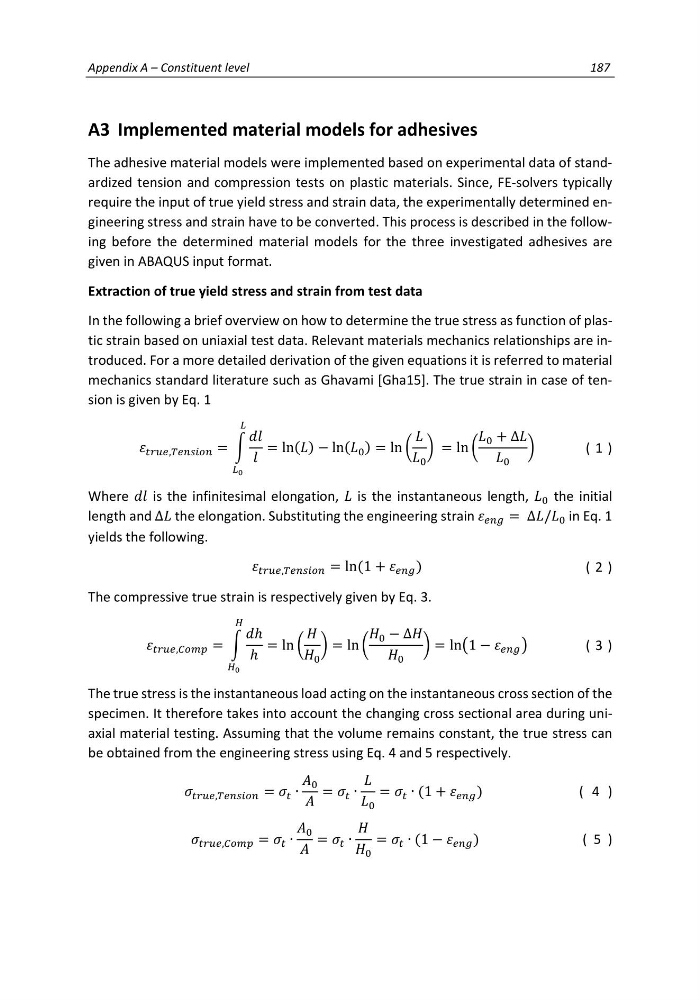
mechanics standard literature such as Ghavami [Gha15]. The true strain in case of tension is given by Eq. 1
,,,,,,,,
ln ln ln n
ln n
∆∆
( 1 )
Where is the infinitesimal elongation, is the instantaneous length, the initial
length and ∆∆ the elongation. Substituting the engineering strain ∆∆// in Eq. 1
yields the following.
,,,,,,,, lnn1 1 1
( 2 )
The compressive true strain is respectively given by Eq. 3.
ln n
ln n
∆∆
lnn1 1 1
( 3 )
The true stress is the instantaneous load acting on the instantaneous cross section of the
specimen. It therefore takes into account the changing cross sectional area during uniaxial material testing. Assuming that the volume remains constant, the true stress can
be obtained from the engineering stress using Eq. 4 and 5 respectively.
,,,,,,,, ∙
∙
∙ ∙1 1 1
( 4 )
,,,,, ∙
∙
∙ ∙1 1 1
( 5 )
187
A3 Implemented material models for adhesives
The adhesive material models were implemented based on experimental data of standardized tension and compression tests on plastic materials. Since, FE-solvers typically
require the input of true yield stress and strain data, the experimentally determined engineering stress and strain have to be converted. This process is described in the following before the determined material models for the three investigated adhesives are
given in ABAQUS input format.
Extraction of true yield stress and strain from test data
In the following a brief overview on how to determine the true stress as function of plastic strain based on uniaxial test data. Relevant materials mechanics relationships are introduced. For a more detailed derivation of the given equations it is referred to material
mechanics standard literature such as Ghavami [Gha15]. The true strain in case of tension is given by Eq. 1
,,,,,,,,
ln ln ln n
ln n
∆∆
( 1 )
Where is the infinitesimal elongation, is the instantaneous length, the initial
length and ∆∆ the elongation. Substituting the engineering strain ∆∆// in Eq. 1
yields the following.
,,,,,,,, lnn1 1 1
( 2 )
The compressive true strain is respectively given by Eq. 3.
ln n
ln n
∆∆
lnn1 1 1
( 3 )
The true stress is the instantaneous load acting on the instantaneous cross section of the
specimen. It therefore takes into account the changing cross sectional area during uniaxial material testing. Assuming that the volume remains constant, the true stress can
be obtained from the engineering stress using Eq. 4 and 5 respectively.
,,,,,,,, ∙
∙
∙ ∙1 1 1
( 4 )
,,,,, ∙
∙
∙ ∙1 1 1
( 5 )