

150
7 Virtual testing approach for sandwich panel joints
using 3D-continuum elements. Therefore, the model framework is essentially a hybrid.
The bond between detailed and 3D-continuum core is implemented using tied contacts.
This has been verified in numerical studies. The majority of required model parameters
for the top-level model is available in the modeling database from previous investigations. Solely the material model of the laminated plastic as edge reinforcement has to
be newly implemented. However, this component does not impact the overall failure
progression. Therefore, it is modelled using a linear elastic material model with a Young’s
modulus of E = 8000 MPa based on available literature [Lam17]. Therefore, there is only
the model synthesis investigation in Phase 3 of the virtual testing approach. The fixture
is included in the model, in order to account for the local core compression in the contact
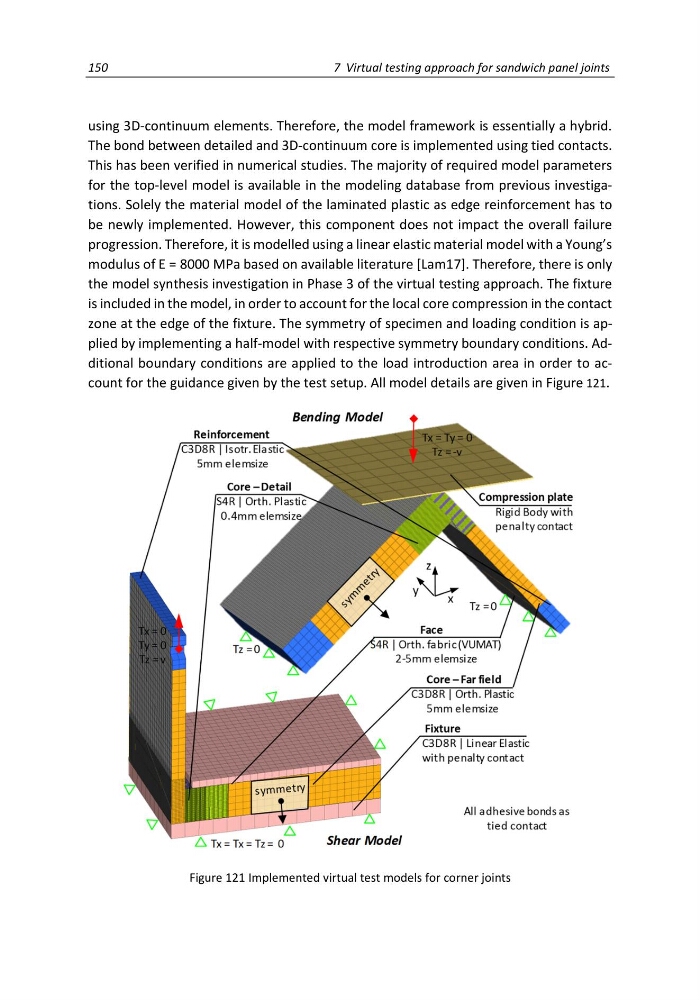
zone at the edge of the fixture. The symmetry of specimen and loading condition is applied by implementing a half-model with respective symmetry boundary conditions. Additional boundary conditions are applied to the load introduction area in order to account for the guidance given by the test setup. All model details are given in Figure 121.
Figure 121 Implemented virtual test models for corner joints
7 Virtual testing approach for sandwich panel joints
using 3D-continuum elements. Therefore, the model framework is essentially a hybrid.
The bond between detailed and 3D-continuum core is implemented using tied contacts.
This has been verified in numerical studies. The majority of required model parameters
for the top-level model is available in the modeling database from previous investigations. Solely the material model of the laminated plastic as edge reinforcement has to
be newly implemented. However, this component does not impact the overall failure
progression. Therefore, it is modelled using a linear elastic material model with a Young’s
modulus of E = 8000 MPa based on available literature [Lam17]. Therefore, there is only
the model synthesis investigation in Phase 3 of the virtual testing approach. The fixture
is included in the model, in order to account for the local core compression in the contact
zone at the edge of the fixture. The symmetry of specimen and loading condition is applied by implementing a half-model with respective symmetry boundary conditions. Additional boundary conditions are applied to the load introduction area in order to account for the guidance given by the test setup. All model details are given in Figure 121.
Figure 121 Implemented virtual test models for corner joints