

7.5 Phase 4 - Application of virtual test
139
nesses and resin coat volumes during manufacturing. However, for the additionally investigated core types no experimental studies have been performed on constituent
level. Instead, the implemented material modelling approach of the reference test is
adapted for the additional cores based on the macroscopic material properties given by
manufacturers (Euro Composites [EUR10] and Hexcel [Hex99]). The cell wall material
models have been calibrated to match these key properties. The ABAQUS input deck
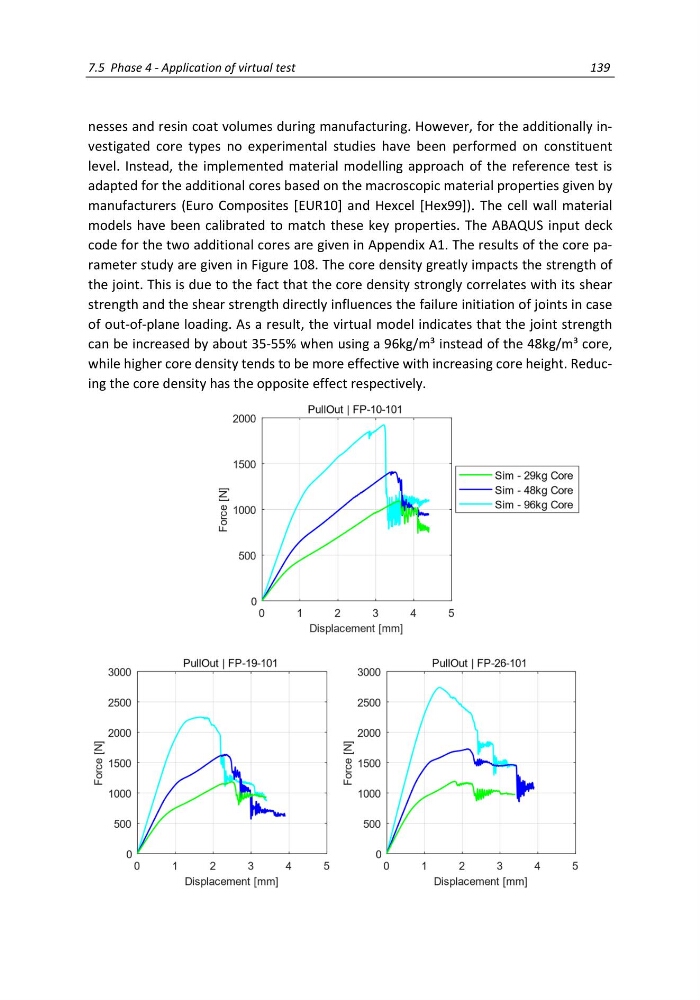
code for the two additional cores are given in Appendix A1. The results of the core parameter study are given in Figure 108. The core density greatly impacts the strength of
the joint. This is due to the fact that the core density strongly correlates with its shear
strength and the shear strength directly influences the failure initiation of joints in case
of out-of-plane loading. As a result, the virtual model indicates that the joint strength
can be increased by about 35-55% when using a 96kg/m³ instead of the 48kg/m³ core,
while higher core density tends to be more effective with increasing core height. Reducing the core density has the opposite effect respectively.
139
nesses and resin coat volumes during manufacturing. However, for the additionally investigated core types no experimental studies have been performed on constituent
level. Instead, the implemented material modelling approach of the reference test is
adapted for the additional cores based on the macroscopic material properties given by
manufacturers (Euro Composites [EUR10] and Hexcel [Hex99]). The cell wall material
models have been calibrated to match these key properties. The ABAQUS input deck
code for the two additional cores are given in Appendix A1. The results of the core parameter study are given in Figure 108. The core density greatly impacts the strength of
the joint. This is due to the fact that the core density strongly correlates with its shear
strength and the shear strength directly influences the failure initiation of joints in case
of out-of-plane loading. As a result, the virtual model indicates that the joint strength
can be increased by about 35-55% when using a 96kg/m³ instead of the 48kg/m³ core,
while higher core density tends to be more effective with increasing core height. Reducing the core density has the opposite effect respectively.