

7.5 Phase 4 - Application of virtual test
137
proven whether that the virtual test can be applied as intended. If this is not the case, it
is returned to Phase 2, where it is evaluated whether an adjustment to the defined
model framework is required before the model development phase is initiated once
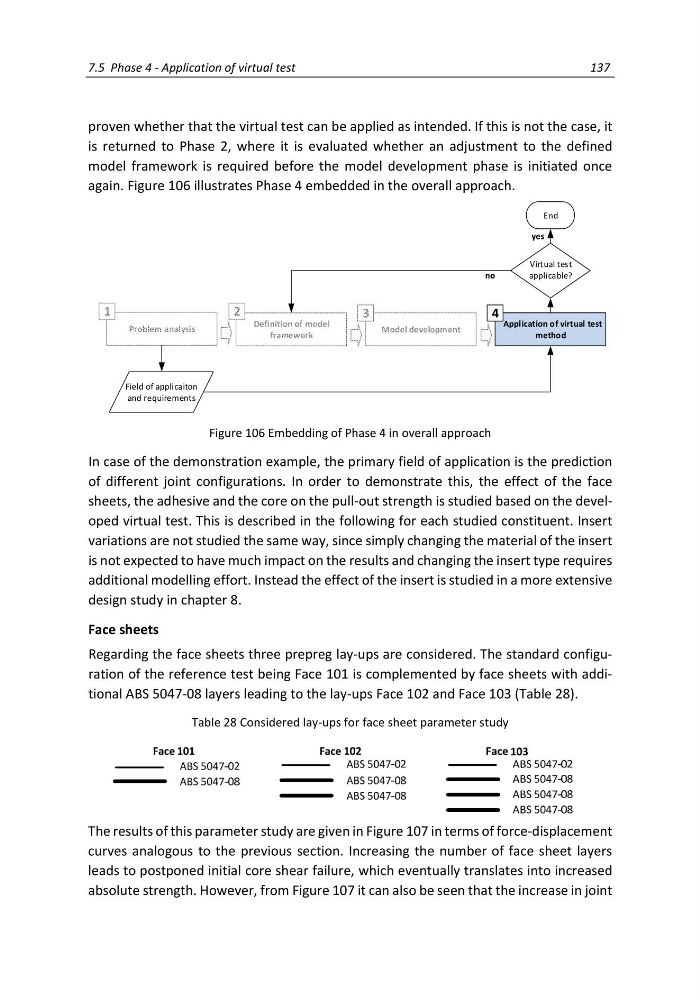
again. Figure 106 illustrates Phase 4 embedded in the overall approach.
Problem analysis
Definition of model
framework
Model development
Application of virtual test
method
1
2
3
4
Virtual test
applicable?
no
Field of applicaiton
and requirements
End
yes
Figure 106 Embedding of Phase 4 in overall approach
In case of the demonstration example, the primary field of application is the prediction
of different joint configurations. In order to demonstrate this, the effect of the face
sheets, the adhesive and the core on the pull-out strength is studied based on the developed virtual test. This is described in the following for each studied constituent. Insert
variations are not studied the same way, since simply changing the material of the insert
is not expected to have much impact on the results and changing the insert type requires
additional modelling effort. Instead the effect of the insert is studied in a more extensive
design study in chapter 8.
Face sheets
Regarding the face sheets three prepreg lay-ups are considered. The standard configuration of the reference test being Face 101 is complemented by face sheets with additional ABS 5047-08 layers leading to the lay-ups Face 102 and Face 103 (Table 28).
Table 28 Considered lay-ups for face sheet parameter study
The results of this parameter study are given in Figure 107 in terms of force-displacement
curves analogous to the previous section. Increasing the number of face sheet layers
leads to postponed initial core shear failure, which eventually translates into increased
absolute strength. However, from Figure 107 it can also be seen that the increase in joint
137
proven whether that the virtual test can be applied as intended. If this is not the case, it
is returned to Phase 2, where it is evaluated whether an adjustment to the defined
model framework is required before the model development phase is initiated once
again. Figure 106 illustrates Phase 4 embedded in the overall approach.
Problem analysis
Definition of model
framework
Model development
Application of virtual test
method
1
2
3
4
Virtual test
applicable?
no
Field of applicaiton
and requirements
End
yes
Figure 106 Embedding of Phase 4 in overall approach
In case of the demonstration example, the primary field of application is the prediction
of different joint configurations. In order to demonstrate this, the effect of the face
sheets, the adhesive and the core on the pull-out strength is studied based on the developed virtual test. This is described in the following for each studied constituent. Insert
variations are not studied the same way, since simply changing the material of the insert
is not expected to have much impact on the results and changing the insert type requires
additional modelling effort. Instead the effect of the insert is studied in a more extensive
design study in chapter 8.
Face sheets
Regarding the face sheets three prepreg lay-ups are considered. The standard configuration of the reference test being Face 101 is complemented by face sheets with additional ABS 5047-08 layers leading to the lay-ups Face 102 and Face 103 (Table 28).
Table 28 Considered lay-ups for face sheet parameter study
The results of this parameter study are given in Figure 107 in terms of force-displacement
curves analogous to the previous section. Increasing the number of face sheet layers
leads to postponed initial core shear failure, which eventually translates into increased
absolute strength. However, from Figure 107 it can also be seen that the increase in joint