

136
7 Virtual testing approach for sandwich panel joints
7.4.3 Modelling database
The modelling database is an integral part of Phase 3. It can be considered as knowledge
base that contains all available model parameters for the implementation of virtual tests.
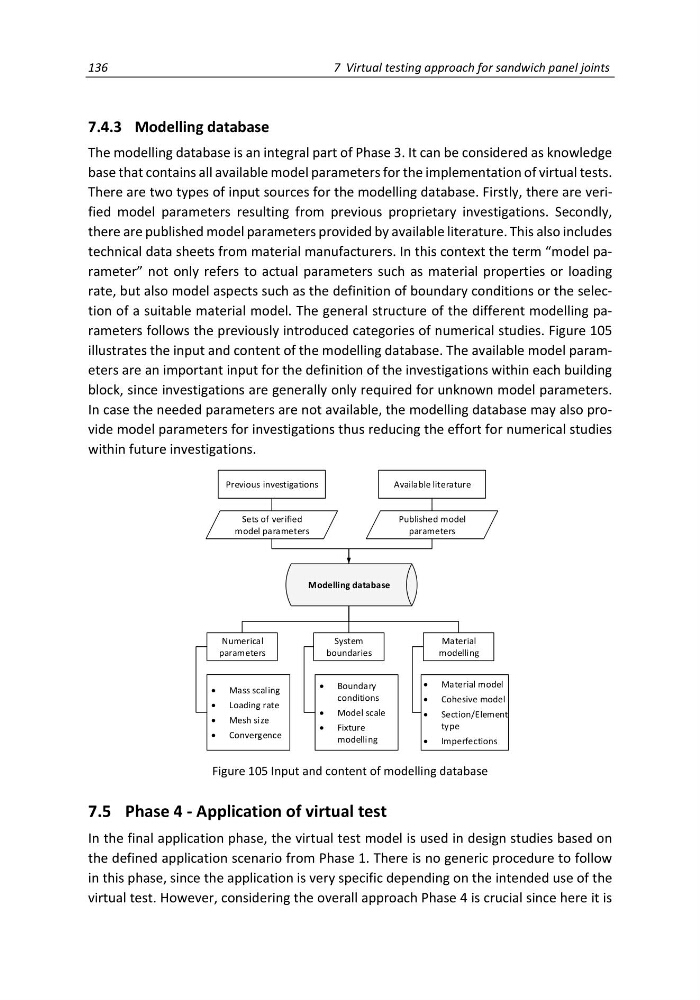
There are two types of input sources for the modelling database. Firstly, there are verified model parameters resulting from previous proprietary investigations. Secondly,
there are published model parameters provided by available literature. This also includes
technical data sheets from material manufacturers. In this context the term “model parameter” not only refers to actual parameters such as material properties or loading
rate, but also model aspects such as the definition of boundary conditions or the selection of a suitable material model. The general structure of the different modelling parameters follows the previously introduced categories of numerical studies. Figure 105
illustrates the input and content of the modelling database. The available model parameters are an important input for the definition of the investigations within each building
block, since investigations are generally only required for unknown model parameters.
In case the needed parameters are not available, the modelling database may also provide model parameters for investigations thus reducing the effort for numerical studies
within future investigations.
7.5 Phase 4 - Application of virtual test
In the final application phase, the virtual test model is used in design studies based on
the defined application scenario from Phase 1. There is no generic procedure to follow
in this phase, since the application is very specific depending on the intended use of the
virtual test. However, considering the overall approach Phase 4 is crucial since here it is
Modelling database
Material
modelling
Numerical
parameters
System
boundaries
Mass scaling
Loading rate
Mesh size
Convergence
Boundary
conditions
Model scale
Fixture
modelling
Material model
Cohesive model
Section/Element
type
Imperfections
Available literature
Sets of verified
model parameters
Published model
parameters
Previous investigations
Figure 105 Input and content of modelling database
7 Virtual testing approach for sandwich panel joints
7.4.3 Modelling database
The modelling database is an integral part of Phase 3. It can be considered as knowledge
base that contains all available model parameters for the implementation of virtual tests.
There are two types of input sources for the modelling database. Firstly, there are verified model parameters resulting from previous proprietary investigations. Secondly,
there are published model parameters provided by available literature. This also includes
technical data sheets from material manufacturers. In this context the term “model parameter” not only refers to actual parameters such as material properties or loading
rate, but also model aspects such as the definition of boundary conditions or the selection of a suitable material model. The general structure of the different modelling parameters follows the previously introduced categories of numerical studies. Figure 105
illustrates the input and content of the modelling database. The available model parameters are an important input for the definition of the investigations within each building
block, since investigations are generally only required for unknown model parameters.
In case the needed parameters are not available, the modelling database may also provide model parameters for investigations thus reducing the effort for numerical studies
within future investigations.
7.5 Phase 4 - Application of virtual test
In the final application phase, the virtual test model is used in design studies based on
the defined application scenario from Phase 1. There is no generic procedure to follow
in this phase, since the application is very specific depending on the intended use of the
virtual test. However, considering the overall approach Phase 4 is crucial since here it is
Modelling database
Material
modelling
Numerical
parameters
System
boundaries
Mass scaling
Loading rate
Mesh size
Convergence
Boundary
conditions
Model scale
Fixture
modelling
Material model
Cohesive model
Section/Element
type
Imperfections
Available literature
Sets of verified
model parameters
Published model
parameters
Previous investigations
Figure 105 Input and content of modelling database