

7.4 Phase 3 - Model development
127
Figure 96 Procedure for defining the required investigations within building blocks
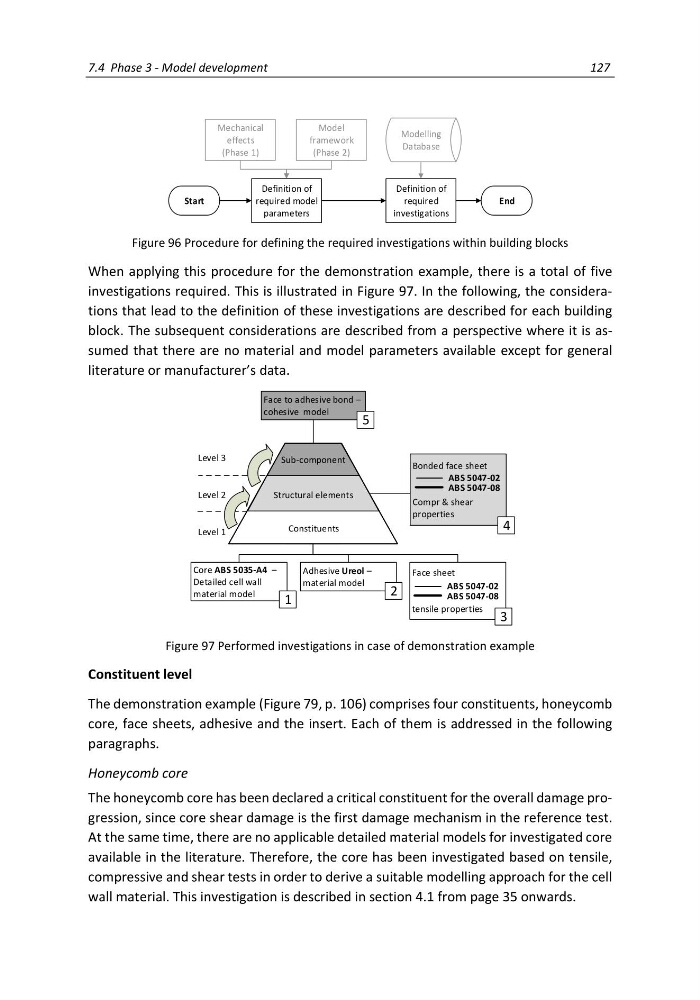
When applying this procedure for the demonstration example, there is a total of five
investigations required. This is illustrated in Figure 97. In the following, the considerations that lead to the definition of these investigations are described for each building
block. The subsequent considerations are described from a perspective where it is assumed that there are no material and model parameters available except for general
literature or manufacturer’s data.
Structural elements
Constituents
Level 1
Level 2
Level 3
Face to adhesive bond –
cohesive model
Constituents
Structural elements
Sub-component
Bonded face sheet
Compr & shear
properties
ABS 5047-02
ABS 5047-08
Core ABS 5035-A4 –
Detailed cell wall
material model
Adhesive Ureol –
material model
Face sheet
tensile properties
ABS 5047-02
ABS 5047-08
1
2
3
4
5
Figure 97 Performed investigations in case of demonstration example
Constituent level
The demonstration example (Figure 79, p. 106) comprises four constituents, honeycomb
core, face sheets, adhesive and the insert. Each of them is addressed in the following
paragraphs.
Honeycomb core
The honeycomb core has been declared a critical constituent for the overall damage progression, since core shear damage is the first damage mechanism in the reference test.
At the same time, there are no applicable detailed material models for investigated core
available in the literature. Therefore, the core has been investigated based on tensile,
compressive and shear tests in order to derive a suitable modelling approach for the cell
wall material. This investigation is described in section 4.1 from page 35 onwards.
Mechanical
effects
(Phase 1)
Definition of
required model
parameters
Definition of
required
investigations
Start
Model
framework
(Phase 2)
Modelling
Database
End
127
Figure 96 Procedure for defining the required investigations within building blocks
When applying this procedure for the demonstration example, there is a total of five
investigations required. This is illustrated in Figure 97. In the following, the considerations that lead to the definition of these investigations are described for each building
block. The subsequent considerations are described from a perspective where it is assumed that there are no material and model parameters available except for general
literature or manufacturer’s data.
Structural elements
Constituents
Level 1
Level 2
Level 3
Face to adhesive bond –
cohesive model
Constituents
Structural elements
Sub-component
Bonded face sheet
Compr & shear
properties
ABS 5047-02
ABS 5047-08
Core ABS 5035-A4 –
Detailed cell wall
material model
Adhesive Ureol –
material model
Face sheet
tensile properties
ABS 5047-02
ABS 5047-08
1
2
3
4
5
Figure 97 Performed investigations in case of demonstration example
Constituent level
The demonstration example (Figure 79, p. 106) comprises four constituents, honeycomb
core, face sheets, adhesive and the insert. Each of them is addressed in the following
paragraphs.
Honeycomb core
The honeycomb core has been declared a critical constituent for the overall damage progression, since core shear damage is the first damage mechanism in the reference test.
At the same time, there are no applicable detailed material models for investigated core
available in the literature. Therefore, the core has been investigated based on tensile,
compressive and shear tests in order to derive a suitable modelling approach for the cell
wall material. This investigation is described in section 4.1 from page 35 onwards.
Mechanical
effects
(Phase 1)
Definition of
required model
parameters
Definition of
required
investigations
Start
Model
framework
(Phase 2)
Modelling
Database
End